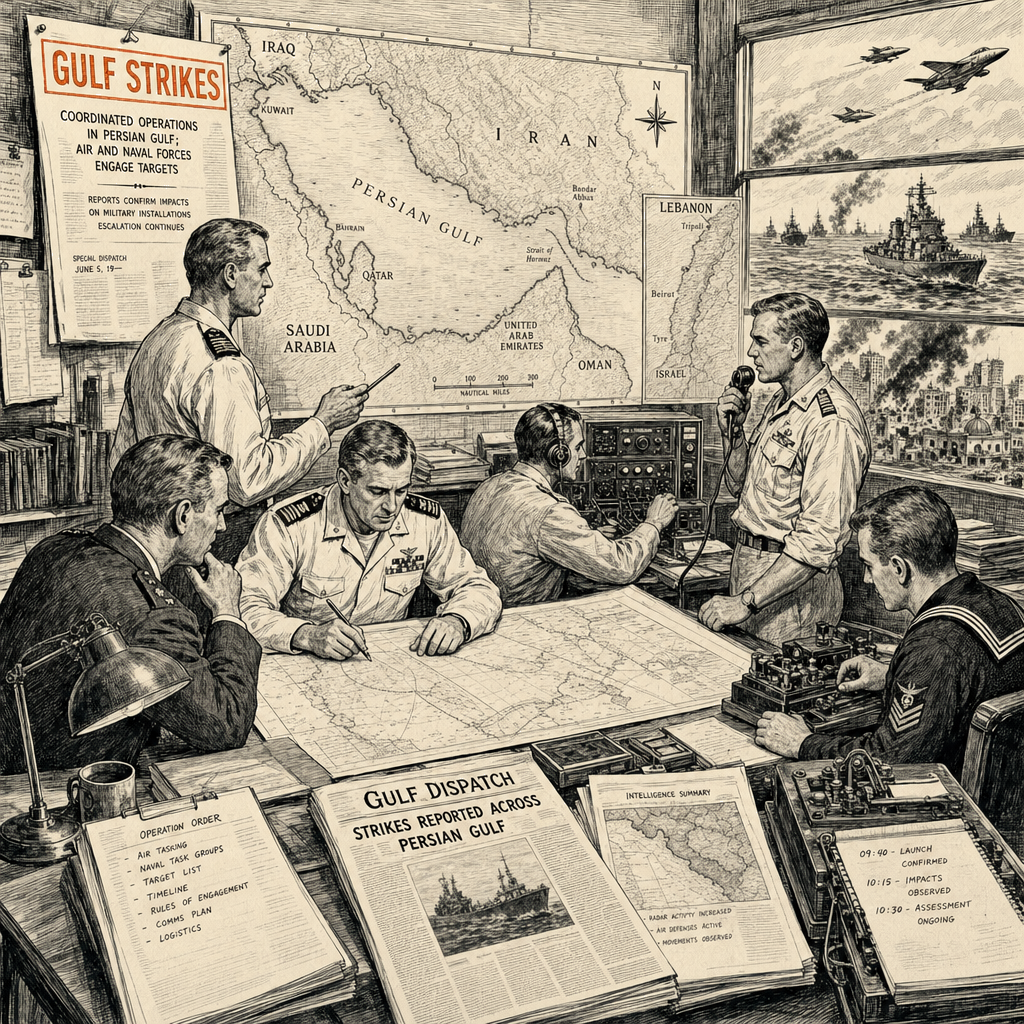
The July 18 exchange of airstrikes, missile volleys, and naval blockades between the United States and Iran is not a singular escalation but the latest turn of a feedback loop that has no built-in off-ramp. The cycle is asymmetric in its costs and structurally self-perpetuating, with both sides choosing the option that inflicts damage without crossing the threshold into direct war.
The escalation cycle
Central Command said in a statement posted to X that it struck “surveillance sites, military logistics infrastructure, underground weapons storage and maritime capabilities” using fighter aircraft, drones, and warships on July 18, while continuing to “fully enforce a naval blockade against Iranian ports.” Iran’s state media reported damage to bridges, roads, and a water desalination plant in Jask, with a local official saying about 10,000 people now face a water shortage.
Iran retaliated the same day by striking two U.S. allies in the Gulf. In Kuwait, a water desalination plant that provides 90% of the country’s drinking water was hit and set on fire. An oil facility also sustained damage, with Kuwait’s petroleum corporation reporting injuries and “severe material losses.” Kuwait’s foreign ministry said the attacks reveal “a systematic hostile approach targeting civilian sites and vital infrastructure that endangers the lives and safety of civilians.” Separately, Jordan’s army announced it had intercepted and shot down 10 Iranian missiles that entered its airspace, with no casualties or damage.
The causal chain is clear: Central Command strikes Iranian military infrastructure; Iran retaliates against allied civilian infrastructure rather than against U.S. forces; the damage to Kuwait and the missile flight into Jordan then reinforce Central Command’s stated rationale for continued strikes. That chain forms an escalation-reprisal cycle — each action feeds the next, and no countervailing force has emerged to dampen it.
The cycle persists because both sides’ dominant move in every round is to escalate. Central Command’s decision to strike Iranian infrastructure rather than confine itself to blockade-only avoids both a full-scale war and the signal of weakness that de-escalation would send. Iran, having observed the U.S. strikes, then chooses between striking U.S. forces (which would risk a war it would lose), absorbing the hit silently (which would cost domestic legitimacy), or hitting U.S. allies instead. The third option dominates because it imposes cost on the coalition without triggering a direct confrontation. The result is that both sides’ dominant move in every subgame is to escalate — a finding that holds whether the moves are treated as sequential or simultaneous.
Iran’s ambassador to Pakistan, Reza Amiri Moghadam, posted on X that the United States “interpreted [MOU] contrary to its terms and gained control over parts of Strait Hormuz to obtain what it couldn’t in the battlefield” and “started a war contrary to the terms of MOU.” The framing on both sides converts action into reaction, removing the appearance of initiation. This is not merely rhetorical — it is the mechanism that sustains the escalation equilibrium, making each side’s next strike domestically and diplomatically cheaper than restraint.
The cycle time is measured in hours and days. This is not a stable standoff. It is a structure in which every turn reinforces the next.
Why the allies absorb the blow
Iran’s retaliation pattern is not random. The strategic logic: make the U.S. coalition absorb civilian suffering its own allies cannot sustain, rather than fighting the U.S. Navy directly. Kuwait — a country that obtains 90% of its drinking water from desalination — had its water desalination plant hit and set on fire. An oil facility was struck, causing injuries and “severe material losses,” according to Kuwait’s petroleum corporation. The desalination plant is a single-point-of-failure node supplying the bulk of national drinking water.
The Kuwait foreign ministry’s statement — “a systematic hostile approach targeting civilian sites and vital infrastructure that endangers the lives and safety of civilians” — functions as both condemnation and inadvertent description. It captures the systematic nature of Iran’s infrastructure targeting without acknowledging the strategic logic that makes it systematic. Iran does not need to hit U.S. military assets to impose costs on the U.S. coalition; it needs to hit infrastructure that the coalition’s allies depend on for daily survival.
Jordan’s situation is different but equally structural. The army’s announcement of the 10-missile intercept — framed as territorial defense rather than coalition participation — carries diplomatic weight beyond the military act. Jordan has historically maintained calibrated distance from U.S. military operations. The intercept itself is the signal; the public announcement is the message. This is not coalition warfare in the traditional sense; it is a system where third-party damage is structural, not incidental.
The current cycle holds only as long as third parties absorb damage without retaliating themselves. Kuwait’s foreign ministry language positions it as an aggrieved party; the most destabilizing option — denial of basing or logistics access to U.S. forces — would directly degrade Central Command’s operational capacity. The equilibrium is bounded to the current inventory of observed behavior, and the condition that holds it in place is not guaranteed.
The strait that traps both sides
The Strait of Hormuz functions as the structural fulcrum of the Gulf escalation. Both sides enforce blockades: the United States blocking Iranian ships and ports; Iran preventing ships from passing through the waterway. The strait is “a vital passage for global oil and gas transport.” Both blockades constrain each side’s ability to project power, but the strait is a shared chokepoint — when it is closed, the economic damage flows to every country that depends on its transit.
The blockades create a mutual-denial structure rather than a feedback loop. They operate on a timescale of weeks to months, much slower than the hours-to-days cycle of strikes and retaliation. They function as a backstop, not a brake — they limit how far each side can project force but do not interrupt the escalation cycle itself. The Hormuz closure is not a cause of the escalation; it is a structural condition that the escalation is embedded in.
The MOU dispute sits adjacent to this structure. The Islamabad Memorandum of Understanding, signed June 17, 2026, is a 14-point document covering Strait of Hormuz navigation, sanctions, and nuclear talks — its existence confirmed by multiple outlets, its full text released by CNN and other organizations. Iran’s ambassador to Pakistan claimed the United States “interpreted [MOU] contrary to its terms and gained control over parts of Strait Hormuz to obtain what it couldn’t in the battlefield.” The specific dispute over U.S. interpretation is Moghadam’s claim alone — not independently verified in the dispatch. But the claim functions as a legitimacy justification: it recasts Iran’s actions as defensive rather than aggressive, removing the normative brake that would otherwise constrain the escalation cycle.
Why the cycle lacks a brake
Four candidate balancing forces exist, but none operates at a speed or scale that can arrest the current spiral.
The first is the diplomatic channel: Lebanese President Joseph Aoun left for Washington on July 18 and is scheduled to meet President Trump on July 21 to discuss the cease-fire with Israel and broader security issues. That meeting is pre-scheduled, not a response to the Gulf escalation, and operates on a four-day lag — far slower than the hours-to-days tempo of the strike cycle. Even if the meeting produced a Lebanon cease-fire, it would not automatically de-escalate the U.S.-Iran standoff because the two theaters are not causally integrated in the current reporting.
The second candidate brake is Jordan’s air-defense intercept. Jordan’s army said its systems shot down all 10 Iranian missiles, preventing damage. That intercept is real-time and effective locally, but it does not prevent strikes on other allies — Kuwait’s infrastructure was damaged without interception. The system’s structure routes the consequences of the U.S.-Iran conflict through states that are not direct combatants, and a single intercept cannot protect all of them.
The third is the dual naval blockade of the Strait of Hormuz. The blockage of a “vital passage for global oil and gas transport” caps both sides’ ability to project power, but as a structural constraint it operates over weeks to months, not hours to days. It does not affect the immediate strike cycle.
The fourth is the absence of any stated time horizon. Neither side has said when the restrictions will lift. Central Command’s statement emphasizes continuing “while fully enforcing a naval blockade against Iranian ports” with no stated condition for lifting. Iran’s MOU grievance offers no concession path. Without a finite horizon, the game continues without termination — and in a game without a stated end date and without a way to return to cooperation, the equilibrium converges to permanent low-intensity conflict rather than cooperation.
Cross-theater parallels and ambiguities
While the Gulf theater dominated July 18, Israel intensified its own bombardment of Lebanon, hitting Nabatieh and the Tyre district. Lebanon’s state National News Agency reported that an Israeli drone struck Nabatieh and that Israeli warplanes struck a neighborhood in Mansouri, with a second pair of planes carrying out a second round of airstrikes. An Israeli military spokesperson said the military struck militants “who posed a threat” in Nabatieh but said it was “not aware” of any attacks in Mansouri on Saturday — operational ambiguity, not denial.
The two theaters run in parallel but are not causally integrated in the current reporting. The Gulf cluster is cyclic (a reinforcing loop with no balancing force at operational tempo); the Levant cluster is acyclic (Israel → Lebanon → Aoun → U.S. terminates). President Aoun’s Washington trip is a diplomatic hedge that could, if a Lebanon cease-fire emerges, create a cross-theater linkage — but that scenario remains hypothetical. De-escalation in one theater would not automatically de-escalate the other; parallel diplomatic tracks are required.
The boundary between the theaters is not fixed. If Hezbollah or Iranian forces enter the Gulf theater in response to Israel’s Lebanon operations, the escalation cycle gains a second point of acceleration. If the Aoun-Trump meeting produces a cease-fire that feeds back into Gulf operations, the diplomatic channel could shift from a lag to a feedback. The current map is valid only while the theaters remain separate.
The intervention that could break the cycle
Three developments could alter the current equilibrium.
First, whether Kuwait responds to the damage by restricting U.S. basing or logistics access — any such action would directly degrade Central Command’s operational capacity and is the most destabilizing option available to a third party. Second, whether China uses its oil-import leverage to signal that continued escalation threatens Iranian revenue. China imports 37–50% of its oil through the Strait of Hormuz, giving it a direct interest in the waterway’s reopening, and its purchasing relationship with Iran gives it cost-infliction capacity the U.S. military cannot match. Economic leverage aimed at revenue constrains the domestic spending that sustains regime legitimacy — the one pressure point that a military campaign cannot reach. Third, whether a stated time horizon for the naval blockade emerges — a finite horizon would transform the conflict from indefinite brinkmanship into a game both sides can reason backward from, potentially enabling a terminal negotiation.
The China lever is the strongest available option. No such signal is reported in the current dispatch, but the economics of the Hormuz closure give China both motive and leverage that no other third party possesses. Russia and Pakistan — absent from the observed game but with Russia’s working relationship with Iran and Pakistan’s role as MOU mediator — could similarly enter if costs mount.
The 48-hour signals to watch
Acceleration would look like a second round of Central Command strikes on Iranian infrastructure within the next two days, or Iranian strikes on additional Gulf allies — Saudi Arabia, the UAE, Bahrain, Qatar — extending the targeting pattern beyond Kuwait and Jordan. A direct Iranian strike on a U.S. naval vessel, or a U.S. strike on Iranian regime targets rather than military infrastructure, would signal threshold-crossing. Hezbollah or Iranian-aligned forces entering the Gulf theater in response to Israeli operations in Lebanon would add a second acceleration node to the cycle.
Deceleration would look like a public de-escalation statement from either Washington or Tehran, a third-party mediation offer from Oman or Pakistan, or Kuwait restricting U.S. basing access as a coercive pressure move rather than passive absorption of damage. A stated time horizon for the naval blockade — a condition for its lifting — would transform the game from indefinite brinkmanship into finite-horizon negotiation. Any public statement from China altering its oil-purchasing posture toward Iran would shift Iran’s cost calculation more effectively than military pressure. The absence of these signals by Sunday evening will indicate that the current cycle continues at its present tempo.
Based on UPI wire report of July 18, 2026, with relationship-mapping, game-theory, and systems-dynamics structural frameworks.
Analytical techniques used in this piece
This analysis applies the methods below. Each links to a short, plain-English explainer you can read and reuse.
- Relationship Mapping
- Extracts the network of ties among people, institutions, and entities.
- Strategic Interaction (Game Theory)
- Models a situation as a game — players, moves, payoffs, and likely equilibria.
- Systems Dynamics (Structural)
- Maps a system’s structure — stocks, flows, and the architecture that shapes its behavior.