The June 2026 US-Iran ceasefire collapsed because the memorandum of understanding left Strait of Hormuz governance ambiguous. The next pause will collapse for the same reason unless three structural gaps are closed — the agreement’s own ambiguity, Iranian decision-making that has no single node that can bind both the civilian and military tracks, and the complete absence of any mechanism to verify who did what when the next disputed event occurs.
The MoU that was built to break. The June deal between President Trump and Iran did not resolve who administers the reopening of the Strait of Hormuz. Iran reads the MoU as granting it the right to manage the waterway’s reopening. The United States reads it as permitting an alternative shipping channel along the Omani coast outside Iranian oversight. Both sides treat their reading as operational reality, not interpretation. The MoU contained no dispute-resolution clause, no compliance-verification protocol, and no enforcement mechanism for the follow-through on jurisdictional terms it deliberately deferred. This was not a drafting failure but a design choice: the architects left the strait question vague to secure an initial signature, betting that later talks would resolve it. The bet failed because there was no mechanism to force follow-through. Four independent sources — ISW, The Guardian, Al Jazeera, and Iran’s own ambassador to Pakistan — corroborate the link between the MoU’s ambiguity and Iran’s decision to begin attacking ships using the Oman corridor in early July, which directly collapsed the deal.
Three nodes, one decision, zero convergence. Iran’s ceasefire-relevant authority runs on at least three tracks that do not share a decision loop. Mohammad Bagher Ghalibaf, the parliament speaker, serves as top negotiator. The Islamic Revolutionary Guard Corps runs the military track and has not responded to any ceasefire proposal floated since the June collapse. The supreme leader, Ayatollah Mojtaba Khamenei, holds ultimate authority and is absent — confirmed by multiple sources to have missed his father’s funeral on July 5. The IRGC struck at least three commercial vessels on July 12, including a Qatari LNG tanker. Its silence on every proposal is not cheap talk: it is a credibility device backed by demonstrated willingness to act. Iran’s constitutional structure gives the Guard no deadline to converge with the civilian track. Even if Ghalibaf accepts a pause, the United States has no reason to believe the IRGC will comply — making acceptance irrational without an enforcement mechanism that does not exist.
The verification vacuum. There is no shared monitoring system for ceasefire compliance. The US-backed Oman corridor and the Iranian-administered strait represent fundamentally different information environments. Neither side can verify the other’s compliance, and neither side trusts the other’s reporting. Without shared monitoring, any disputed event — a projectile on a vessel, a closure of the channel, a strike near a port — can be framed as a violation before any party can demonstrate whether it occurred. This vacuum is the condition that makes all other fixes unfixable: even if the MoU’s strait-governance language were somehow resolved, the next disputed event would restart escalation before any mechanism existed to adjudicate it.
Why the standoff holds. Both sides have demonstrated willingness to absorb costs. The US has conducted nine consecutive nights of strikes, moved F-16 and F-35 warplanes into the region, requested eight aerial refueling tankers from Bulgaria, and attacked Iranian bridges, rail infrastructure, and the Chabahar port control tower. Iran has struck a US base in Jordan, killing two servicemembers and leaving one missing, attacked Kuwait and Bahrain, and struck another vessel in the Strait that started a fire and led the crew to abandon ship. Iran’s security forces have publicly vowed to continue fighting. In game-theory terms: any ceasefire offer functions as a separating move — only a low-resolve Iran would accept neutral Hormuz administration, so the offer separates the type. Ghalibaf’s public rejection (calling US deployments proof of insincerity) is consistent with a high-resolve type defending a separating equilibrium. The mediators’ dilemma is that any ceasefire both sides would accept in a separating equilibrium is one no side has incentive to accept if it believes the other is high-resolve. The repeated-game condition for sustained cooperation — that both parties can punish defection credibly — fails because the IRGC operates entirely outside the civilian negotiating frame. No profitable unilateral deviation exists for any player. The standoff is a stable equilibrium.
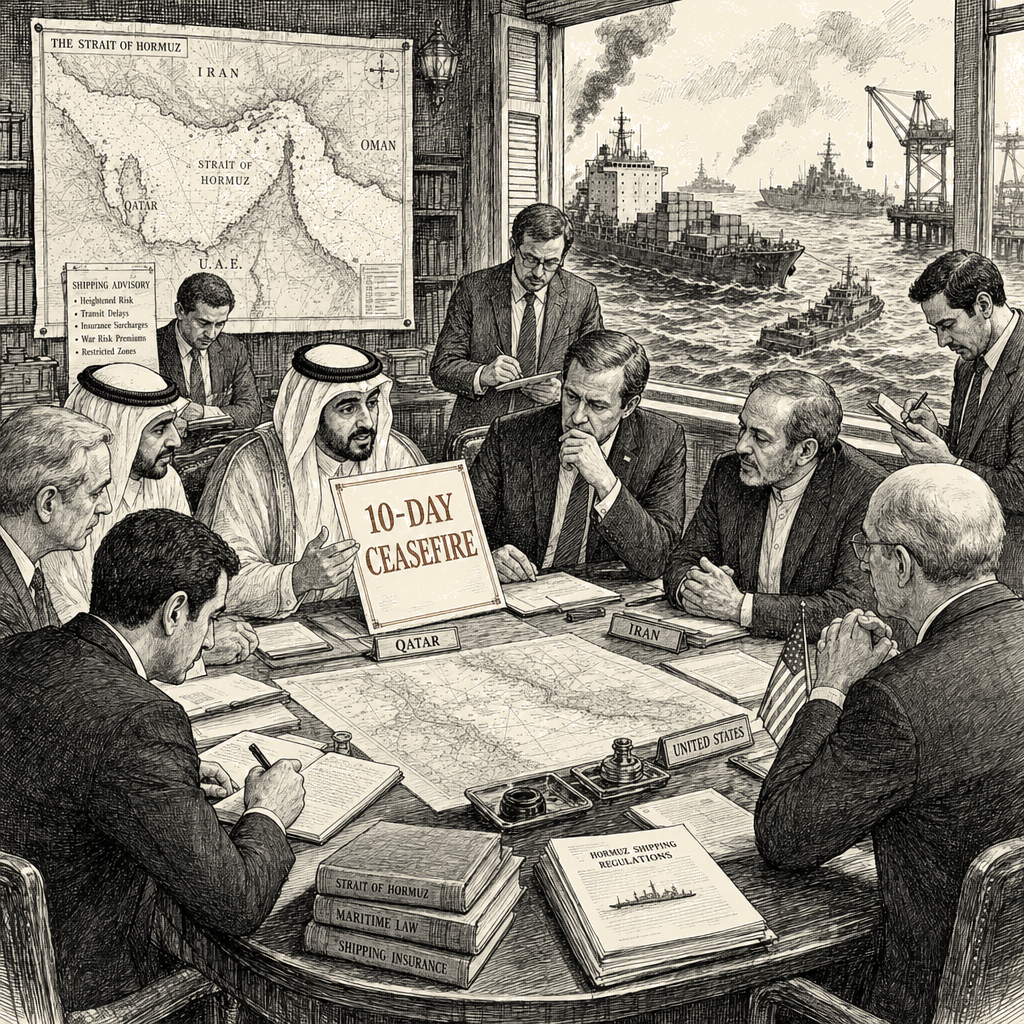
Who speaks, who acts, and who is believed. A credibility audit of the key statements distinguishes cheap talk from commitment. Marco Rubio’s statement that Iran “has signaled through intermediaries it wants to talk” is cheap talk — no concrete concession attached, and the US has not offered to drop its demand for non-Iranian strait management. Ghalibaf’s claim that US military deployments show the US is not serious about ending the war is cheap talk in the opposite direction — he is a civilian official who cannot speak for the Guard, and the framing shifts blame for the impasse. The IRGC’s silence on all proposals is credible because it has already paid the cost of collapsing the June deal to demonstrate its commitment to operational autonomy. The US force deployments are credible as sunk cost: partly irreversible moves against future de-escalation. Iran’s MoU claim is credible via public commitment reinforced by action. Qatar’s 10-day ceasefire proposal is cheap talk unless a coercive mechanism materializes — it has no third-party guarantor, no adjudication protocol, and no enforcement mechanism.
The third side that does not function as one. The conflict’s current structure has a mediator (Qatar, confirmed by Iran’s Foreign Ministry spokesman and referenced by Rubio) and a partial witness (international media, the shipping industry, Ghalibaf’s social media). It lacks a referee (no neutral enforcer for Strait of Hormuz rules), an arbiter (no institution acceptable to both sides can judge the MoU dispute), an equalizer (no actor is strengthening Iran’s position for meaningful negotiation; Qatar’s leverage argument treats Iran’s weakness as a pressure point, not an empowerment mechanism), a peacekeeper (no neutral force is positioned to interpose militarily), a provider (no actor is addressing Iran’s economic needs or the governance substrate driving the conflict), and a healer (active fighting makes it premature). The bridge-builder role was never built around the strait dispute itself — the June MoU was a bridge that collapsed, and no successor has gained traction.
What would need to change. Corrective actions for the current Qatari proposal: include a standstill on Oman corridor operations during the 10-day pause, and attach a written violation protocol with a designated arbiter — Qatar is the natural candidate — to adjudicate any disputed event before it triggers renewed escalation. Preventive actions for any future deal: specify strait governance terms down to operational control of the corridor, with a pre-agreed arbitration mechanism before signing. Include explicit IRGC representation at the table, or have the supreme leader delegate strait authority to Ghalibaf in writing. Establish a joint compliance-verification mechanism — shared radar data, neutral third-party inspection of transiting vessels, a hotline between operational commanders — as a pre-condition, not a post-signature aspiration. The US must stop moving forces forward during the mediation window; the F-16 and F-35 deployments and the Bulgarian tanker request, though they post-date the June collapse, now function as a sunk-cost commitment against any pause.
The most realistic near-term role for any third party may be narrow and containment-focused — preventing the conflict from widening to additional states — rather than attempting full resolution while escalation dynamics dominate. The three conditions that would break the standoff are, in order: a neutral referee for the Strait (Oman paired with the UN International Maritime Organization, certifying ship inspections and passage fees in place of both Iran’s claimed right and the US corridor); a credible economic off-ramp from Qatar for Iran (verified access to frozen assets in exchange for verifiable de-escalation); and a freeze on forward US force movements during the negotiation window. The June deal collapsed because none of these conditions existed. The Qatari proposal will collapse for the same reason unless the mediators address the structure rather than the timeline.
Analytical techniques used in this piece
This analysis applies the methods below. Each links to a short, plain-English explainer you can read and reuse.
- Root-Cause Analysis
- Traces a symptom back along its causal chain to the conditions that actually generated it.
- Strategic Interaction (Game Theory)
- Models a situation as a game — players, moves, payoffs, and likely equilibria.
- The Third Side
- Takes the vantage of the surrounding community that has a stake in resolving a conflict (Ury).