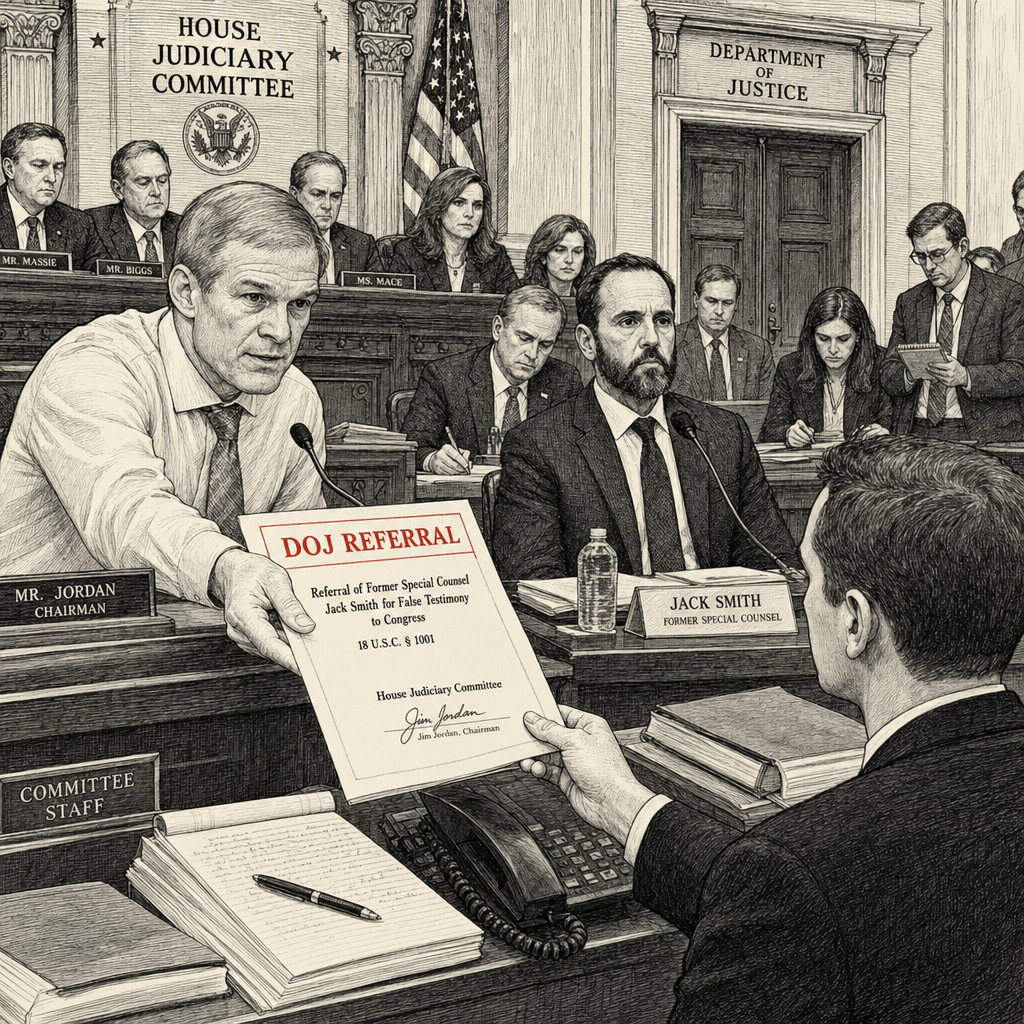
House Judiciary Committee Chairman Jim Jordan (R-OH) referred former special counsel Jack Smith to the Department of Justice on July 22, 2026, for potential criminal investigation, alleging Smith “knowingly made false statements” during sworn congressional testimony. The referral arrived at acting Attorney General Todd Blanche’s DOJ with a problem embedded in its own text: Jordan’s letter does not actually claim Smith made a false statement.
What it claims, instead, is that the July 14, 2026 DOJ documents “call into question the completeness and accuracy” of Smith’s statements — language Smith’s Covington & Burling attorneys immediately seized on. “The referral is made not because Mr. Smith made a false statement — the letter concedes he did not — but because he did not proactively disclose information that was not responsive to a question asked,” they wrote. That characterization is not defense spin; it is a description of Jordan’s own letter.
The questions Smith actually answered
The referral centers on a December 17, 2025 closed-door deposition. Smith was asked whether he and his team sought a search warrant for the content of any text messages from members of Congress. He answered, “No, I don’t recall.” Asked whether the records they requested included the content of phone calls and text messages, Smith answered “No” to both.
Jordan’s accusation: Smith’s team “had obtained text-message content involving members of Congress, including communications Jordan described as potentially privileged.” Smith’s attorneys’ response: the toll-record subpoenas at issue “sought communications metadata and did not seek the content.” The underlying July 14 DOJ documents have not been released, so the factual predicate for the entire dispute — whether Smith’s team held message content or metadata — cannot be independently resolved from the public record.
But the legal problem precedes that factual dispute. Federal false-statements statutes, including 18 U.S.C. § 1001, require proof that the defendant made a statement that was false or misleading at the time it was made, knowingly and willfully, and that the statement was material. A witness’s failure to volunteer information the committee did not ask for does not satisfy the “knowingly false statement” element. Even assuming Smith’s answers were misleading, the question scope was contested — Jordan’s questions targeted search warrants, and Smith’s team used toll-record subpoenas, a distinct legal mechanism — making the scienter element difficult to establish regardless of what the July 14 documents show.
This is the structural deficiency at the core of the referral: it conflates a failure to volunteer with a false statement. Jordan’s own letter, by using “completeness and accuracy” language rather than alleging an outright falsehood, provides the textual basis for DOJ to dismiss the referral on legal grounds without ever reaching the factual dispute.
Three paradigms, one irreconcilable question
The dispute maps onto three competing frames, each with its own definition of what “false testimony” means.
The procedural-precision frame (Smith’s attorneys, Ranking Democrat Jamie Raskin) holds that a witness’s obligation is to answer questions asked. Toll-record subpoenas seek metadata; search warrants seek content. The question-answer pair is the unit of evaluation. Smith answered the questions the committee asked, and the committee’s failure to ask a broader question is not Smith’s legal problem.
The institutional-oversight frame (Jordan) holds that a witness under oath bears an affirmative obligation to surface material facts, even when the questions do not directly ask for them. The July 14 documents, in this frame, show that Smith’s answers created a misleading impression that the committee was entitled to have corrected.
The anti-weaponization frame (Raskin, Covington) holds that the referral is not a good-faith oversight act but part of a pattern of retaliation — Jordan’s multi-year investigation since June 2023, the Trump administration’s parallel review of Smith, the suspension of Covington attorneys’ security clearances, Trump’s public attacks. The act of referring is itself the impropriety, regardless of the referral’s content.
These frames produce four irreconcilable disagreements. “False statement” means different things in each — a question-answer mismatch in the procedural-precision view, a disclosure failure in the oversight view. “Access to content” maps to method of acquisition in one (subpoena for metadata, not warrant for content) and to possession status in the other (Smith’s team held content). The success criteria for “knowingly made false statements” diverge: criminal-law elements versus oversight-accountability standards. And the burden of eliciting information is placed on the witness in the oversight frame, on the committee in the procedural-precision frame.
Raskin crystallized the procedural-precision position in his public statement: “The Republicans fault Mr. Smith for not reading the minds of congressional investigators and for not volunteering information they didn’t ask for. This is absurd. Mr. Smith may be telegenic but he is not telepathic.” He also predicted the referral’s judicial reception: “This referral, if ever brought before a judge, will get laughed out of court.”
The frames converge on one irreducible question: does a truthful witness owe candor to the expected question or only to the asked one? The answer is paradigm-dependent — which is why Blanche cannot act on the referral without picking a frame.
The political context Blanche inherits
The referral arrives more than six months after Smith’s December 2025 deposition. Jordan has been investigating Smith and his criminal probes of President Trump since at least June 2023, well before the deposition or the July 14 documents. Since Trump’s return to the White House, his administration has launched a review of Smith’s investigations, ordered the suspension of security clearances held by Covington attorneys who represented Smith, and Trump has publicly attacked Smith repeatedly.
The referral was received by an acting Attorney General appointed by the same administration that has already been targeting Smith through other mechanisms. A neutral observer has grounds to question whether the referral functions as an independent legal assessment or as a stage-managed step in an existing campaign. The six-month gap between testimony and referral undercuts any claim of urgent concern about false swearing.
Jordan controls the committee’s document-release discretion and has not released the July 14 DOJ documents. The nine Republican members of Congress whose communications are the factual predicate for the entire dispute are not quoted in the public record as having filed complaints, endorsed the referral, or made statements about access to their records. Jordan speaks for colleagues who have not publicly authorized him to do so.
What Blanche will likely do
The predicted outcome is a decline, grounded in the referral’s structural weaknesses:
The referral’s legal theory — that failure to volunteer unasked information constitutes a false statement — is not supported by federal false-statements law. An acting AG serving the president whose opponent the referral targets has every institutional reason to let a facially weak referral die quietly. Declining lets Blanche appear independent without antagonizing the committee chair. If Blanche investigates, he inherits a factual predicate he does not control — the unresolved content-versus-metadata question — and a prosecution that could embarrass the administration if it fails. The procedural-precision frame lets Blanche decline on law rather than politics. Raskin’s on-record prediction that the referral will be “laughed out of court” gives DOJ cover to decline without appearing to bow to political pressure. DOJ has procedural options: decline outright, conduct a pro forma review, or refer the matter to the Office of Professional Responsibility, each of which achieves a decline without a formal declination.
The precedent stakes
If the referral were accepted as legally viable, it would establish that a witness who does not proactively volunteer information beyond the scope of questions asked can be referred for false testimony — a principle that would apply broadly to future congressional witnesses regardless of party. If rejected, future committees could still use the accusation as a political weapon regardless of legal viability, but the rejection would preserve the adversarial norm that the examiner bears the burden of asking precise questions.
Neither precedent is costless. Blanche is expected to pick the reading that costs him least: the one that lets the referral die on its own legal theory.
The irreducible gap
The three frames converge on one question the available evidence cannot resolve: was Smith’s testimony a truthful answer to the asked question, or a substantive evasion of the expected one? The answer determines whether the referral is a legitimate oversight act, a procedural nullity, or an act of political retaliation. It can be all three simultaneously, depending on which frame the decision-maker adopts. The referral’s legal target is narrow; its institutional implications are broad. Blanche’s choice of frame will be the decisive act in this dispute.
Analytical techniques used in this piece
This analysis applies the methods below. Each links to a short, plain-English explainer you can read and reuse.
- Red-Team Assessment
- Models a capable adversary probing a plan for the seams they would exploit.
- Stakeholder Mapping
- Charts the parties to a situation — their interests, power, and alignments.
- Worldview Cartography
- Maps the clashing worldviews underlying a dispute.