The advisory pattern across three opinions
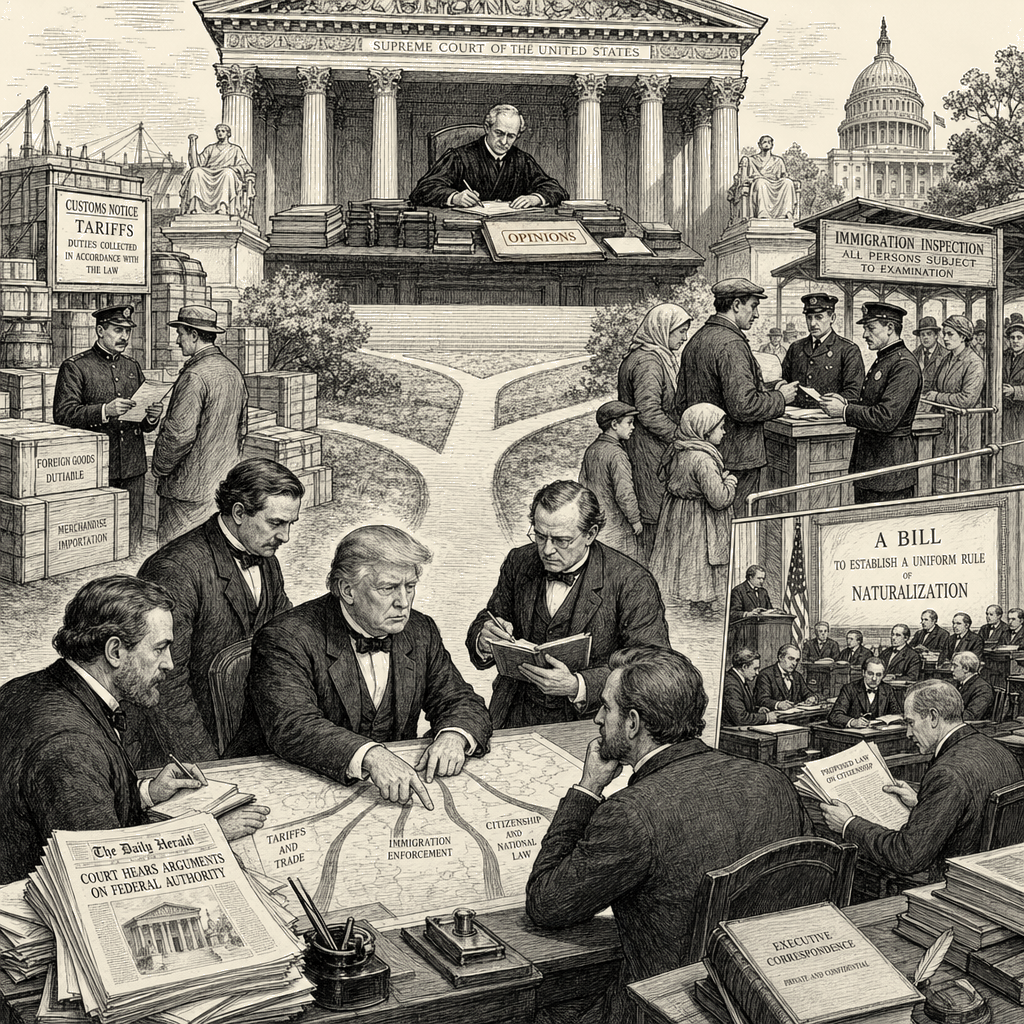
Justice Brett Kavanaugh’s three separate opinions this term — a sole concurrence on immigration stops in September 2025, a dissent on tariff authority in February 2026, and a dissent on birthright citizenship in June 2026 — do not simply register disagreement with the Supreme Court majorities that rejected the Trump administration’s asserted legal authorities. They supply alternative pathways the administration immediately adopts.
The pattern is documented across all three cases. In Learning Resources, Inc. v. Trump, the Supreme Court ruled 6-3 in February 2026 that the International Emergency Economic Powers Act did not grant the president broad tariff authority. Kavanaugh authored the principal dissent. He then engaged in what has been described as “highly unusual and borderline improper speculation” about non-litigated economic and trade statutes that “might justify most (if not all) of the tariffs at issue in this case.” Among the statutes Kavanaugh flagged: Section 122 of the Trade Act of 1974.
Trump called the justices who ruled against him “fools” and “lap dogs.” Of Kavanaugh, he said: “I’m so proud of him.” Within hours of the ruling, the president announced a 10% global temporary import surcharge using Section 122 — precisely the statute Kavanaugh had flagged. The surcharge remained in effect for approximately three months, producing interim revenue and political signaling, before the U.S. Court of International Trade struck it down as illegal on May 7, 2026. Trump has since threatened additional tariffs, including 25% on Brazil, 100% on Britain and European nations over digital services taxes, and 50% on most Canadian goods.
The birthright citizenship case followed a parallel structure. In Trump v. Barbara, decided June 30, 2026, Kavanaugh dissented from the court’s ruling on Trump’s birthright citizenship executive order. He stated the order violated federal law but was not unconstitutional, and argued that “significant illegal immigration into the United States is a new circumstance that was largely unknown as of 1868.” The framers of the 14th Amendment, Kavanaugh claimed, “would not have intended the odd result of granting a substantial birthright citizenship benefit” to children of foreigners who entered unlawfully. He proposed that Congress could amend federal law to create exceptions and that such legislation “would pass constitutional muster.”
Within minutes of the dissent, Trump responded: “We can easily make it up in legislation. No long and unwieldy Constitutional Amendment is necessary!” House Speaker Mike Johnson echoed: “If there’s some legislative fix, we’ll advance that immediately.” A bill was proposed but has no chance of enactment and would be struck down under the recent ruling if passed.
What the immigration opinion produced on the ground
The immigration concurrence produced a different trail of consequences — operational enforcement change, not a single discrete policy adoption — and those consequences are documented.
In September 2025, Kavanaugh issued a sole concurrence in Noem v. Vasquez Perdomo, staying a lower court’s temporary restraining order that had restricted ICE from targeting individuals based primarily on race, language, or occupation. Kavanaugh wrote that stopping people based on ethnic appearance, speaking Spanish, and working certain jobs was a “relevant factor” and “common sense” to establish reasonable suspicion.
Justice Sonia Sotomayor dissented, accusing the court of legitimizing “racial profiling on a massive scale.” She wrote: “We should not have to live in a country where the Government can seize anyone who looks Latino, speaks Spanish, and appears to work a low wage job.”
The documented consequences were swift. According to a ProPublica investigation cited by the Guardian, within a month of the September 2025 ruling, more than 170 U.S. citizens were detained — “dragged, tackled, beaten, tased and shot.” Through July 2026, 32 American children had been detained. Thirty-one people had died at ICE detention camps. Six people had been shot and killed, including two U.S. citizens. In July 2026, two men who were not the targets ICE agents were seeking were killed — Lorenzo Salgado Araujo in Houston on July 7, and Johan Sebastián Durán Guerrero in Biddeford, Maine.
In December 2025, in an unrelated case, Trump v. Illinois, Kavanaugh inserted a footnote repudiating his earlier language: “Officers must not make interior immigration stops or arrests based on race or ethnicity.” The stops — known as “Kavanaugh Stops” — continued in Texas and Maine with fatal consequences. The corrective footnote did not alter the enforcement practice it addressed.
The reasoning shifts; the direction holds
Kavanaugh’s legal method shifts from opinion to opinion, but the functional direction does not.
In the immigration case, the operative method was “common sense.” Kavanaugh cited no evidence for his factual assertions about ethnic appearance and language as indicators of immigration status. Jennifer Chacón, vice-dean at Stanford Law School, wrote that his invocation of “common sense” came “at the expense of facts and evidence.” Duncan Hosie, an academic fellow at the Stanford Constitutional Law Center, described the claims as “factual revisionism” and “a previously unrecognized form of precedent subversion.” Sherrilyn Ifill, a professor at Howard Law School, called the opinion preposterous — the stops amounted to “grabs and kidnapping.”
In the tariff case, the method shifted to “history and precedent.” But no president before Trump had used IEEPA for broad tariffs — the historical precedent Kavanaugh cited did not include the specific exercise of authority he defended.
In the birthright citizenship case, the method shifted again to hypothetical framers’ expectations. Kavanaugh argued that significant illegal immigration was “largely unknown as of 1868.” Anna O. Law, a constitutional scholar at CUNY Brooklyn College, offered a contrary reading: “If the 14th Amendment framers wanted to exclude the babies of temporary visitors … they would have said so. They didn’t.” The framers were familiar with immigration and deliberately chose the language “all persons born in the United States.”
A justice applying “common sense” over evidence in one case, citing “history and precedent” without the precedent in another, and invoking hypothetical framers’ expectations against the text’s deliberate language in a third is not applying a single consistent interpretive method. The contradictions suggest the paradigmatic commitment is instrumental rather than principled.
The sequential equilibrium
The interaction between Kavanaugh and the administration is sequential and asymmetric in information. Kavanaugh selects which statutory routes to flag in his separate opinions; Trump observes and adopts. The Court of International Trade’s invalidation of the Section 122 surcharge demonstrates that these pathways are not guaranteed to survive litigation — but the surcharge produced three months of interim effect before reversal.
A subgame-perfect equilibrium describes the dynamic: at each decision node, no player has an incentive to deviate. Kavanaugh gets to shape constitutional law toward expansive executive authority while maintaining the Court’s posture of independence. Trump gets immediate policy guidance. The pattern is robust across three cases in a single term, which means it is a repeated game, not a series of one-shot interactions. The speed of adoption — the surcharge announced within hours of the Learning Resources dissent — and the differential praise pattern confirm that Trump is not independently discovering these statutory pathways. The coordination effect requires that Trump’s response is non-obvious until Kavanaugh reveals it.
A bounded-rationality reading produces the same observable behavior for different reasons. Kavanaugh’s “common sense” framing in Vasquez Perdomo reflects an anchoring heuristic substituting correlation for the evidentiary standard the Fourth Amendment requires. The rational equilibrium says breadth is optimal given the probability of reversal; the bounded reading says it reflects desire, not calibration.
Strategic pathways to disrupt the pattern
Three interventions target different nodes in the sequential game.
Congressional statutory closure would remove the statutory targets Kavanaugh identifies. The specific statutes at issue: IEEPA (struck down by Learning Resources 6-3), Section 122 of the Trade Act of 1974 (adopted within hours, struck down by the CIT on May 7, 2026), and the federal birthright citizenship statute (Kavanaugh proposed Congress could amend to create exceptions). The equilibrium would collapse when the alternative statutory pathways cease to exist.
Early district-court intervention would degrade the focal-point value of Kavanaugh’s signals. Judicial action at the district level, before Kavanaugh issues a concurrence, would reduce the administration’s payoff to immediate action. District courts become earlier interdictors in the sequential game, reducing the window in which interim policy benefits accrue.
State attorneys general litigation would test whether proposed pathways survive judicial review. The CIT’s Section 122 ruling demonstrates this strategy’s viability. Converting the repeated coordination game into a multidistrict litigation landscape raises the expected cost of immediate executive action.
The paradigms behind the dispute
The dispute over Kavanaugh’s three opinions concerns whether the Constitution limits the state’s physical power over identifiable populations — not a methodological dispute but a foundational one.
Three incommensurabilities reveal this. “Common sense” means judicial notice of obvious social facts to Kavanaugh’s operative method, unexamined cultural stereotype to the rights-protective tradition, and a category error to originalist textualism. “Emergency” means a pretext for state violence demanding constitutional minimization to one paradigm and a legally recognized expansion of authority to another. The very label “legal roadmap versus legal opinion” is paradigm-dependent — one reading sees law and policy as distinct categories and the opinion as crossing that line; another sees identifying what the law permits as identical to suggesting what the executive should do.
The paradigms define “judging” so differently that they are conducting three different activities with the same name. The three opinions share a functional orientation toward expanding executive authority, but they draw on different paradigms to do so — originalism for birthright citizenship, “history and tradition” without historical support for tariffs, “common sense” over evidence for immigration stops.
What the rights-protective paradigm would lose if silenced is the constitutional check on executive overreach, with its documented consequences. What Kavanaugh’s operative paradigm would lose if silenced is the judiciary’s capacity to coordinate with the executive in rapid policy change. What originalism would lose if silenced is the constraint of democratic self-governance against judicial policymaking. These losses cannot be weighed against each other in shared terms.
The dynamic will continue producing harm before the judicial system can respond
The documented consequences of the immigration opinion are not collateral damage. They are the operational output of a judicial suggestion that enforcement agencies operationalized before any corrective mechanism could act. The December 2025 footnote repudiating the earlier language had no practical effect: the stops continued. The advisory dynamic does not merely tolerate harm; it structures the conditions under which harm becomes policy.
When the next Kavanaugh separate opinion identifies an alternative legal pathway, the administration will adopt it with the same speed. Lower courts and state attorneys general will determine whether the suggested pathways survive judicial review — but the interim effects will already have been produced. The equilibrium will hold until one player’s payoff structure changes, and the available levers — congressional statutory closure, early district-court intervention, state attorneys general litigation — each target a different node in the sequential game.
Analytical techniques used in this piece
This analysis applies the methods below. Each links to a short, plain-English explainer you can read and reuse.
- Red-Team Assessment
- Models a capable adversary probing a plan for the seams they would exploit.
- Strategic Interaction (Game Theory)
- Models a situation as a game — players, moves, payoffs, and likely equilibria.
- Worldview Cartography
- Maps the clashing worldviews underlying a dispute.