Justice suggested legislative path to limit birthright citizenship, critics say
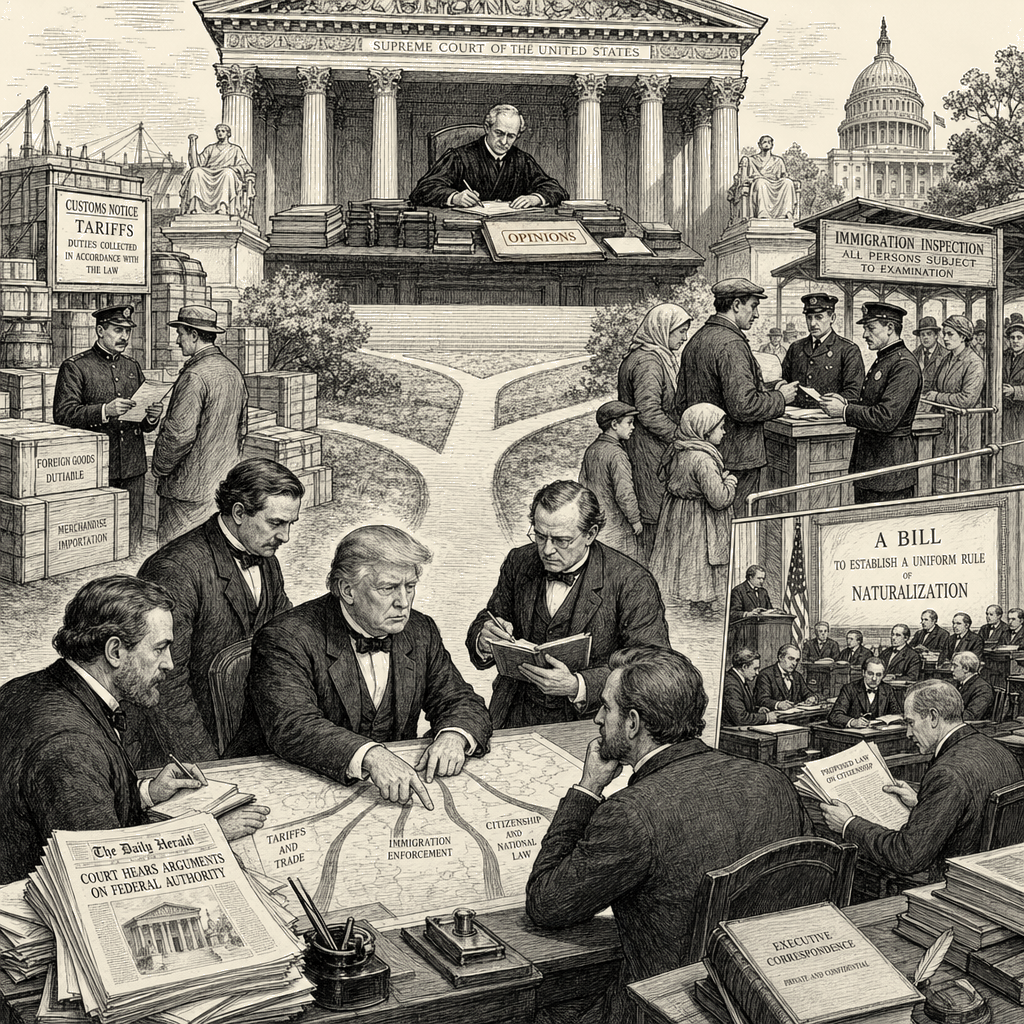
Justice Brett Kavanaugh has emerged this Supreme Court term as a key figure offering President Donald Trump legal justifications for policies on immigration enforcement, tariffs, and birthright citizenship, according to a Guardian analysis by columnist Sidney Blumenthal that drew on legal scholars and other reports.
In September 2025, Kavanaugh issued a sole concurrence in Noem v. Vasquez Perdomo, staying a lower court’s temporary restraining order that had restricted Immigration and Customs Enforcement from targeting individuals based primarily on race, language, or occupation. Kavanaugh wrote that stopping people based on ethnic appearance, speaking Spanish, and working certain jobs was a “relevant factor” and “common sense” to establish reasonable suspicion.
Justice Sonia Sotomayor dissented, accusing the court of legitimizing “racial profiling on a massive scale.” She wrote: “We should not have to live in a country where the Government can seize anyone who looks Latino, speaks Spanish, and appears to work a low wage job.”
Legal scholars criticized Kavanaugh’s reasoning. Jennifer Chacón, a professor and vice-dean at Stanford Law School, wrote that his invocation of “common sense” came “at the expense of facts and evidence,” noting that Kavanaugh cited no evidence for his factual assertions. Duncan Hosie, an academic fellow at Stanford Constitutional Law Center, described Kavanaugh’s claims as “factual revisionism” and “a previously unrecognized form of precedent subversion.” Sherrilyn Ifill, a professor at Howard Law School, called the opinion preposterous, saying the stops amounted to “grabs and kidnapping.”
Within a month of the ruling, more than 170 U.S. citizens were detained, “dragged, tackled, beaten, tased and shot,” according to a ProPublica report cited by the Guardian. Through July 2026, the report said, 32 American children had been detained, 31 people had died at ICE detention camps, six people had been shot and killed — including two U.S. citizens — and in July 2026 two men who were not the targets ICE agents were seeking were killed.
In an unrelated case, Trump v. Illinois, in December 2025, Kavanaugh inserted a footnote repudiating his earlier language: “Officers must not make interior immigration stops or arrests based on race or ethnicity.” But according to the Guardian, the stops — which have come to be known as “Kavanaugh Stops” — have continued, including in Texas and Maine, with fatal consequences.
In February 2026, Kavanaugh authored the principal dissent in Learning Resources, Inc. v. Trump, a 6-3 ruling striking down Trump’s claim that he had absolute power to impose tariffs under the International Emergency Economic Powers Act. Kavanaugh argued tariffs were “a traditional and common tool” and cited “history and precedent” — though, according to the Guardian, no president before Trump had used IEEPA for broad tariffs. Kavanaugh also engaged in what the Guardian described as “highly unusual and borderline improper speculation” about other non-litigated economic and trade statutes that “might justify most (if not all) of the tariffs at issue in this case,” laying out a potential workaround.
Trump called the justices who ruled against him “fools” and “lap dogs” but said of Kavanaugh: “I’m so proud of him.” Within hours, Trump announced he would impose a 10% global temporary import surcharge using Section 122 of the Trade Act of 1974. The U.S. Court of International Trade struck down that surcharge on May 7, 2026 as illegal. Trump has since threatened additional tariffs, including a 25% tariff on Brazil, 100% tariffs on Britain and European nations over digital services taxes, and a punitive 50% tariff on most Canadian goods.
In the term’s final major case, Trump v. Barbara on June 30, 2026, Kavanaugh dissented from the court’s ruling on Trump’s birthright citizenship executive order. He stated that the order violated federal law but was not unconstitutional. Kavanaugh argued that “significant illegal immigration into the United States is a new circumstance that was largely unknown as of 1868” and that the framers of the 14th Amendment “would not have intended the odd result of granting a substantial birthright citizenship benefit” to children of foreigners who entered the country unlawfully. He suggested Congress could amend federal law to create exceptions and that such a statute “would pass constitutional muster.”
Anna O. Law, a constitutional scholar at CUNY Brooklyn College, said the framers of the 14th Amendment were quite familiar with the concept of illegal immigration and deliberately included all children born in the United States. “If the 14th Amendment framers wanted to exclude the babies of temporary visitors … they would have said so. They didn’t,” Law wrote.
Within minutes of Kavanaugh’s dissent, Trump said: “We can easily make it up in legislation. No long and unwieldy Constitutional Amendment is necessary!” House Speaker Mike Johnson echoed Trump, saying: “If there’s some legislative fix, we’ll advance that immediately.” A bill was proposed but, according to the Guardian, has no chance of enactment and would be struck down under the recent court ruling if it were passed.
Legal scholars and commentators have described Kavanaugh’s approach as offering Trump roadmaps to achieve his goals through alternative legal routes. The Guardian’s Blumenthal wrote that Kavanaugh “acts as though he is in an ex-officio capacity to the administration’s legal staff writing option memos.”