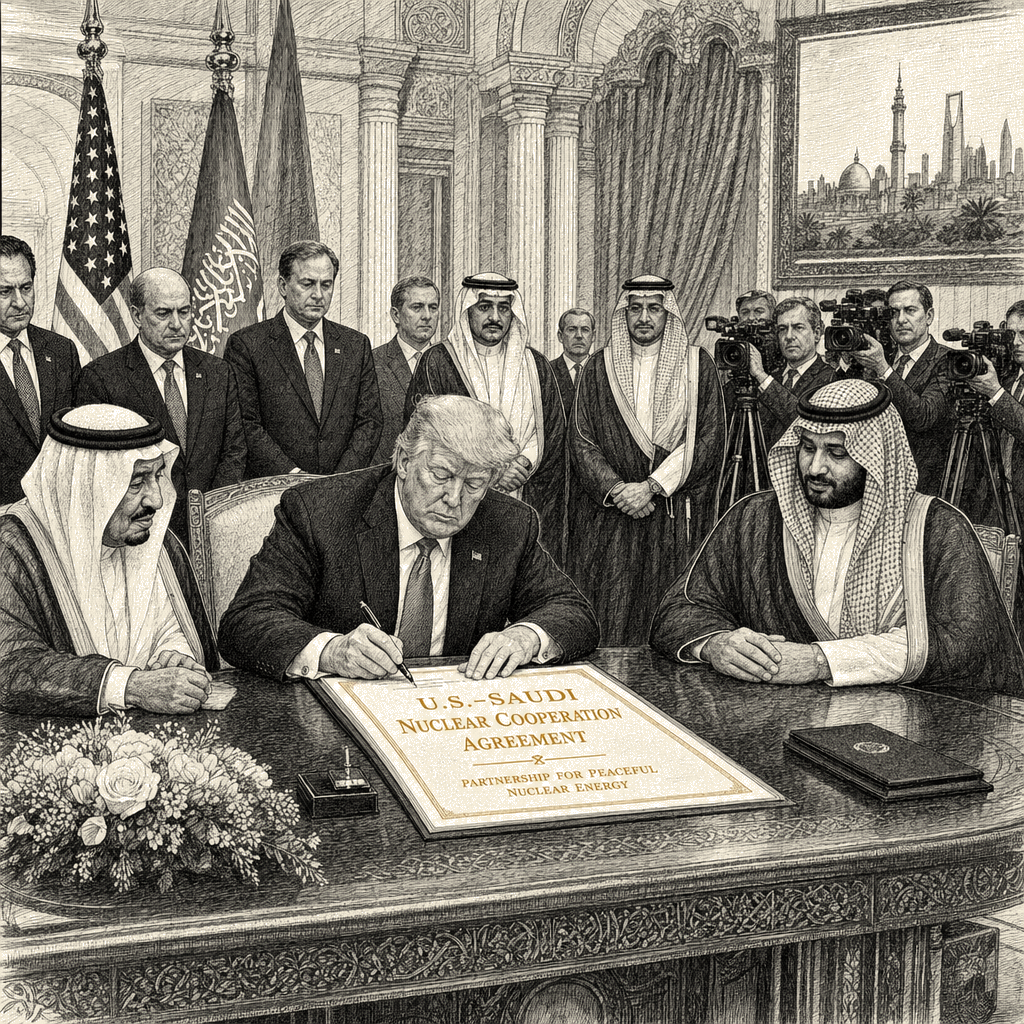
A nuclear cooperation agreement between the Trump administration and Saudi Arabia, signed July 22, 2026, drops the longstanding U.S. demand that the kingdom normalize relations with Israel and permits uranium enrichment on Saudi soil without the “gold standard” of oversight applied to the 2009 U.S.-UAE nuclear deal. The BBC, which broke the story, reports that the agreement “lacks strict enforcement measures to block Saudi Arabia from developing a military nuclear program in the future.” Critics including Israeli lawmaker Avigdor Lieberman and Democratic Rep. Ro Khanna warn the deal could trigger a regional arms race. Energy Secretary Chris Wright defends it as upholding “the highest standards of nuclear safety and nonproliferation.”
The war with Iran is reshaping alliances across the Middle East, and the deal is the latest sign of that shift. It allows Saudi Arabia to enrich uranium on its own soil and drops the U.S. demand that the kingdom normalize relations with Israel, a condition that had been the core of Washington’s approach to Gulf nuclear cooperation for nearly two decades. In its place, the deal offers a rationale of strategic competition: keep Saudi nuclear contracts away from China, secure energy diversification for a Gulf ally at war, and accept a looser oversight regime as the cost of a continued U.S. presence. The coverage treats these competing rationales as an even-handed menu, not as the war of incompatible frameworks they actually are.
How the deal changes the rules
The most consequential departure from past U.S. policy is the enrichment provision. The 2009 U.S.-UAE nuclear agreement set what became known as the “gold standard”; the UAE forswore enrichment and reprocessing and accepted strict International Atomic Energy Agency inspections. The new Saudi deal does neither. The BBC reports that the agreement “differs sharply” from the UAE accord and “lacks strict enforcement measures to block Saudi Arabia from developing a military nuclear program in the future.” Imran Bayoumi, a resident fellow at the Atlantic Council and former policy adviser at the U.S. Defense Department, told the BBC the deal “helps lay the groundwork for nuclear weapons in the future.”
The second structural change is the removal of the Israel normalization linkage, and this is where the security-dilemma spiral begins. The BBC’s headline states the deal “drops the longstanding U.S. demand that the kingdom normalize relations with Israel.” With normalization removed and no replacement leverage, a dual escalation pathway opens: Saudi enrichment accelerates an Iranian breakout, and Israel, facing a nuclear-capable Saudi Arabia without normalization, faces pressure to respond with preemptive or covert action. Avigdor Lieberman, a member of the Israeli parliament and former defense minister, said a civilian nuclear program in Saudi Arabia would “lead to a mad arms race across the entire Middle East.” Rep. Ro Khanna, a California Democrat, called the deal “a giveaway to the Saudis” that would “fuel further ambitions from Iran” and “destabilise the region with Israel.”
The reporting’s sourcing architecture reveals an asymmetry between those carrying the alarm and those carrying the justifications. The most alarming claims come from political actors (Lieberman and Khanna) whose positions are structurally motivated. The single proliferation-risk analyst quoted, Bayoumi, offers a hedged formulation (“helps lay the groundwork”) with no technical specifics on enrichment ceilings, IAEA Additional Protocol status, or buyback provisions. On the administration side, Energy Secretary Chris Wright’s statement that the pact would “uphold the highest standards of nuclear safety and nonproliferation” is the sole counterweight; that statement borrows nonproliferation vocabulary while operating on geopolitical logic, a rhetorical overlay that treats a political choice as a technical standard. No independent verification mechanism or enforcement schedule is cited. The reader cannot distinguish a legitimate energy deal with imperfect oversight from an actual proliferation pathway.
Whose account the reporting advances, and what each frame excludes
A frame audit of the BBC article maps four competing paradigms, each treating different questions as the right one. The article presents them as equally valid. They are not equally valid; they are incommensurable, and the article’s refusal to adjudicate is itself a choice.
The U.S. nonproliferation security frame claims the enrichment concession is the only fact that matters, and by that standard it is consistent with its own premises. It treats enrichment without the gold standard as a proliferation risk, assumes enrichment capability inside a sovereign state cannot be reliably reversed, and evaluates the deal against the 2009 UAE benchmark. But its premises cannot accommodate the crisis context that produced the deal. Its limitation is that it cannot see the deal as a response to a crisis, only as a concession to one. What this frame excludes: the reality that Saudi Arabia was going to build nuclear infrastructure with or without the United States, and that the alternative was a Chinese-supplied program with no U.S. oversight at all.
The Gulf sovereignty and energy diversification frame makes the opposite claim: nuclear energy is inevitable in the Middle East regardless of U.S. involvement, and only this deal keeps U.S. companies in the room. Yusuf Can, a Middle East expert at Amena Strategies, told the BBC: “Countries in the Middle East want to develop their nuclear infrastructure and they’re going to do it even if the US is not involved. Washington at this point is recognising that.” Christopher Russo, an energy expert at Charles River Associates, added the energy-security case: “Oil can be disrupted. You can bomb oil fields. Oil tankers can be stuck somewhere, as we’re seeing right now in the Strait of Hormuz. Nuclear power is pretty self-contained.” Russo’s point on oil vulnerability is the deal’s most defensible rationale. But it rests on an implicit timeline claim, that the decade-long construction window is the relevant risk window, which the article does not test. What this frame excludes: the dual-use reality of enrichment. It treats enrichment as inherently civilian and has no vocabulary for the weapons horizon at all. If enrichment is later weaponized, this frame’s civilian legitimacy collapses while the geopolitical logic persists; the pro-deal coalition could fracture under stress even though both components currently support the deal.
The Israeli security and balance-of-power frame, represented by Lieberman’s warning of a “mad arms race,” evaluates the deal primarily by its effect on Israel. Its limitation is that it cannot account for the Saudi sovereignty pressures or the Iran-war context that drove the administration’s decision, and it assumes the deal’s effects on Israel are the primary evaluative criterion.
The progressive internationalist critique, represented by Khanna’s characterization of the deal as a “giveaway,” operates in a transactional register, evaluating U.S. leverage lost against the Saudi benefit. Its limitation is that it does not articulate an achievable alternative under the structural conditions (the Iran war, Chinese nuclear diplomacy) that made the gold standard unobtainable, and it treats “giveaway” as self-explanatory without accounting for what alternative outcome was achievable.
The reporting presents these frames without resolving them. The article alternates between alarm and justification, performing neutrality without adjudication. It also conflates Lieberman’s and Khanna’s objections, treating them as the same type of claim, when Lieberman is worried from a nonproliferation lens (“mad arms race”) and Khanna from a geopolitical-fiscal one (“giveaway”). The underlying problem is that the frames define “risk” in incommensurable ways: for the nonproliferation frame, risk is proliferation probability; for the sovereignty frame, risk is energy-dependency vulnerability. The word “enrichment” names the same physical activity, but the paradigms attach opposite meanings to it. The disagreement is at the level of which question counts as the right one. The reporting’s refusal to pick a question is not neutrality; it is a structural evasion that leaves the reader holding four incompatible frameworks without the tools to choose among them.
What the reporting leaves underdeveloped
The article’s truncated China-competition thread is the most consequential structural gap. Can’s quote (which continues: “the US is basically saying you don’t have to work with China. You can work with us”) opens the strongest pro-deal rationale: the agreement is a U.S. countermove against Chinese nuclear diplomacy in the Gulf. External sourcing from the Wilson Center and Atlantic Council confirms that Chinese nuclear offers to Saudi Arabia are a real strategic dynamic. But the BBC article develops the China thread no further. No source provides data on Chinese nuclear offers; no comparison of terms is drawn; no analyst assesses whether the China threat justifies the oversight concessions. The article introduces the strongest justification for the deal and then abandons it.
The article’s most consequential contextual fact appears in a single unattributed sentence: “The war with Iran likely accelerated the administration’s decision, as Washington sought to ease tensions with Gulf allies who have been targeted by Tehran and who briefly denied the U.S. access to Saudi airspace earlier in the conflict.” The Saudi airspace denial is sourced to unnamed “analysts,” the article’s vaguest attribution, and the duration qualifier “briefly” is not corroborated by other outlets that reported the event. If Saudi Arabia denied U.S. military access during active hostilities with Iran, a deal that concedes enrichment rights under such conditions carries a very different strategic logic than one negotiated in peacetime. The article buries this context in an unattributed subordinate clause.
Finally, the article’s closing sentence (“Saudi Arabia will likely take a decade or longer to build and open new nuclear plants, experts said”) conflates the reactor construction timeline with the enrichment capability timeline. Enrichment infrastructure can reach weapons-relevant capability well before a reactor generates electricity. The proliferation concern is not about when reactors come online; it is about when enrichment infrastructure reaches weapons-relevant capability. Ending on the reactor timeline without addressing the enrichment timeline implies a longer window of safety than the enrichment concession may actually provide.
Questions the reporting fails to answer, and a reader needs to ask
- What enforcement measures, if any, does the agreement actually include, and what inspection regime does Saudi Arabia commit to under the IAEA Additional Protocol? The article does not specify these.
- How does the removal of the Israel normalization condition change the security calculus for the region, and what replacement leverage does the United States hold? The article does not address this.
- What is the timeline for Saudi enrichment capability versus the timeline for reactor construction? The article conflates them.
- Does the Iran war context, including the reported denial of U.S. access to Saudi airspace, justify the oversight concessions, and on what evidence does that context rest? The article attributes this to unnamed analysts and does not develop it.
This is an Analysis, published under news-floor discipline. Facts not in dispute are stated as such. No claim about intent is made about any party cited. The analysis identifies framing patterns and sourcing architecture; it does not assert that the report is inaccurate.
Analytical techniques used in this piece
This analysis applies the methods below. Each links to a short, plain-English explainer you can read and reuse.
- Red-Team Assessment
- Models a capable adversary probing a plan for the seams they would exploit.
- Systems Dynamics (Structural)
- Maps a system’s structure — stocks, flows, and the architecture that shapes its behavior.
- Worldview Cartography
- Maps the clashing worldviews underlying a dispute.