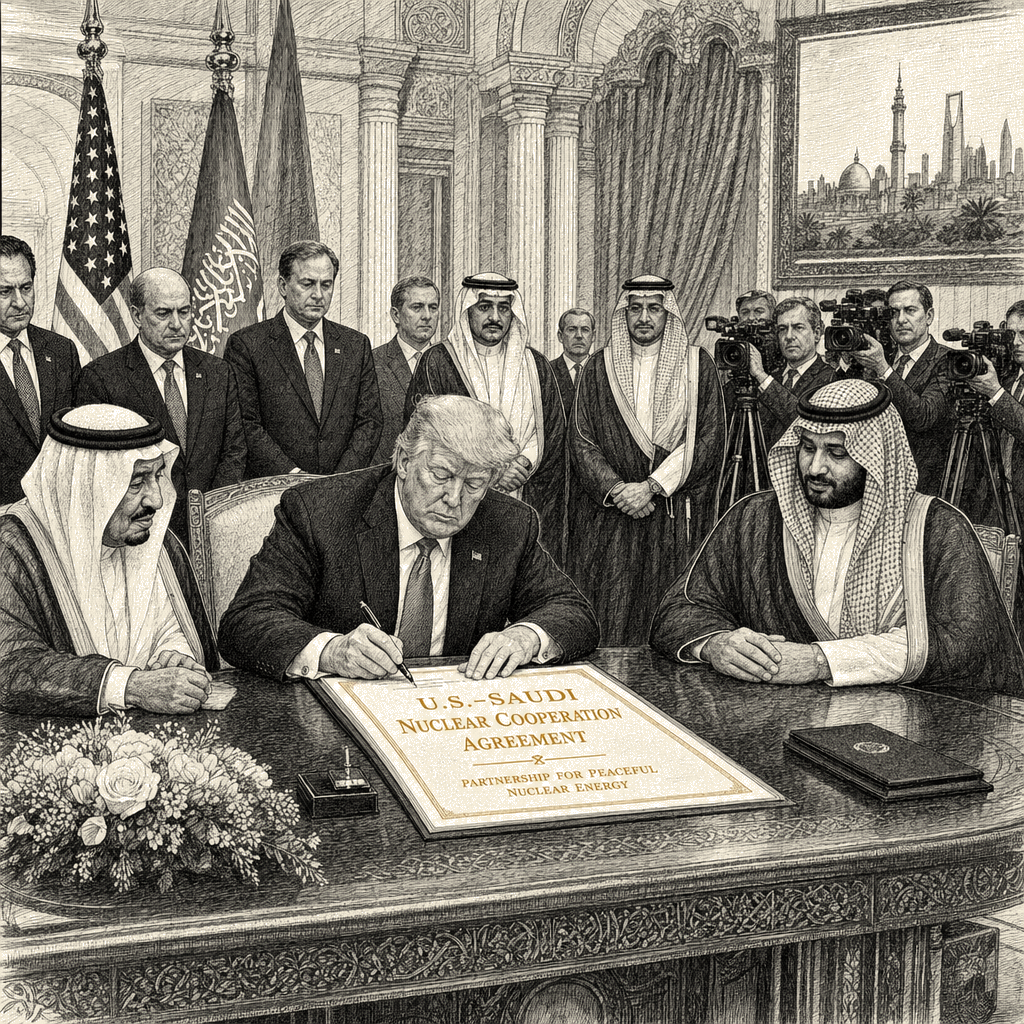
Deal allows Saudi uranium enrichment on its own soil
The agreement opens the door for U.S. companies including Westinghouse to build nuclear reactors on Saudi territory. A senior administration official said the U.S. will support creating a civilian nuclear power program in the kingdom.
“Countries in the Middle East want to develop their nuclear infrastructure and they’re going to do it even if the US is not involved,” said Yusuf Can, a Middle East expert at consulting firm Amena Strategies. “Washington at this point is recognising that.”
With the nuclear deal, Can added, “the US is basically saying you don’t have to work with China. You can work with us.”
The deal lacks strict enforcement measures to block Saudi Arabia from developing a military nuclear program in the future, according to the BBC, and differs sharply from a 2009 agreement with the United Arab Emirates that required strict International Atomic Energy Agency inspections.
“It certainly helps lay the groundwork for nuclear weapons in the future,” said Imran Bayoumi, a resident fellow at the Atlantic Council and former policy adviser at the U.S. Defense Department.
Israeli politicians reacted with alarm. “A civilian nuclear program in Saudi Arabia [will] lead to a mad arms race across the entire Middle East,” Avigdor Lieberman, a member of the Israeli parliament and former defense minister, said in a social media post.
Democratic Rep. Ro Khanna of California told the BBC the deal was “a giveaway to the Saudis” that would “fuel further ambitions from Iran” and “destabilise the region with Israel.”
Trump did not preside over the signing ceremony. He attended a dignified transfer ceremony for four U.S. service members killed in Iran before holding a rally in Georgia, where he argued his policies were making the Middle East more stable.
Energy Secretary Chris Wright said the agreement would boost the American economy and strengthen national security. In a statement posted to social media, Wright said the pact would “uphold the highest standards of nuclear safety and nonproliferation.”
Analysts said the deal cements Saudi Arabia’s status as a major regional force and allows it to diversify its energy sector without the political cost of normalizing ties with Israel. The war with Iran likely accelerated the administration’s decision, as Washington sought to ease tensions with Gulf allies who have been targeted by Tehran and who briefly denied the U.S. access to Saudi airspace earlier in the conflict.
Christopher Russo, an energy expert at Charles River Associates, said the deal makes economic sense for Riyadh. “Oil can be disrupted. You can bomb oil fields. Oil tankers can be stuck somewhere, as we’re seeing right now in the Strait of Hormuz,” Russo said. “Nuclear power is pretty self-contained.”
Saudi Arabia will likely take a decade or longer to build and open new nuclear plants, experts said.