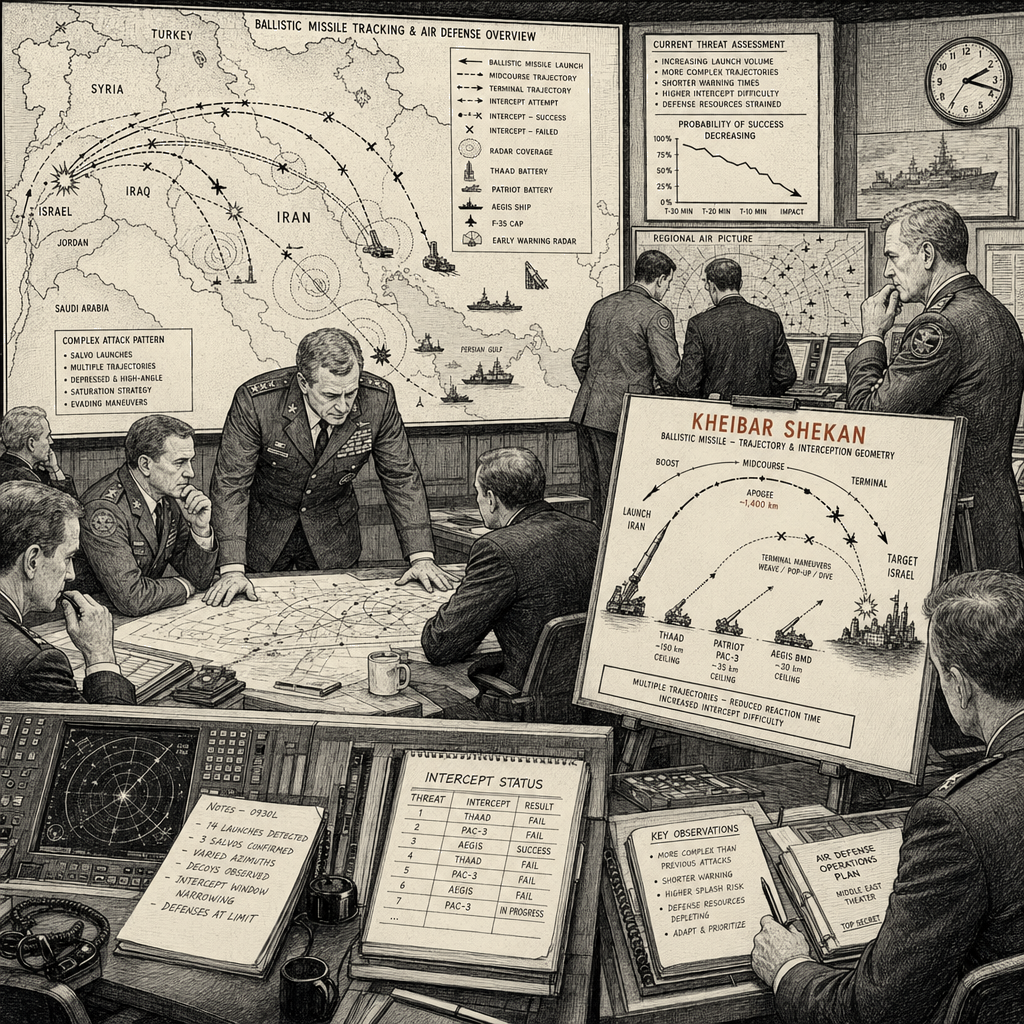
Since the ceasefire collapsed, Iran has been firing the Kheibar Shekan — a solid-fuel, single-stage ballistic missile with a range of at least 900 miles — at American bases across the Middle East. U.S. officials told the Wall Street Journal that most have been shot down, but some have penetrated, and Iran “is paying attention, and they’re learning and they’re looking for ways that they can get at us,” retired Army Gen. Joseph Votel, a former commander of U.S. Central Command, told the Journal. The question the pattern raises is whether the defense’s current edge is sustainable: each combat use, as independent missile expert Fabian Hinz told the Journal, gives Iran data on “what types of maneuvers are the most effective ones for overcoming missile defense,” and Iran is adapting its tactics across flight paths, speeds, salvo composition, and sensor targeting.
What the missile’s design requires of the defender
The Kheibar Shekan can be kept fueled and loaded into trucks or other vehicles for launching. Unlike Iran’s older liquid-fuel missiles that required lengthy pre-launch fueling — a window that exposed them to pre-emptive air strikes — the Kheibar Shekan eliminates that vulnerability entirely. Iran can fire the missile before U.S. or Israeli warplanes can reach the launch site, U.S. officials told the Journal. The missile can also vary its trajectory more than some other ballistic missiles, making it harder to detect and destroy, according to military analysts cited by the Journal.
The technical problem for the defender compounds in the terminal phase. In some variants, the nose section, which carries the explosive warhead, detaches during the final phase of flight and is equipped with a small engine that adjusts its direction as it nears its target at 6,000 miles an hour, according to analysts and officials cited by the Journal. A warhead altering course at 6,000 mph forces re-engagement calculations that compress the reaction window below what fixed-interceptor engagement envelopes were designed to handle. Hinz confirmed that Iran has long claimed the Kheibar Shekan can maneuver in the final stage of flight and that the claim appears operational.
The combined effect compresses the defender’s window at both ends. The launch site cannot be struck before firing. The warhead in its final seconds is adjusting course at 6,000 miles per hour — changing lanes, in effect, faster than the guidance system of an interceptor built to hit a predictable trajectory can recalculate. The warhead is hardest to engage in the very phase when interception must occur.
The combat-data learning loop
The strongest single driver of Iran’s improving penetration rate over time is the information feedback loop. Hinz told the Journal: “Every single combat use gives you some sort of data, so that’s very useful for the Iranians.” U.S. officials told the Journal that Iran is varying flight paths, speeds, and altitudes across launches to confuse prediction algorithms. It is possible some of the observed variation reflects pre-planned profiles rather than real-time empirical learning, but the pattern of improving effectiveness across engagements strongly suggests an adaptive feedback loop. Each launch — whether it hits or is intercepted — produces telemetry on what the defense’s radar and interceptor systems detect and where the gaps are. Over successive launches, Iran builds a profile of which trajectories, terminal maneuvers, and launch configurations produce higher penetration probability.
The learning loop operates asymmetrically. Iran learns from every engagement; the defender gains no analogous data about how to defeat the Kheibar Shekan on the cheap. Each failed intercept tells Iran something about the defender’s engagement envelope; each successful intercept costs the defender $2 million to $15 million in expended rounds. Nicole Grajewski, an expert on Iranian strategy at Sciences Po in Paris, told the Journal: “The Iranians kind of figured out during the war that the Kheibar Shekans are great because it’s pretty cheap to produce, it’s flexible with launch systems, and it’s pretty effective.”
Cost asymmetry and defender sustainability
The Kheibar Shekan is “far cheaper” than the U.S. and Israeli interceptors used to take it down, analysts told the Journal. While Iran has not disclosed the missile’s per-unit cost, the Journal reported the interceptor cost band at $2 million to $15 million per round, depending on the system — Patriot-class interceptors and other platforms referenced without specifying each variant by name. Analysts estimate Iran trades missiles at roughly a 3-to-1 or 4-to-1 cost advantage, based on interception rates and missile production costs.
The cost-exchange ratio creates a structural pressure. Every successful intercept is a net economic loss for the defender. Over a sustained campaign — even one in which the defender intercepts most incoming missiles — the defender’s inventory of interceptor rounds drains disproportionately faster than Iran’s stockpile of Kheibar Shekans, because Iran can afford a much higher ratio of launch inventory to expenditure. The learning loop compounds the cost asymmetry: as Iran iterates on flight paths, speeds, and maneuvers, the probability that each interceptor round succeeds drops. The cost gap widens not because interceptors get more expensive but because they get less effective per round.
The U.S. interceptor inventory is finite. The Journal’s reporting does not address current stockpile levels or production-resupply timelines. At the upper end of the per-round cost range, a sustained campaign of the type the officials describe — repeated salvos of Kheibar Shekans paired with drones and decoy-level missiles — consumes hundreds of millions of dollars in interceptor rounds for a defense that, by the officials’ own account, is letting some missiles through. How long that exchange rate is sustainable at its current scale is a question the available record does not resolve.
Sensor degradation and multi-threat saturation
Iran applies two additional pressures that compound the defense problem.
First, the Journal reported, citing U.S. officials, that Iran has repeatedly targeted the radars that underpin air defenses across the region. Radars like the AN/TPY-2 are semi-fixed systems without rapid repositioning capability; once struck, coverage holes persist until field repairs or replacements arrive. The causal chain is direct: radar damage reduces detection range, which reduces intercept opportunities, which increases the probability that a maneuvering terminal warhead reaches its target. Each degradation in the sensor layer removes one more chance to intercept the maneuvering warhead — already the hardest single target in the salvo because of its terminal-phase agility.
Second, Iran launches high-speed attack drones and less sophisticated missiles at the same locations it targets with Kheibar Shekans, the U.S. officials told the Journal. The defender must allocate interceptors across multiple threat types simultaneously. Less sophisticated weapons saturate lower-tier defenses while the Kheibar Shekans challenge upper-tier interceptors. The defender’s performance against Kheibar Shekans depends on the concurrent demand from drones and other missiles — a demand that Iran can vary to open windows for the Kheibar Shekan to penetrate. Intercept performance against the Kheibar Shekan depends in part on how much of the defender’s interceptor budget — in both rounds expended and dollars spent per salvo — has already been committed to the rest of the incoming wave.
Where the feedback loops hit their bounds
The Kheibar Shekan’s threat profile is simultaneously intensifying and finite. U.S. and Israeli estimates placed Iran’s pre-war combined stockpile at roughly 2,500 Kheibar Shekans and other medium-range missiles — a figure that bundles the Kheibar Shekan with other systems, leaving the precise Kheibar-only count unclear. Hinz told the Journal that the production facilities where Kheibar Shekan engines were built have been destroyed, though Iran “might be assembling more from components stored in underground bases.” The destruction caps Iran’s ability to replenish expended missiles at pre-war manufacturing rates.
The combat-data learning loop, which consumes missiles, draws down the inventory Iran can use for future offensives. Iran faces a tradeoff between using missiles for immediate tactical effect — generating data that improves penetration — and preserving them for future engagements. If the learning loop is driving penetration rates up faster than the stockpile is drawn down, the pressure on the defender compounds in the near term; if stockpile exhaustion outpaces tactical improvement, the pressure eases as Iran’s launch tempo declines. Current evidence — Iran continuing to fire salvos and adapt tactics, and Hinz describing active learning — tilts toward the learning loop outpacing depletion in the near term. The destroyed engine-production facilities impose a hard ceiling on how long that dynamic can persist, but they do not bound the threat at its current scale.
A second mechanism may be converging on the same symptom from the defender side. Even a static Iranian threat with no improvement in tactics could produce declining intercept rates if U.S. and allied interceptor inventories thin under sustained combat expenditure — a defender-side supply problem that degrades effectiveness independently of Iranian learning. The two mechanisms likely operate in parallel, making the exchange ratio degrade faster than either mechanism alone would predict.
Iran has also claimed targeted strikes with Kheibar Shekans on the office of Israeli Prime Minister Benjamin Netanyahu and the headquarters of Israel’s air force commander; the Journal reported that the results of those attacks could not be determined. U.S. officials said the United States and its partners have shot down most Kheibar Shekans throughout the war. “Most” admits a remainder. How large the remainder grows — and whether the defense can sustain the cost of maintaining “most” as Iran’s accuracy improves and its inventory narrows — is the equation that frames the threat’s trajectory in the months ahead.
Questions to carry forward
- How many Kheibar Shekans does Iran still hold after sustained combat expenditure, and at what rate is it expending them per month relative to the learning loop’s data appetite?
- Can Iran maintain or accelerate the learning loop’s pace with a declining stockpile, or does the tactical improvement curve flatten as the remaining missile count drops toward a preservation threshold?
- Does the defender have a path to a lower-cost-per-shot intercept capability — directed energy, hypervelocity projectiles, or multi-missile salvo doctrine — that would neutralize the cost-asymmetry structure before the interceptor inventory depletes below a strategic reserve?
- How rapidly can the defender reconstitute radar coverage after Iranian sensor strikes, and does the defender have a distributed low-cost sensor network as a fallback if semi-fixed radars continue to be destroyed?
Analytical techniques used in this piece
This analysis applies the methods below. Each links to a short, plain-English explainer you can read and reuse.
- Relationship Mapping
- Extracts the network of ties among people, institutions, and entities.
- Root-Cause Analysis
- Traces a symptom back along its causal chain to the conditions that actually generated it.
- Strategic Interaction (Game Theory)
- Models a situation as a game — players, moves, payoffs, and likely equilibria.