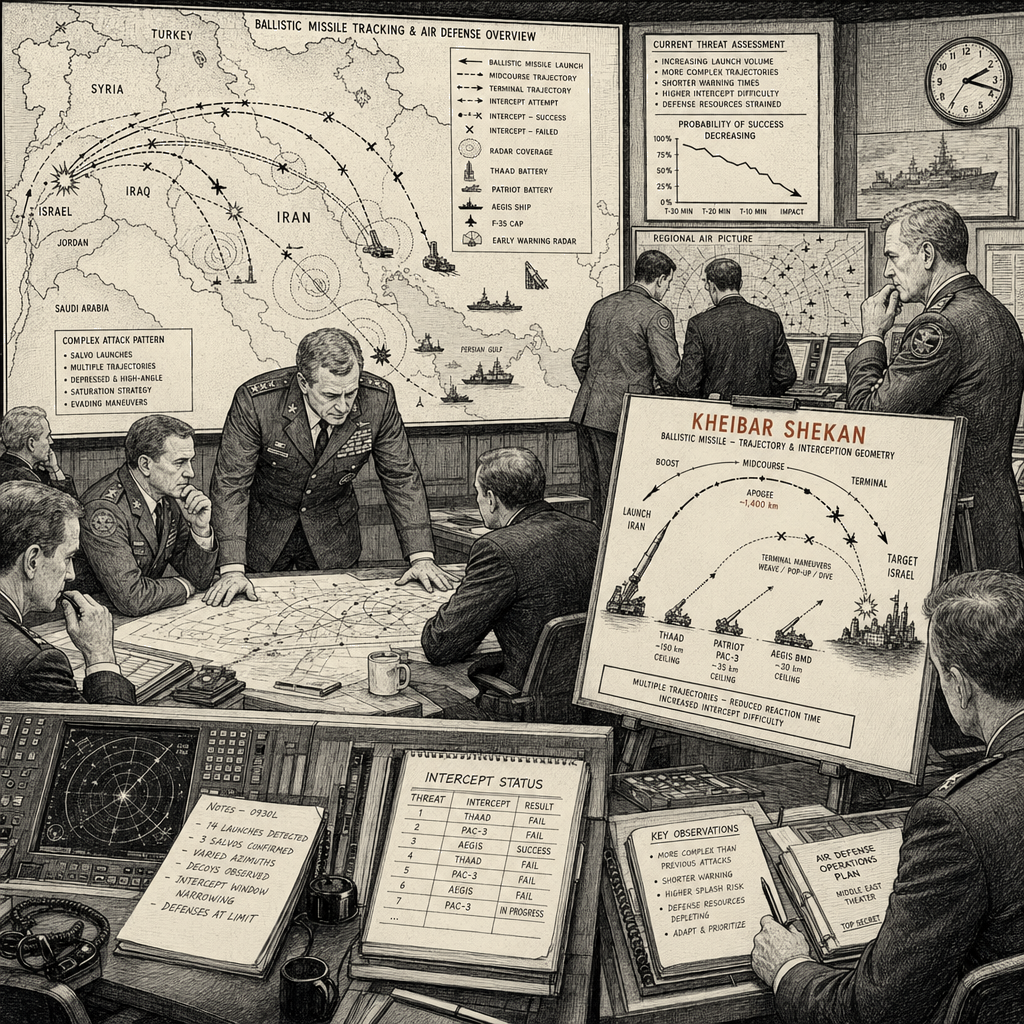
Mobile launchers and terminal maneuvering warhead complicate U.S. air defense
Since fighting resumed after the collapse of the ceasefire, Iran has been firing the Kheibar Shekan at American bases across the Middle East, U.S. officials told The Wall Street Journal. The officials said Iran is using a combination of different flight paths, maneuvers and speeds to try to confuse U.S. defenses.
The U.S. and its partners have shot down most Kheibar Shekans throughout the war, one of the U.S. officials said, but some have gotten through. Iran has also repeatedly targeted housing areas where U.S. troops stay at bases, as well as the radars that underpin air defenses across the region, the officials said.
“I think what it tells us is Iran is paying attention, and they’re learning and they’re looking at ways that they can get at us,” retired Army Gen. Joseph Votel, who has led U.S. Central Command, told the Journal.
Unlike Iran’s older missiles that require lengthy prelaunch fueling, military analysts said the Kheibar Shekan can be kept fueled and loaded quickly into trucks or other vehicles for launching. The feature allows Iran to fire the missile before U.S. and Israeli warplanes can strike the launch site.
The Kheibar Shekan is a solid-fuel, single-stage ballistic missile with a range of at least 900 miles, according to analysts. Military analysts who have studied the weapon said it can vary its trajectory more than some other ballistic missiles in an attempt to make it harder to detect and destroy.
In some variants, the nose section, which carries the explosive warhead and detaches during the final phase of flight, is equipped with a small engine that makes it capable of adjusting its direction as it nears its target at 6,000 miles an hour, according to analysts and officials cited by the Journal.
Iran has long said the Kheibar Shekan can maneuver in the final stage of its flight to evade air defenses, said Fabian Hinz, an independent missile expert.
Iran seems to have improved its missile attacks, likely by studying previous launches and figuring out how to maximize the possibility the weapons will get through, Hinz told the Journal.
“Iran ‘has seen what types of maneuvers are the most effective ones for overcoming missile defense,’” Hinz said. “Every single combat use gives you some sort of data, so that’s very useful for the Iranians.”
Iran is also launching high-speed attack drones and less sophisticated missiles at the same locations it is targeting with the satellite-guided Kheibar Shekans, adapting its tactics throughout the war, the U.S. officials said.
Iran was believed to have 2,500 Kheibar Shekans and other medium-range missiles before the war began, according to U.S. and Israeli estimates cited by the Journal. It might be assembling more from components stored in underground bases, but the production facilities where engines for the missiles were built have been destroyed, Hinz said.
“The Iranians kind of figured out during the war that the Kheibar Shekans are great because it’s pretty cheap to produce, it’s flexible with launch systems, and it’s pretty effective,” said Nicole Grajewski, an expert on Iranian strategy at Sciences Po in Paris.
The missile’s low cost relative to the interceptors is a key factor. Iran has not disclosed the cost of a Kheibar Shekan, but analysts said it is far cheaper than the U.S. and Israeli interceptors used to take them down, which cost between $2 million and $15 million per interceptor, depending on the system.
Iran has fired Kheibar Shekans at Israel, which said it shot most of them down. Iran has also claimed that it targeted the office of Israeli Prime Minister Benjamin Netanyahu and the headquarters of Israel’s air force commander using Kheibar Shekans. Last month, it announced another attack with the missiles, along with jet-powered drones. The Journal reported that the results of those attacks could not be determined.
The missile is named after the Battle of Khaybar, the 628 campaign in which the Prophet Muhammad’s forces conquered the fortified oasis of Khaybar, then held by Arabian Jews.