Iran rebuilt missile bases after US, Israeli strikes, analysts say
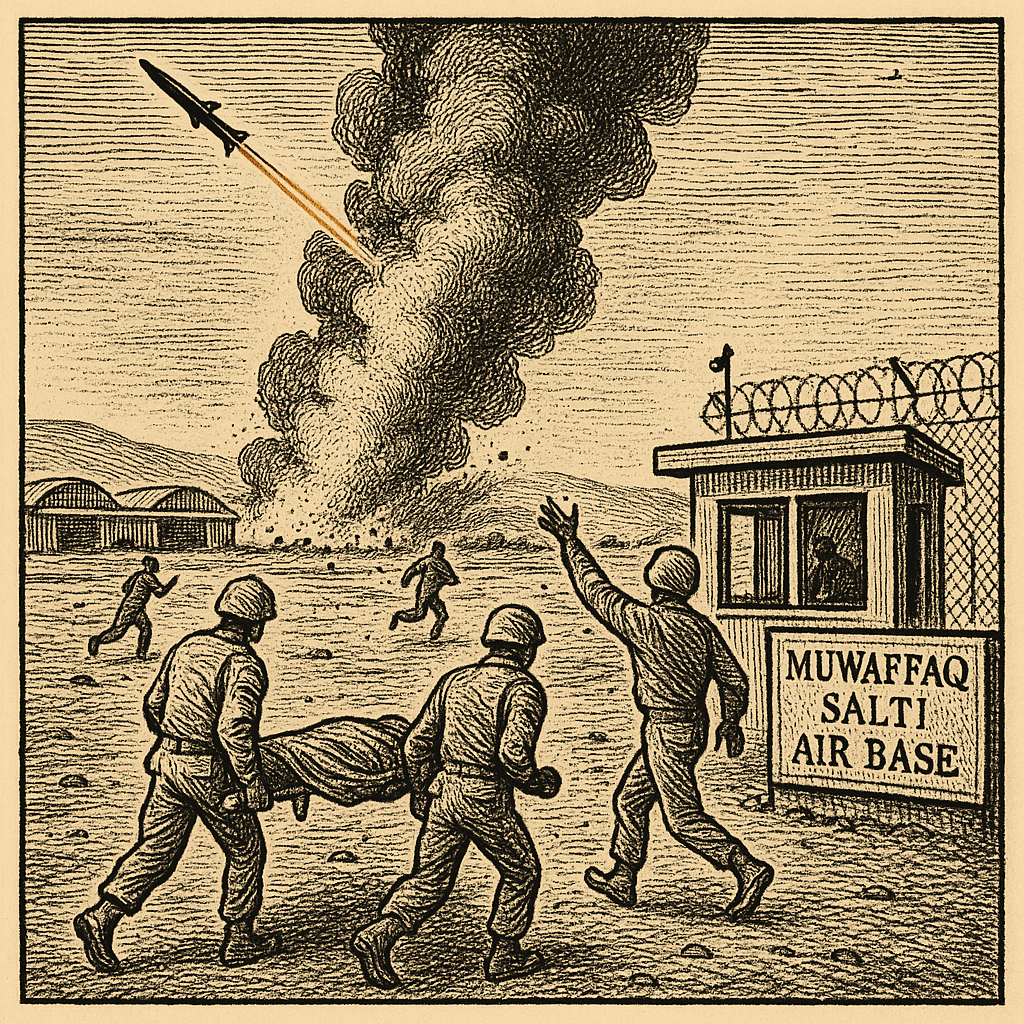
Iran’s missile attack Friday on a Jordan air base that killed three U.S. service members demonstrated that Tehran retains a significant missile arsenal despite President Trump’s claim to have “totally destroyed” Iran’s military, military analysts said.
The strike on Muwaffaq Salti Air Base was likely carried out by Iran’s most effective missiles, including the Kheibar Shekan medium-range system, according to military analysts cited by the Wall Street Journal. The Kheibar Shekan, introduced in 2022, has a range of at least 900 miles and uses solid fuel with a satellite-guidance system. Iran has claimed the missile has a maneuverable re-entry warhead designed to evade air defenses.
A video issued in recent days by the Islamic Revolutionary Guard Corps, which oversees Iran’s missile forces, said the latest attacks also included Fattah, Zolfaghar, Fateh-110, and Qiam ballistic missiles, as well as Shahed drones and Paveh cruise missiles.
The Pentagon confirmed a third soldier was killed in the Jordan attack. Sgt. Angel Rampersad, 28, of Ozone Park, N.Y., was listed as missing before his death was confirmed.
Defense Secretary Pete Hegseth told reporters in April that Iran’s missile program was “functionally destroyed” with launchers and missiles “depleted and decimated and almost completely ineffective.” Trump said last month that only 21% of Iran’s prewar missile stockpile remained, though he acknowledged that it was “still a lot.”
During an Appropriations Committee hearing Tuesday, Sen. Jon Ossoff (D., Ga.) sharply questioned Hegseth about his April statements that the U.S. had achieved its objectives in the war, including to “obliterate Iran’s missile threat.” Hegseth replied: “We never expected they would stop having capabilities to shoot. The question is at scale against an opponent like the United States of America.”
The Kheibar Shekan and other missile systems were housed in vast underground facilities that the U.S. and Israel spent weeks pounding in March and April. Since then, Iran has dug out the openings and resumed firing from some of the bases, analysts said. Iran has used ceasefires to rebuild, setting new roads and reinforcing tunnel entrances at multiple missile base locations throughout the country, according to Ben Tzion Macales, an Israeli geo-analyst who has studied commercial satellite images.
One attack in the early days of the war inflicted heavy blows to an Iranian missile base north of the city of Kermanshah. Multiple buildings were turned to rubble, and munitions left large craters where access roads previously led to tunnels bored deep into a mountain. By the first week of June, crews had repaired the two roads, enabling trucks to clear dirt and work on reopening the collapsed tunnel entrances, according to satellite imagery.
“They can go after the tunnel entrances, but as we’ve seen, the Iranians can take those out with their engineering teams relatively quickly and get back to operations,” said Jim Lamson, a visiting research fellow at King’s College London and former Central Intelligence Agency analyst focusing on the Iranian military.
For Iran, the goal is to raise the cost to the U.S. of prolonging the conflict, hoping that Trump will back away from his threats to escalate the war and renegotiate a settlement that leaves Tehran in control of the Strait of Hormuz, according to analysts.
“Iran’s incremental scorched-earth policy against the Arab world is designed to get America to back out of the region, not to double down,” said Behnam Ben Taleblu, senior director of the Iran program at the Foundation for Defense of Democracies.
That the missiles were able to slip through U.S. air defenses points to the challenges in protecting the estimated 50,000 troops stationed in the region, even though Iran is shooting fewer missiles in its salvos than it did earlier in the war. Ran Kochav, a former commander of Israel’s air and missile defense forces, said it was likely more missiles are getting through because of damage to radars and other air-defense systems from Iranian attacks earlier in the war.
“Their radars are exposed; their infrastructure is exposed,” he said, noting that radars and air-defense batteries in Jordan and in Gulf countries were hit in the first phase of the war.
Nicole Grajewski, an expert on Iranian strategy at Sciences Po in Paris, said the missiles fired at Jordan likely came from a base near the city of Tabriz or other bases in western Iran that have resumed operations. “It means that Iran was able to replenish its missiles or maybe dig out some of the ones that were in the bases, and they clearly still have some of their more efficient missiles,” she said.
Tom Karako, a missile expert at the Center for Strategic and International Studies, said the continuing attacks highlight the difficulty of defending against missile attacks from an adversary that has spent years studying the U.S. military. “The Iranians, having watched decades of how America fights, have built an overall infrastructure that is designed to ride out” a war with the U.S., he said.