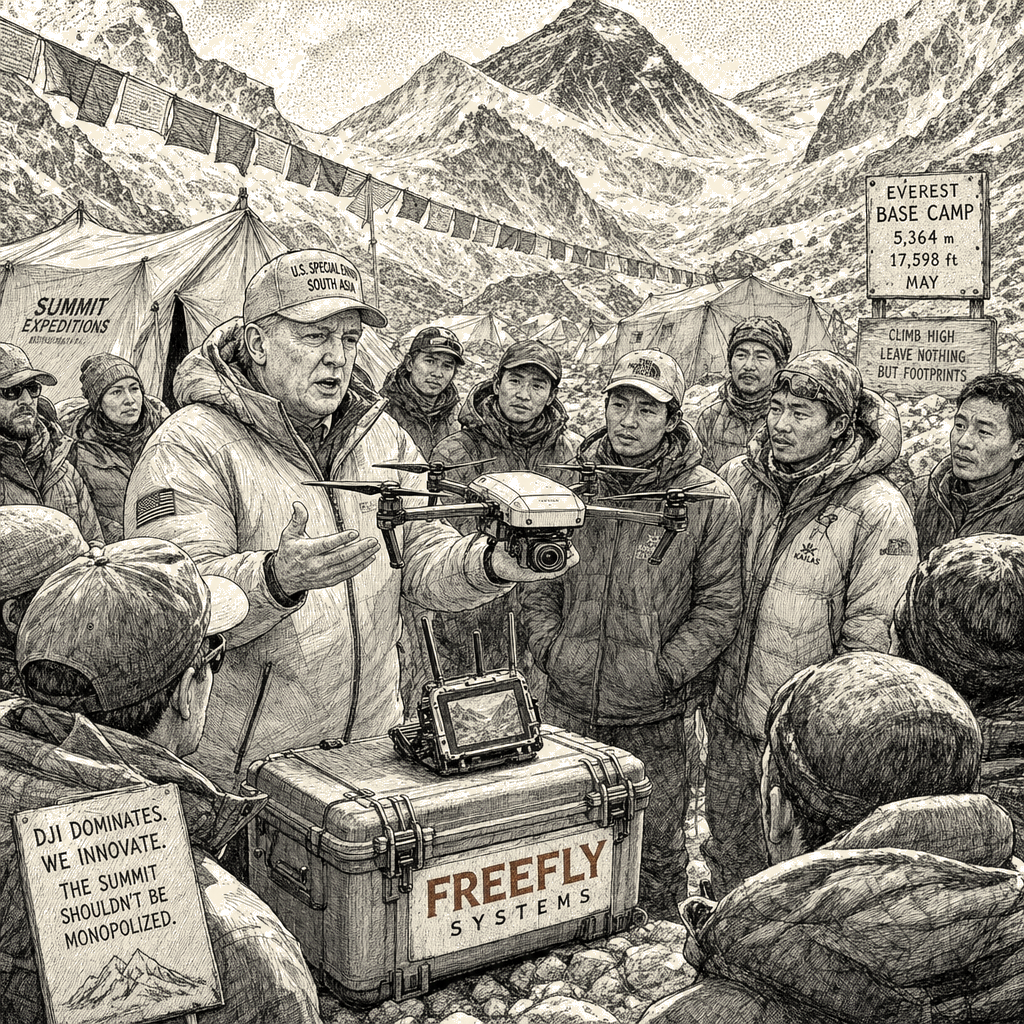
When a story is framed as a superpower showdown, the parties who actually decide the outcome can disappear from view. The Wall Street Journal reported that the U.S. is pushing Freefly Systems’ drone to challenge China’s DJI in the business of delivering supplies to Everest climbers and hauling away trash, setting up what the report described as “an unusual superpower contest in one of the most remote areas of the world.” But the outcome of the 2025 climbing season’s drone contest was not settled by Washington or Beijing. It was settled in a late-April letter from Nepal’s Home Affairs Ministry to local authorities at base camp — and by what happened when that letter reached the expedition operators who depend on drone logistics to run their expeditions.
What happened at base camp
One day in May, Sergio Gor, President Trump’s special envoy for South Asia, appeared at Mount Everest base camp wearing a black jacket emblazoned with “Trump Force One” and called an industrial drone made by Woodinville, Washington-based Freefly Systems “the finest technology in the world—American,” according to The Wall Street Journal. The U.S. Embassy in Nepal said at the time that U.S. commercial drone technology “will enable deliveries on Mount Everest in a few minutes, in contrast to multiple-day treks.” The visit cast the Freefly drone as a direct challenger to China SZ DJI Technology, which the U.S. has designated a Chinese military company and whose FlyCart 100 drone has been delivering supplies and removing waste on Everest since 2024 through the Nepali operator Airlift Technology.
The night before Gor’s scheduled arrival at base camp, Nepal’s Home Affairs Ministry told local authorities it would not grant permission for the American drone’s flight, citing “security sensitivities,” according to an April 30 letter seen by the Journal. In the same letter, the ministry pulled the permit for DJI’s drone that it had granted in March. Binoj Basnyat, a retired Nepali army major general and independent strategic analyst in Kathmandu, said the initial restriction on both drones “could be interpreted as an effort to maintain strategic neutrality.”
Whose pressure broke the freeze
The timing was consequential. A massive overhanging glacial chunk called a serac had blocked the Khumbu Icefall for much of the early climbing season. Icefall doctors had finally opened the route, leaving roughly one month of the season. A record 495 climbers from dozens of countries were waiting to start their ascents.
What followed was not diplomatic negotiation between great powers. It was direct action by the people who needed the drones working. Expedition operators surrounded the government’s field office at base camp. “We will uproot your tent!” some of them said, according to Khim Lal Gautam, the Nepal government officer in charge of monitoring mountaineering activities at base camp.
Five days later, the Home Affairs Ministry reinstated the DJI permit for three months. The Freefly permit was not reinstated. The ministry added conditions requiring drones to maintain a minimum distance from Nepal’s border with China and barring imagery capture outside permitted areas. The outcome is a stakeholder map whose most consequential parties are not the drone manufacturers or their state sponsors but the expedition operators whose concentrated, immediate leverage turned a regulatory freeze into a working season.
Basnyat characterized the reinstatement as revealing “the tension between strategic neutrality and practical necessity.” The phrase captures the structural pattern: Nepal performs a sovereignty display by suspending all foreign drone access, then restores the incumbent under operational pressure, adding conditions that permit it to claim it has tightened control. The Freefly drone, which had not operated on Everest and carried a tested payload roughly one-sixth to one-tenth of DJI’s — a ratio extrapolated from a sea-level test, not measured at altitude — remained grounded.
What each drone can actually do
This spring, the DJI FlyCart 100, which can carry roughly 100 pounds at altitude per company specifications, delivered thousands of pounds of supplies from base camp at approximately 17,500 feet to the next camp at 19,900 feet. DJI reported it hauled away more than 6,000 pounds of refuse generated by climbers — used oxygen cylinders, discarded climbing gear, and human excrement. The drone made it possible to deliver a hot breakfast in minutes to Sherpa climbers setting out in the dark. A DJI survey drone mapped the Khumbu Icefall, a deadly stretch of the ascent, to help veteran Sherpa climbers plan safer routes. That mapping capability is not a logistics function. It is safety-of-life infrastructure with no Freefly counterpart, and it raises the cost of switching away from the incumbent ecosystem — lock-in through demonstrated operational dependency.
Milan Pandey, co-founder of Airlift Technology, told the Journal that his team tested the Freefly drone after it arrived in Nepal and found it could lift 33 pounds at sea level. Based on data from Everest operations, Pandey estimated its payload would likely drop to about a third of that on the mountain. Pandey’s sea-level test and altitude projection put Freefly’s mountain payload at roughly one-sixth to one-tenth of DJI’s — a ratio he extrapolated, not one measured at altitude. Even at the higher end of that range the directional claim holds: the gap is structural. Pandey noted the U.S. drone may have an edge on speed given its lighter weight and said it was suited for rapid emergency response. That framing — a lighter, faster platform that complements rather than replaces the heavy lifter — positions Airlift between the two ecosystems, a broker rather than a battlefield.
Airlift’s structural position is the map’s cross-link. It operates DJI hardware in production and was set to help Freefly conduct a test flight before the suspension. Pandey’s public statement that “the Chinese and U.S. drones could complement each other” is a hedging move — it preserves relationships with both providers while the permit regime determines which can operate. The dependency asymmetry, however, is structural: DJI delivers operational results now; Freefly is prospective.
The game the season forces
A game-theory read of the episode reveals a sequential structure in which the positive-sum cooperation between Nepal and the expedition operators resolves a zero-sum symbolic contest between the U.S. and China in DJI’s favor.
The sequence runs backward from the final stage. With 495 climbers and one month of season remaining, expedition operators facing a permit denial had credible escalation: surround the field office, threaten direct action, force the government officer’s hand. The threat was cheap to carry out relative to the cost of losing the season. At the penultimate stage, knowing operators would force the issue, Nepal’s Home Affairs Ministry chose among reinstating DJI only, Freefly only, or both. Reinstating Freefly alone would destroy the season given the payload disparity. Reinstating both would validate U.S. entry and risk Chinese economic retaliation — Beijing’s investment and involvement in Nepal have grown significantly, though the specific instruments of leverage are not in the public record. Reinstating DJI only, with border-distance and imagery restrictions attached, satisfied operators, preserved the season, and provided the sovereignty fig leaf of new rules. That move was the unique subgame-perfect choice.
At the root stage, the U.S. could not have expected a Freefly demonstration flight to succeed this season, given Nepal’s strategic-neutrality instinct and the operator pressure dynamic. The U.S. payoff from Gor’s appearance was therefore not the flight itself but the publicity event — establishing the frame that the U.S. competes with China on technological credibility in South Asia, and forcing Nepal into the sovereignty gesture of suspending both permits, a signal that neither power can operate unilaterally.
The credibility asymmetry
The U.S. Embassy’s claim that the American drone “will enable deliveries in a few minutes” lands as what the game-theory framework would classify as cheap talk — a statement without a commitment device, made before the drone had been tested on Everest, and never backed by a permit or operational demonstration. Gor’s branding of Freefly as “the finest technology in the world—American” is a political endorsement, not a strategic commitment. The DJI permit reinstatement speaks with a higher-credibility signal: sunk costs in Nepal operations since 2024, thousands of pounds delivered, thousands more in waste removed, and a Khumbu Icefall survey that established a safety dependency.
DJI acknowledged the dynamic in a different frame. In response to questions about the U.S.-China rivalry at Everest, the company said “it’s unfortunate for our innovation-driven industry that country of origin often overshadows the technological breakthroughs solving real-world problems.” The company has previously characterized U.S. suspicions about its drones as unfounded and as a form of protectionism. The U.S. has designated DJI as a Chinese military company. These are the two principals’ public positions. The operational reality is that one drone has a track record on the mountain and the other does not.
Why incumbency wins in a repeating season
The Everest drone contest is not a one-time event. The climbing season recurs annually, and each season Nepal faces the same structural pressures: sovereignty signaling to manage the China relationship, operator demand to preserve the climbing economy, and the practical question of which technology can move supplies and waste at 17,500 feet. In a one-shot game, Nepal might hold a suspension longer to extract concessions from both sides. In the repeated game, Nepal cannot afford to lose a season of drone service — that would damage its credibility as a facilitator of expeditions that bring revenue to the country.
The speed of DJI’s reinstatement — five days — reflects this repeated-game discipline. Nepal’s permit pattern across seasons builds a track record for the incumbent that disadvantages late entrants. DJI has operational data, a local partner in Airlift Technology, and a mapping capability on the Khumbu Icefall that no competitor has replicated. Freefly has a diplomatic endorsement and a sea-level test. The gap is not merely technical. It is structural: each season of DJI operations raises the switching cost for the next one.
Pandey has suggested a path through the impasse. He said he believes the Freefly drone could have an edge on speed given its lighter weight, and noted its suitability for rapid emergency response. If Freefly were to demonstrate one high-profile rescue that DJI’s heavier platform could not perform quickly enough, the payload disadvantage could reframe as a specialization signal — lightweight speed versus heavy-lift capacity — if Freefly executes a high-profile rescue the heavier DJI platform could not match. That demonstration has not occurred. It remains contingent, not recorded.
The Cold War parallel and its limits
The Journal reported that the U.S. government’s push for a foothold for American drone technology on Everest “recalls the history of geopolitical jostling in the Himalayan region during the Cold War,” noting that in the 1960s Nepal’s Mustang region served as a base for CIA-backed Tibetan rebels fighting against China. The analogy carries the right geography and the same principals — U.S. and China competing for influence on Nepali soil — but differs in the mechanism of resolution. In the Cold War episode, external powers exercised direct influence through covert operations. In the drone contest, the decisive intervention came from a domestic constituency with a commercial stake and a shrinking season window, not from Langley or Beijing.
The Mustang precedent does, however, supply a structural memory that helps explain Nepal’s institutional behavior. A Home Affairs Ministry that suspends both parties’ drones — including the incumbent’s — when a U.S. envoy visits base camp is acting on historically informed caution: overt alignment with the U.S. has previously risked Chinese retaliation. That caution produced the “security sensitivities” delay; the expedition operators’ pressure at the field office terminated it.
What the frame leaves out
The superpower-rivalry frame centers two state-backed drone programs and Nepal as the contested ground. A stakeholder map that extends beyond that frame identifies parties whose stakes are structurally absent from the reporting.
The most consequential absence is the porter economy. The Journal’s reporting notes that the U.S. Embassy positioned the Freefly drone as a replacement for “multiple-day treks” to move supplies. The labor those treks represent — Sherpa porters carrying loads between base camp and higher camps — is being substituted by drone delivery, but the article does not identify the workers whose income is being displaced or ask what happens to them as drone logistics scale. The porter economy’s absence from the bargaining table reinforces the operator-driven equilibrium: no counter-coalition emerges to slow drone adoption, so the displacement proceeds without countervailing pressure.
Local Khumbu communities that bear the physical consequences of drone traffic, noise, and potential accidents are unrepresented in the discourse. Environmental and conservation organizations that would have a stake in robust waste-management impact assessment on a mountain that produced 6,000-plus pounds of refuse this season alone are absent from the reporting. The permit process itself does not appear to involve civilian participation or public transparency. Other drone manufacturers — Skydio, Parrot, others — are excluded by a frame that casts the contest exclusively as Freefly versus DJI, with no room for a technology-merit comparison that includes additional players.
What happens next
The equilibrium is stable as long as three conditions hold: Nepal is not forced to choose exclusively between the U.S. and China; the expedition economy’s revenue weight exceeds the incremental geopolitical cost of allowing DJI operations; and neither principal makes the contest an existential demand for exclusive access.
Four developments would shift it. If Freefly demonstrates a capability the heavier DJI platform cannot perform — Pandey’s emergency-response scenario, a high-profile rescue executed faster than DJI could manage — the payload disadvantage could reframe as a specialization signal: lightweight speed versus heavy-lift capacity, if Freefly executes a high-profile rescue the heavier DJI platform could not match. If the U.S. converts its cheap talk into a commitment device — publishing altitude-deployment data from an independent Freefly performance test, even at a lower-altitude Nepali site that satisfies the Home Affairs Ministry’s security sensitivities — it replaces political endorsement with a verifiable record. If China escalates to demanding DJI-only permits, the equilibrium destabilizes into a zero-sum contest that Nepal’s economic dependency on Beijing — whose specific instruments (aid packages, infrastructure commitments, border-cooperation terms) are not in the public record — would likely shape. If Nepal formalizes parallel-permitting rules ahead of next season — written payload limits, operational zones, and the border-distance rule as standing policy rather than emergency condition — it reduces the diplomatic friction of each principal’s lobby while preserving the sovereignty signal.
The permanent structure behind the seasonal drama is a pattern: the incumbent with sunk operational costs and a safety dependency holds the leverage; the challenger without a demonstrated altitude record plays the publicity game; Nepal calibrates; and the operators force the issue when the climbing window begins to close.
Analytical techniques used in this piece
This analysis applies the methods below. Each links to a short, plain-English explainer you can read and reuse.
- Relationship Mapping
- Extracts the network of ties among people, institutions, and entities.
- Stakeholder Mapping
- Charts the parties to a situation — their interests, power, and alignments.
- Strategic Interaction (Game Theory)
- Models a situation as a game — players, moves, payoffs, and likely equilibria.