Nepal reinstates DJI after briefly suspending both drone operations
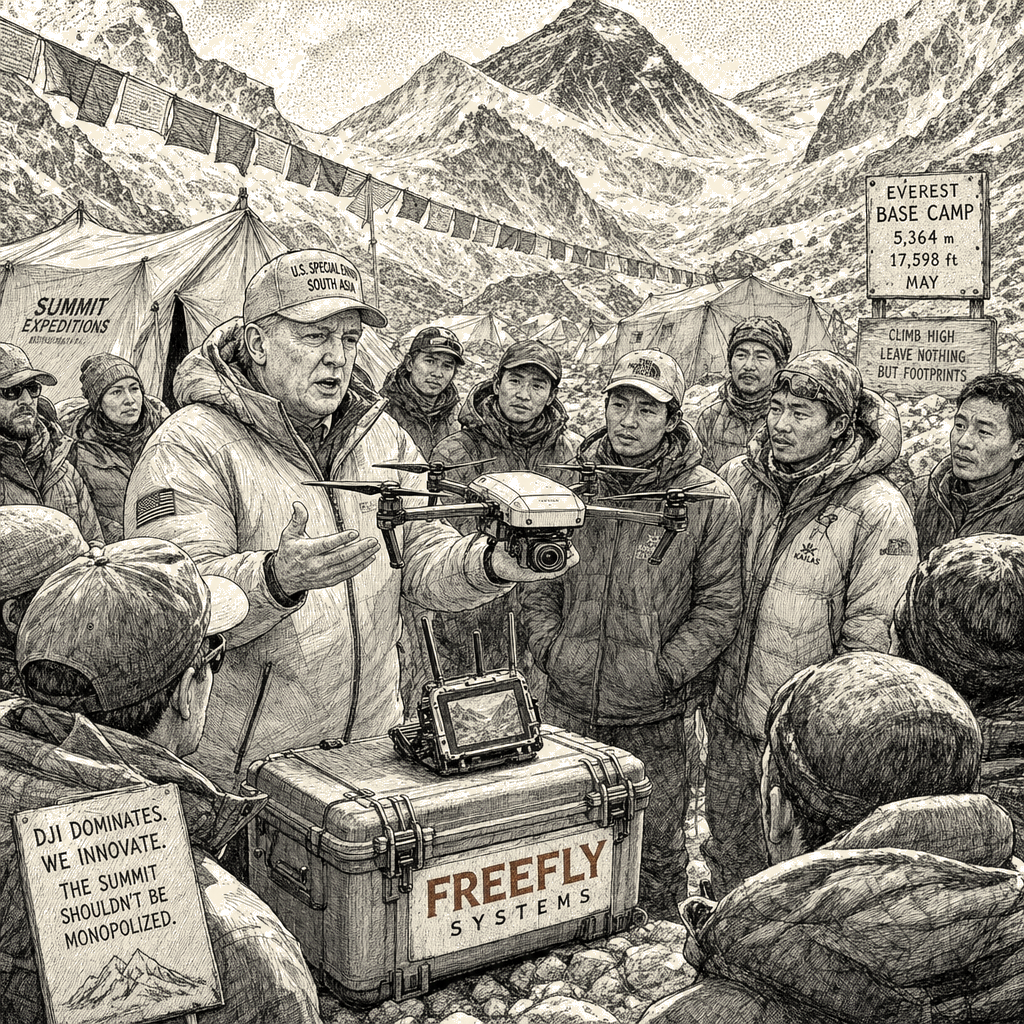
One day in May, Sergio Gor, President Trump’s special envoy for South Asia, appeared at Mount Everest base camp. Dressed in a black jacket emblazoned with “Trump Force One,” Gor praised an industrial drone made by Freefly Systems, a Woodinville, Wash.-based designer and manufacturer of heavy-lift drones. “The finest technology in the world—American,” Gor said, according to The Wall Street Journal.
The U.S. is pushing the Freefly drone to challenge China’s SZ DJI Technology in the business of using drones to deliver supplies to climbers and carry away trash, setting up an unusual superpower contest in one of the most remote areas of the world, the Journal reported. Mount Everest straddles the border between Nepal and China. Beijing’s investment and involvement in Nepal have grown significantly in recent years. The U.S. has designated DJI as a Chinese military company.
Since 2024, Nepali drone operator Airlift Technology has been working with DJI. This spring, the DJI FlyCart 100, which can carry roughly 100 pounds at altitude, delivered thousands of pounds of supplies from base camp at about 17,500 feet to the next camp at 19,900 feet, according to company specifications. DJI said it hauled away more than 6,000 pounds of refuse generated by climbers, including used oxygen cylinders, discarded climbing gear and human excrement. The drone made it possible to deliver a hot breakfast in minutes to Sherpa climbers setting out in the dark. A DJI survey drone mapped the Khumbu Icefall, a deadly stretch of the ascent, to help veteran Sherpa climbers plan safer routes, the Journal reported.
In the run-up to Gor’s visit, Airlift was set to help Freefly carry out a test flight up the mountain, said Airlift co-founder Milan Pandey. The American Embassy in Nepal said at the time that U.S. commercial drone technology “will enable deliveries on Mount Everest in a few minutes, in contrast to multiple-day treks.”
However, the night before Gor’s scheduled arrival at base camp, Nepal’s Home Affairs Ministry told local authorities it would not grant permission for the flight of the American drone, according to an April 30 letter seen by the Journal. The ministry said it needed to “consult with other stakeholder agencies regarding security sensitivities.” In the same letter, the ministry pulled the permit for the DJI drone that it had granted in March.
The suspension came during a critical period. Icefall doctors had finally opened the Khumbu Icefall section after a massive overhanging glacial chunk, called a serac, blocked the path for much of the early season. With only a month of the climbing season remaining and a record 495 climbers from dozens of countries waiting to start their ascents, anxious expedition operators surrounded the government’s field office at base camp, asking it to resume drone supply flights. “We will uproot your tent!” some of them said, according to Khim Lal Gautam, a Nepal government officer in charge of monitoring mountaineering activities at the base camp.
Five days later, the Home Ministry gave the go-ahead for the DJI drone to again operate on Everest for three months. The ministry reiterated rules requiring drones to maintain a minimum distance from the country’s border with China and said the drone should not capture imagery outside its permitted area of operation.
Binoj Basnyat, a retired Nepali army major general and independent strategic analyst based in Kathmandu, said the initial restriction on both drones “could be interpreted as an effort to maintain strategic neutrality,” while the reinstatement of the DJI drone showed “the tension between strategic neutrality and practical necessity.”
Pandey said he believes the Chinese and U.S. drones could complement each other. His team tested the Freefly drone after it arrived in Nepal and found it could lift 33 pounds at sea level. Based on data from Everest operations, its payload would likely drop to about a third of that on the mountain, a fraction of the Chinese drone’s capability. He said the U.S. drone may have an edge on speed given its lighter weight, and noted its suitability for rapid emergency response.
The U.S. government’s push for a foothold for American drone technology on Everest recalls the history of geopolitical jostling in the Himalayan region during the Cold War, the Journal reported. In the 1960s, Nepal’s Mustang region was a base for CIA-backed Tibetan rebels fighting against China.
The U.S. Embassy in New Delhi declined to comment. Freefly described its device as “the world’s toughest drone” but did not address specific questions about its potential use on Everest. DJI said in response to a query about the U.S.-China rivalry at Everest that “it’s unfortunate for our innovation-driven industry that country of origin often overshadows the technological breakthroughs solving real-world problems.” The company has previously said U.S. suspicions about its drones are unfounded and are a form of protectionism.