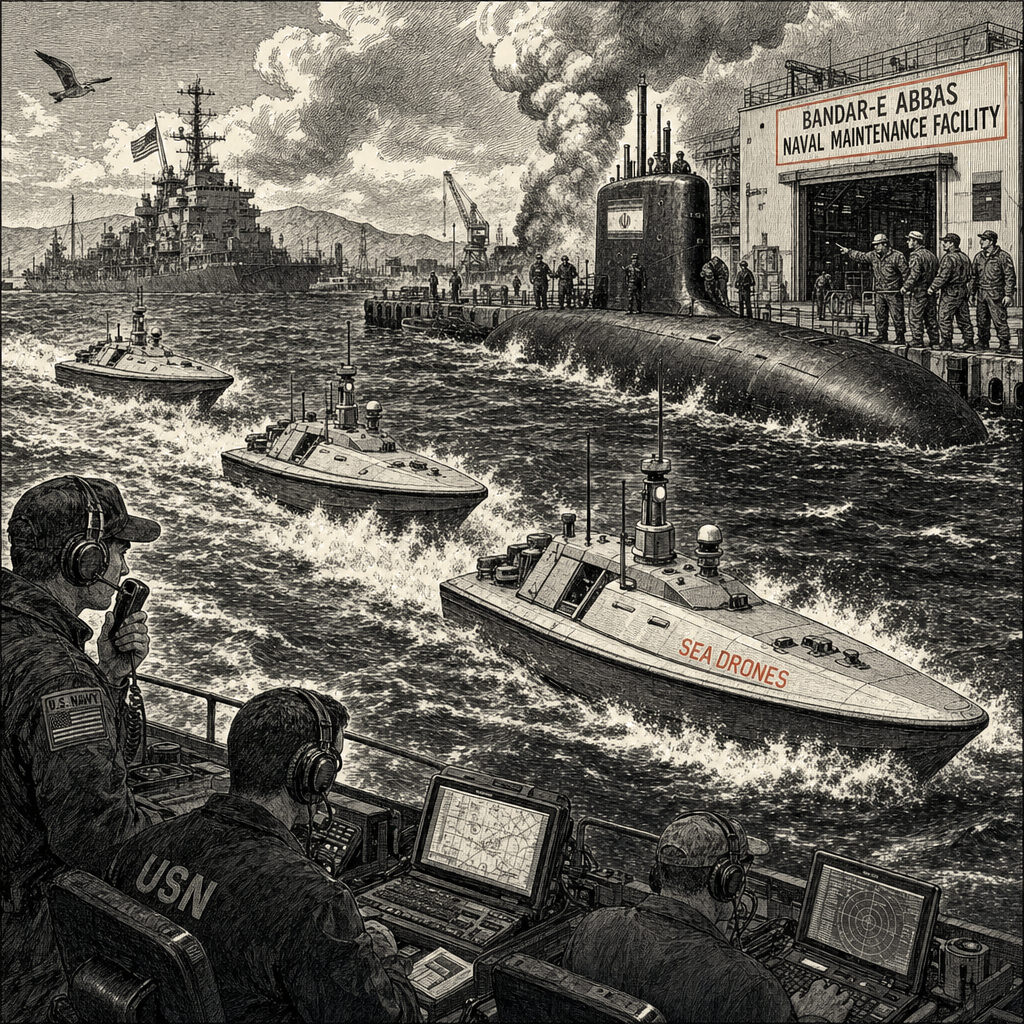
Saronic Corsairs cost under $1 million each, carry 1,000-pound payloads
Three Saronic Corsair unmanned surface vessels entered Bandar Abbas and struck a submarine and ship maintenance facility at the Iranian naval base on Sunday, according to U.S. Central Command. The 24-foot Corsairs cost less than $1 million apiece, can travel more than 1,000 miles, and can carry up to 1,000 pounds, according to the company and U.S. officials.
A Corsair was used in June to rescue two crew members of an Apache helicopter that had been downed off the coast of Oman by Iranian fire, as MSI previously reported. Sunday’s attack marked the first time the U.S. military had used sea drones in combat operations, CENTCOM said.
The drone boat assault was part of a broader wave of U.S. attacks on Iranian targets Sunday as fighting has intensified in and around the Strait of Hormuz after the collapse of peace negotiations, a senior U.S. official told The Wall Street Journal.
The vessels were built in Texas by Saronic, a defense-tech firm co-founded by former Navy SEAL Dino Mavrookas along with Rob Lehman, Vibhav Altekar and Doug Lambert. Established defense companies including BAE Systems and Naval Group, and startups from Anduril to Kraken Technology, are racing to develop unmanned vessels with greater range and explosive power, according to the Wall Street Journal.
“We are proud that our technology supported this mission and helped degrade threats to commercial shipping,” Saronic said in a statement.
The Corsairs deployed in Sunday’s attack arrived in the Middle East in late March, after the war started, a U.S. official told the Wall Street Journal. The vessels are designed to carry out a range of missions, according to a company spokesperson.
Adm. Brad Cooper, the CENTCOM commander who in 2021 established an artificial intelligence and drone task force in the Middle East, has stated his intent to accelerate the fielding of new technologies with the regional force, according to CENTCOM.
“The U.S. military’s first combat use of one-way attack sea drones is another example of how wartime drives rapid adoption of new capabilities,” said Cynthia Cook, a naval drones expert at the Center for Strategic and International Studies.
Ukraine began using unmanned vessels against Russian naval targets in 2022, including an attack on a Russian naval base, and deployed “Sea Baby” maritime drones against a bridge connecting Russia to occupied Crimea the following summer. Ukraine’s security service said last year it had “effectively disabled” a Russian submarine with an underwater drone, described as a first in warfare.
According to the Wall Street Journal, unmanned vessels have limitations: their small size affects range, they are vulnerable to having communications cut off by electronic warfare, and communicating with underwater drones is particularly difficult. Navies have begun adapting — Russia has moved ships farther from the combat zone, and the United Kingdom has said it would build vessels designed to act as mother ships for drones rather than replace its fleet of destroyers.
Saronic was established in 2022 and said earlier this year it had raised $1.75 billion at a $9.25 billion valuation, with backing from investors including Joe Lonsdale’s 8VC, Caffeinated Capital and Andreessen Horowitz. Mavrookas said in a podcast interview last year that Saronic set out to develop autonomous vessels with the goal of growing U.S. shipbuilding capacity and to “redefine maritime superiority” using autonomy.