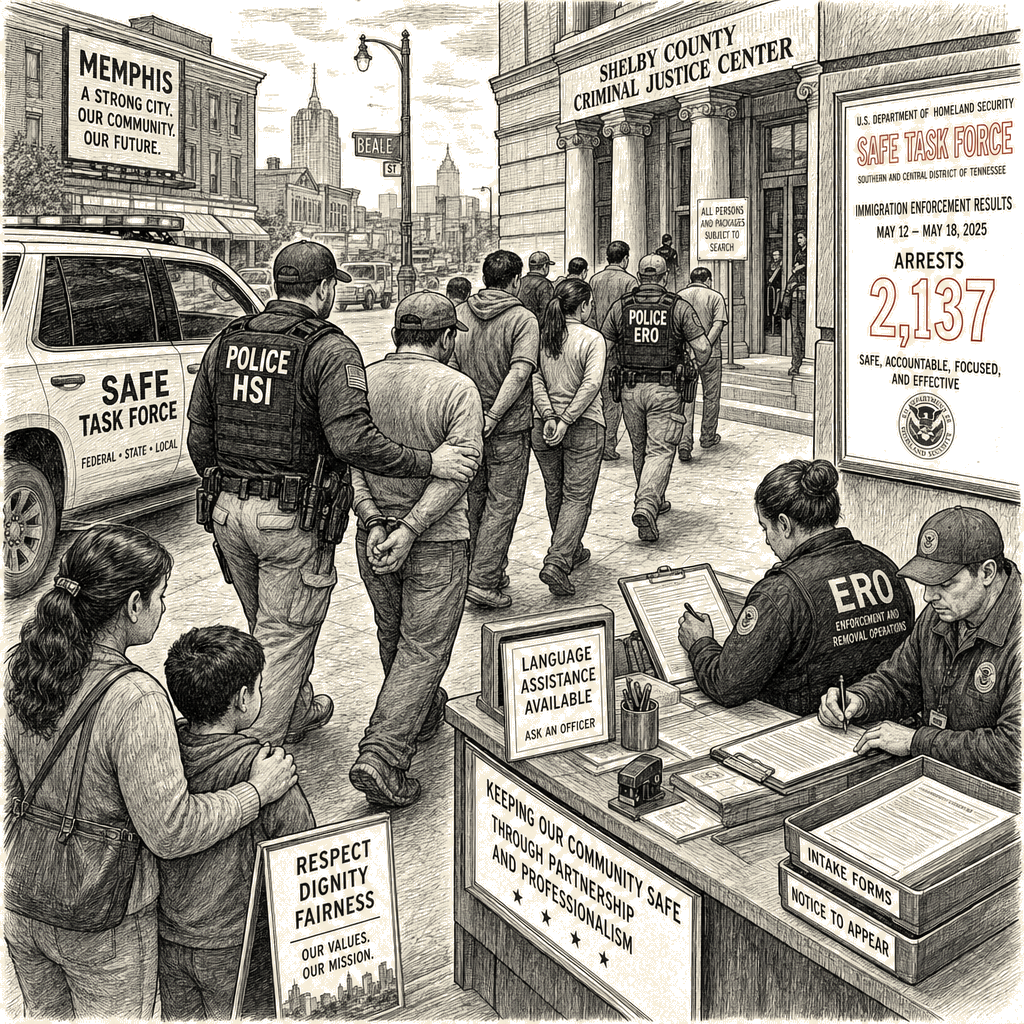
A federal anti-crime task force deployed to Memphis at the moment crime was at a 25-year low did what the combination of its design, its architects, and its political cover made almost inevitable: it became an immigration crackdown. The crime justification was never the operation’s primary function — it was the legal and rhetorical frame that allowed federal immigration enforcement to operate in a non-border state with state-level political cover and minimal local resistance.
The numbers are the cleanest evidence. In the first months of the Memphis Safe Task Force, launched in October 2025 by President Trump alongside Tennessee Governor Bill Lee, immigration arrests increased sixfold over the previous months’ baseline. More than a dozen federal agencies and hundreds of Tennessee National Guard members were deployed against a city whose overall crime had already dropped to a 25-year low, a decline predating the task force by years. The Institute for Public Service Reporting’s analysis of federal immigration data found that 91 percent of immigrants apprehended in street arrests during the task force’s first 17 days had no criminal record. Sixfold is not incidental. It is the signature of a mission whose actual object is different from its announced one.
The piece of this architecture that made Memphis different from Minneapolis — where similar federal immigration raids generated far more national attention — was state-level cooperation. Governor Lee sat alongside Trump, Defense Secretary Pete Hegseth, and Stephen Miller at a March 2026 roundtable in Memphis, where Trump declared the task force a success and said crime had been “fixed.” Lee thanked Miller directly for his focus on the operation. Then he discussed only crime reduction, without mentioning immigration enforcement. The split is the story: high interest in claiming crime credit, zero interest in being associated with the immigration dimension. The silence is not a gap in the record; it is the operative political choice, and it supplied the cover under which federal agencies could operate without the accountability that other cities have demanded.
Memphis Mayor Paul Young, a Democrat, was not invited to that roundtable. At a separate press conference he said he was not “supportive” of the high number of immigration arrests but could not control it because federal and state officials were in agreement. “My goal is to make sure that I can control what I can control. And there’s no mayor in America that can control the immigration aspects of this.”
The enforcement mechanism was straightforward: Memphis Police Department traffic stops concentrated in the city’s two main Hispanic neighborhoods, with ICE agents following and arresting. Hunter Demster, a Memphis resident who films task force activity, said the stops were “very evident” as an immigration operation. “This isn’t necessarily about finding the worst of the worst or fixing crime. It’s about targeting Black and brown folk.” Chioma Chukwu of American Oversight stated the position plainly: “This administration has used crime as a pretext for furthering and advancing its immigration enforcement agenda.” Casey Bryant of Advocates for Immigrant Rights in Memphis described the architecture as “really going to be about the federal agencies that were riding the coattails of the National Guard.”
The case that exemplifies the pattern is Yasser Jose Lopez Soza, an 18-year-old junior at Memphis Business Academy, arrested in February as a passenger in a car on his way to a soccer game. A Memphis police traffic stop; immigration agents following; 63 days at the West Tennessee Detention Facility. A U.S. district court judge found his arrest and detention violated due process and ordered his release. His classmates staged a walkout. The ruling is a single judicial check against a pattern of hundreds — the judiciary can intervene for the individual whose case reaches court, but the task force’s operational pace exceeds the speed of case-by-case adjudication, and the enforcement architecture that produced Lopez’s detention is unchanged by his release.
The community impact that does not appear in any arrest statistic was the fear. Mauricio Calvo, president and CEO of Latino Memphis, said children stopped attending school, people stopped going to work, medical providers reported patients missing appointments. “There was a spike of fear and panic.” The immigrant community is roughly 10 percent of Memphis’s population — mostly Hispanic and Haitian, the fastest-growing demographic segment — and the enforcement was concentrated in the parts of the city where they live and move. Maria Oceja, co-founder of the local rapid-response network Vecindarios 901, said the warning signs were visible before the operation launched. On the first night, the hotline received so many calls that four people had to answer simultaneously — a pace sustained for months.
The institutions that would normally provide a check on enforcement of this scale are silent in the record. No congressional delegation, committee, or member is quoted on whether the multi-agency framework implicates federal appropriations or oversight authority. The Memphis City Council is not quoted on whether local police cooperation with ICE was authorized or debated. Medical providers report patients missing appointments but no hospital system, clinic, or public-health official is on the record. Haitian-led organizations are absent despite Haitian residents forming a major component of the immigrant community. No employer, business association, or economic-development entity has spoken on the workforce disruption. The transparency that would document the operation has been reduced by the city’s own decision to remove immigration arrest numbers from a public dashboard that initially published them.
The party that caused this harm cannot be the party that heals it, and no neutral institution occupies that space. Community organizations have stepped into the gap: Vecindarios 901’s hotline, Latino Memphis’s community voice, Advocates for Immigrant Rights in Memphis’s legal and policy work, Amber Hampton’s makeshift food pantry delivering groceries to families who still limit their time outside. But the healer role — addressing the psychological and social damage that Calvo documented — is unfilled by any formal institution, and the power structure that generates the need remains unchanged. The provider and witness functions are active; the healer and bridge-builder functions are absent. That is not oversight. It is the shape of a conflict in which the stronger party sets the terms and the third side operates in the space it leaves.
The escalation signals accumulated through 2026 all point in the same direction. Stephen Miller told officers during the rollout: “You are unleashed.” Trump declared crime “fixed” in March. White House spokesperson Abigail Jackson touted “tremendous results” without offering evidence. Emily Williams of the U.S. Marshals Service, which leads the task force, said: “Our primary focus is violent offenders. We arrest anyone who is breaking the law — if you are in the country illegally, you are committing a crime.” The city removed its immigration arrest data. Ronnie Davis, a barber in the Frayser neighborhood who initially felt safer with the added law enforcement presence, revised his view after learning about cases like Lopez’s. “They are only touting the good things,” he said. “But had I been Hispanic, I’d be terrified. If I was Haitian, I’d be terrified.”
The task force has no end date. National Guard troops remain in grocery store parking lots. Unmarked SUVs with tinted windows patrol thoroughfares. Mutual aid groups report sustained demand for food and other assistance. The trajectory points toward containment, not resolution — because the alignment that enabled this operation is structural, not contingent. Lee’s political cover holds. Young cannot change it. The federal judiciary can rule case by case, but one due-process finding does not alter the architecture. The immigration enforcement apparatus, the White House coalition, the Marshals Service, and the Memphis Police Department all have high power and high interest in the operation continuing. The community has legitimacy and urgency but no power.
That is not a dispute between equivalent parties. It is the exercise of federal enforcement authority under a crime-fighting cover, and the evidence for the cover is in the numbers no one on the enforcement side is arguing with.
Analytical techniques used in this piece
This analysis applies the methods below. Each links to a short, plain-English explainer you can read and reuse.
- Stakeholder Mapping
- Charts the parties to a situation — their interests, power, and alignments.
- The Third Side
- Takes the vantage of the surrounding community that has a stake in resolving a conflict (Ury).
- Worldview Cartography
- Maps the clashing worldviews underlying a dispute.