Analysis — public-source, mode-integrated. Facts not in dispute are unhedged; framing findings are claims about the text, not about authorial intent. No claim is made about any party’s motives.
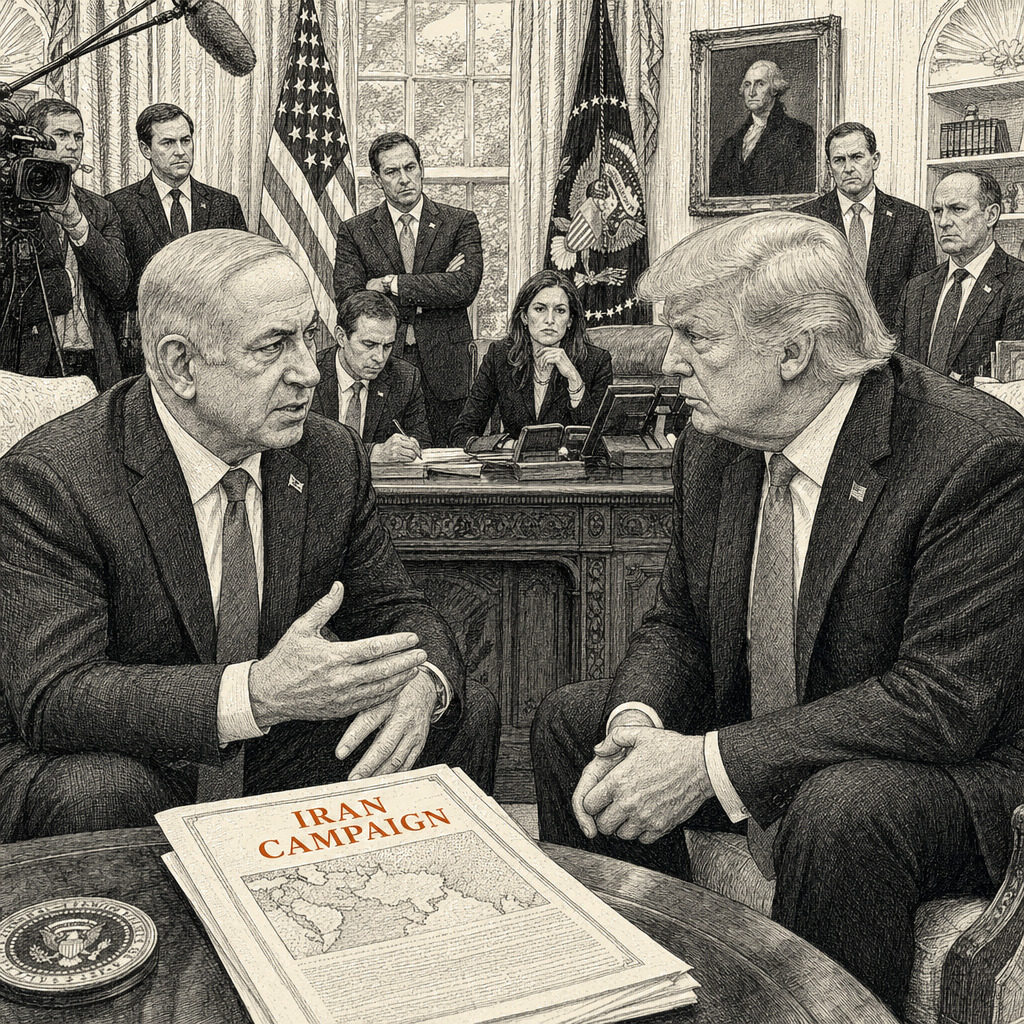
The White House described the July 28 meeting between Benjamin Netanyahu and Donald Trump as a first face-to-face encounter since the two countries launched a joint military campaign against Iran in February. That framing serves both leaders. It hides what a relationship map of the actors around the meeting reveals: Trump holds decision authority on the Iran file, Netanyahu arrives bearing intelligence to share rather than terms to set, and the formal agenda covers domains where Israel retains control while the war’s strategic direction rests with the U.S. president. Independent adversarial risk assessment for this meeting was not completed; the red-team evaluation of the bilateral dynamics did not pass final review, leaving threat scenarios potentially unexamined.
Netanyahu’s own words on Fox News confirm the dependency he cannot afford to name publicly. “Because I think, in many ways, it’s his decision” on how to move forward with Iran, Netanyahu told Maria Bartiromo. “If he can do so without returning to intense military fighting, that’s fine. Why not?” He added: “But one way or the other, they have to end their nuclear program.” The posture is that of a leader bringing raw material to the man who makes the final call. Trump acknowledged the gap when asked about the two leaders being on the same page: “We have a little difference. But pretty close, yeah.” The difference went unspecified. The distance between “pretty close” and “one way or the other” is the space in which the bilateral’s outcome will be negotiated, and a relationship map of the meeting places Trump at its center — the bottleneck for every decision on Iran, the single point of failure for the entire regional architecture. Every decision routes through him. Netanyahu cannot bypass him. If their alignment breaks, all the spokes lose their foundation.
Yet Netanyahu retains tactical initiative in the peripheral theaters, and his control of those levers provides a form of negative leverage. A collapse in Lebanon or Gaza on Trump’s watch would undermine any claim of victory, tying the U.S. president to Israeli stability even as he holds the decision on Iran. In southern Lebanon, where Israeli forces occupy much of the territory, Israel agreed to allow the Lebanese army to deploy to some villages as part of a pilot program testing their ability to secure areas once controlled by Hezbollah. The U.S. State Department said the next round of talks will take place next week in Rome with a focus on expanding the program. On Gaza, Israel’s security cabinet approved a measure granting entry to the first members of an international stabilization force outlined in a U.S.-backed ceasefire deal between Israel and Hamas. Few countries have pledged troops. The forces, including from Morocco and Uganda, would be allowed to operate only in a small area in Rafah, where the plan is to vet and house some displaced Palestinians. These are parallel elements of a regional architecture the U.S. is building, bridging otherwise separate theaters under one strategic umbrella. Their inclusion provides Netanyahu with domestic deliverables while the Iran decision rests with Trump.
A stakeholder analysis of the actors in and around the bilateral identifies a defining asymmetry. The most powerful parties — Trump, Netanyahu, Iran’s leadership, the IDF, Congress — hold divergent and partly incompatible interests. The most affected parties — Gaza civilians, Iranian civilians, Southern Lebanese residents, the American public — hold the least power to shape outcomes. Iranian civilians, at least 657 killed and 2,037 wounded by June in the campaign that began in February according to HRANA estimates, are not mentioned in the source reporting. Southern Lebanese civilians, whose villages are occupied by Israeli forces and whose return is framed as a matter for pilot programs and Rome talks rather than rights, have no seat at the table. The global shipping economy dependent on Strait of Hormuz passage — Iran disrupted shipping after the February campaign — is a structural stakeholder with diffuse interests that no party at the White House represents.
The Strait of Hormuz disruption is not a background condition. It is a ticking pricing mechanism. Every week the strait is contested, global energy prices rise, exerting pressure on the American midterm electorate. By not addressing shipping directly, the White House meeting deferred a pressure point that will independently force its way onto the agenda.
On the U.S. side, an AP-NORC poll published earlier this month found a dramatic erosion of support among American adults for Israel. The country has lost significant bipartisan support, particularly over its conduct in Gaza. The same poll found approximately 3 in 10 American adults believe Israel has committed genocide against Palestinians. Trump faces pressure to end the conflict as November midterm elections approach. The vice president, JD Vance, attended the meeting. In June, Vance warned Israeli officials that Trump was their only friend among world leaders. Vance’s message and the AP-NORC data are not separate data points. They bridge bilateral diplomacy to domestic U.S. politics: as the broader American public moves away from Israel, Netanyahu’s dependency on Trump tightens, making Trump’s friendship both more critical and more politically fragile.
On the Israeli side, Netanyahu is up for reelection. His coalition includes hardliners who reject compromise. Israeli political commentators have publicly named the asymmetry the meeting’s agenda is designed to manage. Amit Segal, writing in Israel Hayom, said: “The Americans are making it clear to the Israelis they are the ones who are running the war. It is clear to everyone that Israel has been put in the back seat.” Ben Caspit of Maariv wrote: “We’ve lost America. Thank you, Bibi.” The meeting’s stated agenda does not contradict those characterizations. It supplies the face-management material that makes them politically survivable.
It is a trap. Netanyahu cannot afford to appear as a supplicant at home, yet the meeting’s entire structure — the intelligence he carries, the phrasing “it’s his decision” he offered on Fox — casts him precisely as one. The meeting cannot solve this contradiction; it can only paper over its surface. The formal agenda items — the Lebanon framework agreement, Abraham Accords expansion — foreground areas where Israel retains tactical initiative and the U.S. needs Israeli cooperation. They provide Netanyahu with deliverables for his domestic audience while Trump considers the strategic direction of the war.
There is a dangerous additional asymmetry. Military and political timelines diverge. CENTCOM and IDF operational preferences — force protection, destruction of Iranian military capabilities — may not align with the de-escalation pressure Trump faces domestically. The joint campaign’s coordination requirements place additional strain on an already-stressed alliance. When Trump’s electoral clock and Netanyahu’s nuclear red line do not converge, the military chain of command becomes the institution that absorbs the tension.
The Lebanon framework and the Gaza stabilization force also create a fork. If the pilot program and stabilization force proceed smoothly, Trump gains diplomatic cover to de-escalate on Iran without appearing to abandon Israel. If they stall, Netanyahu’s domestic pressure to escalate in peripheral theaters could bring him into direct conflict with Trump’s midterm timeline. Cover is not resolution. The question is which party’s timeline breaks first: Trump’s midterm deadline, Netanyahu’s reelection, or Iran’s willingness to absorb continued strikes while preserving its nuclear infrastructure.
Which absent stakeholder reasserts itself first? Gulf states seeking independent security arrangements may test the meeting’s output by pursuing parallel talks with Iran. European allies, excluded from the framework, could push a separate diplomatic track at the UN. The shipping economy dependent on Hormuz passage has no seat at the White House but will impose itself through insurance markets and fuel prices. Each of these pressures sharpens the same core question: who decides when the war ends, and on what terms?
Analytical techniques used in this piece
This analysis applies the methods below. Each links to a short, plain-English explainer you can read and reuse.
- Red-Team Assessment
- Models a capable adversary probing a plan for the seams they would exploit.
- Relationship Mapping
- Extracts the network of ties among people, institutions, and entities.
- Stakeholder Mapping
- Charts the parties to a situation — their interests, power, and alignments.