Summary
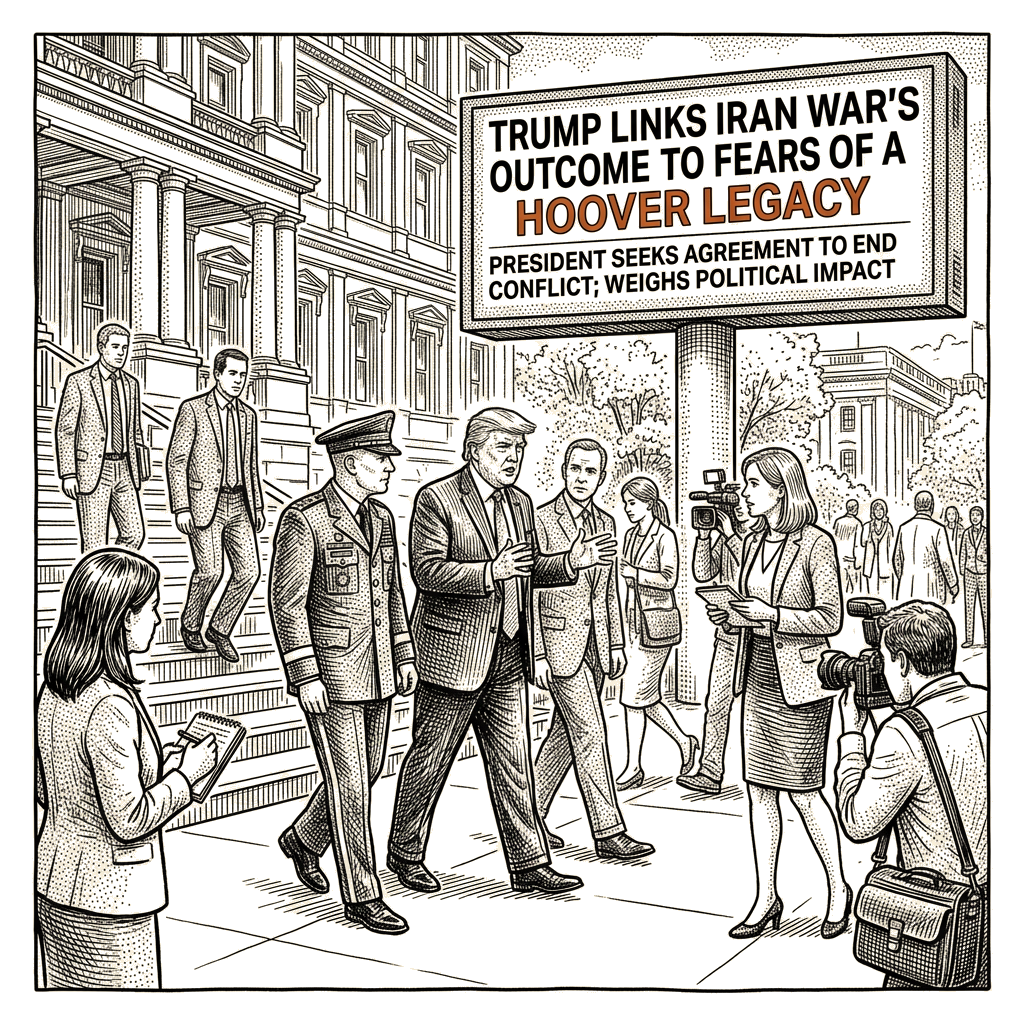
- President Donald Trump’s stated aversion to a Herbert Hoover-style legacy is operating as a public frame on his push to end the Iran war, with presidential historian Tevi Troy attributing the force of that frame to Trump’s upbringing during the period when Hoover was codified as a cautionary figure.
- Republican presidencies facing economic downturns (Ronald Reagan in 1981–82, George W. Bush in 2008, and Trump’s in 2026) absorb the Hoover comparison, with Democratic counterparts facing comparable conditions not having acquired the label — a pattern indicating that the frame functions as a partisan-coded reference rather than a neutral cautionary tale.
- The Iran war operates as a transmission belt linking foreign conflict to domestic political reputation by feeding gas prices and inflation that have persisted for five years, with KPMG chief economist Diane Swonk stating that recession risks are now “higher than before the war” but conditioned on the Federal Reserve’s posture.
- The end-state question is whether Trump ends the war on terms that preempt the Hoover label before economic conditions force the comparison from “dread” to “alignment.”
Lede
In a war, the cost-of-living channel can reach a president’s legacy as surely as the battlefield outcomes can. The Iran war has now entered that channel: it has run longer than predicted, and its gas-price and inflation effects have become the input that feeds a frame Trump has named in public remarks — the Herbert Hoover comparison. How that frame lands, and whether the war is ended on terms that preempt it, will shape the political inheritance Trump has said he wants to leave behind.
The Hoover frame as Republican legacy anxiety
Trump’s aversion to a Hoover-style legacy has surfaced in remarks at the June 2026 G7 summit in France and in behind-the-scenes efforts to end the Iran war, per NPR’s Franco Ordoñez (August 9, 2026). At the G7, Trump said: “I’ve studied presidents, some good, some bad, some great. Not too many are great and some really bad. We had one just recently. The one president I did not want to be was the late, great Herbert Hoover. I didn’t want that and who knows what would have happened. But bad things happen.” The closing “bad things happen” registers as a warning — a leader who fails to act risks the catastrophic legacy Hoover now carries.
Tevi Troy, a presidential historian and former White House aide to George W. Bush, attributed the frame’s force to Trump’s generational exposure. “Trump often reveals what he’s thinking with these comments he makes,” Troy said. “They sound like asides, but I think they’re indicative of his upbringing. He grew up in a period where Herbert Hoover was a very negative thing to be.” Trump was born in 1946, when the Hoover failure frame was already solidifying in American political memory.
The frame is anchored in policy substance, not personality: Hoover’s administration held that government should not interfere in the economy during the 1929–1933 collapse, a position that “many viewed as a major political mistake of the 20th century,” per NPR.
The Iran war as a transmission belt
The Iran war has lasted longer than predicted. Its effects on inflation, gas prices, and voter exposure have become the input that reactivates the Hoover frame. KPMG chief economist Diane Swonk told NPR that recession risks are now “higher than before the war” but “not off the charts,” and that those risks could rise further if inflation persists and the Federal Reserve leaves it unaddressed. Swonk noted that inflation has persisted for five years.
Swonk drew a limit on the comparison. “It’s hard to get back to a Hoover-type situation where there are all these Hoovervilles. There were so many policy mistakes made back then that caused that situation and how it played out.” The current economy, in her reading, is “different from the one Hoover faced” because “policymakers now have better tools to prevent a similar catastrophe.”
The war therefore operates as a transmission belt between two otherwise separate domains: the foreign policy it grew out of, and the domestic political reputation Trump has named as a concern. The article’s central cross-link is the framing of the war as “another way for the conflict to shape his presidency,” alongside economic performance generally.
A historical pattern, asymmetrically partisan
The Hoover comparison is not isolated to Trump. A pattern across three Republican presidencies — Reagan in 1981–82, Bush in 2008, and Trump’s in 2026 — shows the label reactivating under economic stress. “Any Republican president who gets hit with bad economic times faces the danger of being tagged as Herbert Hoover,” Troy said. “It’s constantly something that happens to Republican presidents.”
The 2008 precedent is the closest analogue in source material. According to Russell Riley’s Inside the George W. Bush White House: An Oral History (Oxford University Press, 2026), Bush told congressional leaders during the financial crisis: “We’re going to act. I’m not going to be Herbert Hoover.” Reagan absorbed the comparison during his 1981–82 recession and avoided the association after the economy rebounded.
Troy’s observation that the comparison attaches to Republicans but not to Democrats — even when those Democrats faced comparable economic stress — establishes the frame as structurally partisan-coded rather than as a generic policy mistake. The pattern holds across recessions, inflations, and presidencies under different partisan control.
The structural root: the 1932 realignment
A root-cause read locates the pattern’s origin in the 1932 New Deal electoral realignment. Political historians broadly hold that the settlement bound interventionism to the Democratic brand and laissez-faire to the Republican brand — an interpretive consensus rather than a claim sourced from a single authority in NPR’s reporting. Once that binding was set, the Hoover failure frame attached to Republican identity in a way that did not attach to Democratic recession presidents.
The chain runs: Hoover’s 1929–1933 non-intervention stance widened the economic collapse; the 1932 realignment coded non-intervention as Republican and intervention as Democratic; every subsequent Republican president facing economic downturn reactivates the frame; Democratic presidents in comparable conditions do not. Carter’s late-1970s economic stress is the out-of-sample test: the frame did not attach, which the partisan-binding mechanism predicts.
The 1932 settlement is the structural cause. Trump’s biographical location (born 1946), the Iran war’s length, five-year persistent inflation, and Federal Reserve posture are contributing factors — they amplify the probability of frame reactivation without singly causing it. The cleavage is causal: root structural, contributors amplifying.
Who is named, and who is not
A stakeholder map of NPR’s coverage shows that the cast is small, with material stakes for several parties who do not appear in the article.
Quoted in the article: Trump, Tevi Troy, and Diane Swonk — the latter two as expert interpreters whose framings shape how the Trump-Hoover analogy lands. The three Republican reference points (Hoover, Bush, Reagan) appear as historical anchors.
Central to the war but not given a quoted voice: the Iranian state, Iranian civilians, US troops deployed to the Iran theater, and regional allies including Israel and the Gulf states. Each has material stakes — for the Iranian state, the terms of any settlement; for Iranian civilians, survival and infrastructure; for US troops, end of deployment and casualty exposure; for regional allies, the deterrence architecture. None is quoted.
Domestically exposed but not named directly: the 2028 Republican field, sitting congressional Republicans facing 2026 midterms, and US anti-war constituencies. Troy’s “any Republican president” observation extends to them by implication: if recession lands and the Hoover label spreads, it will spread down-ballot.
The article also folds the Iranian state and Iranian civilians into a single “Iran” object, leaving unexamined the divergence between the state’s interests (prolong the conflict, activate proxies, lean on Russia and China) and civilians’ exposure (more strikes, displacement, infrastructure damage).
What happens next
Endgame diplomacy is reportedly underway. The Hoover frame is in place. Will the settlement land before the label does?
An MSI Analysis describes conduct in sourced terms, attributes claims to their stated sources, and does not assign motive. What is settled here is documented; what is open is marked open.
Analytical techniques used in this piece
This analysis applies the methods below. Each links to a short, plain-English explainer you can read and reuse.
- Relationship Mapping
- Extracts the network of ties among people, institutions, and entities.
- Root-Cause Analysis
- Traces a symptom back along its causal chain to the conditions that actually generated it.
- Stakeholder Mapping
- Charts the parties to a situation — their interests, power, and alignments.