Summary
- Carney’s “dollar-for-dollar” pledge, issued after bilateral talks collapsed, anchors a hub-and-spoke retaliation architecture whose spokes are calibrated by sector rather than by arithmetic.
- The September 8 paper tariff (25–50%) is sized to the political sensitivity of the supply chain rather than to the dollar value of the trade, exposing a Canadian lumber dependency that survives any “made in America” framing.
- USTR Greer’s on-record reassurance in the same article contradicts P&G’s prior statement; the supply-chain detail carried in the article — 141 rolls per American per year, Costco’s Canadian sourcing — is the mechanism Greer did not name.
- Carney’s published list of roughly 900 American goods is a commitment device; each sector generates a named domestic critic on the US side, from Senator Susan Collins on lobster to Procter & Gamble on tissue, and the credibility gap with Greer’s unsubstantiated denial is the structural asset of the Canadian posture.
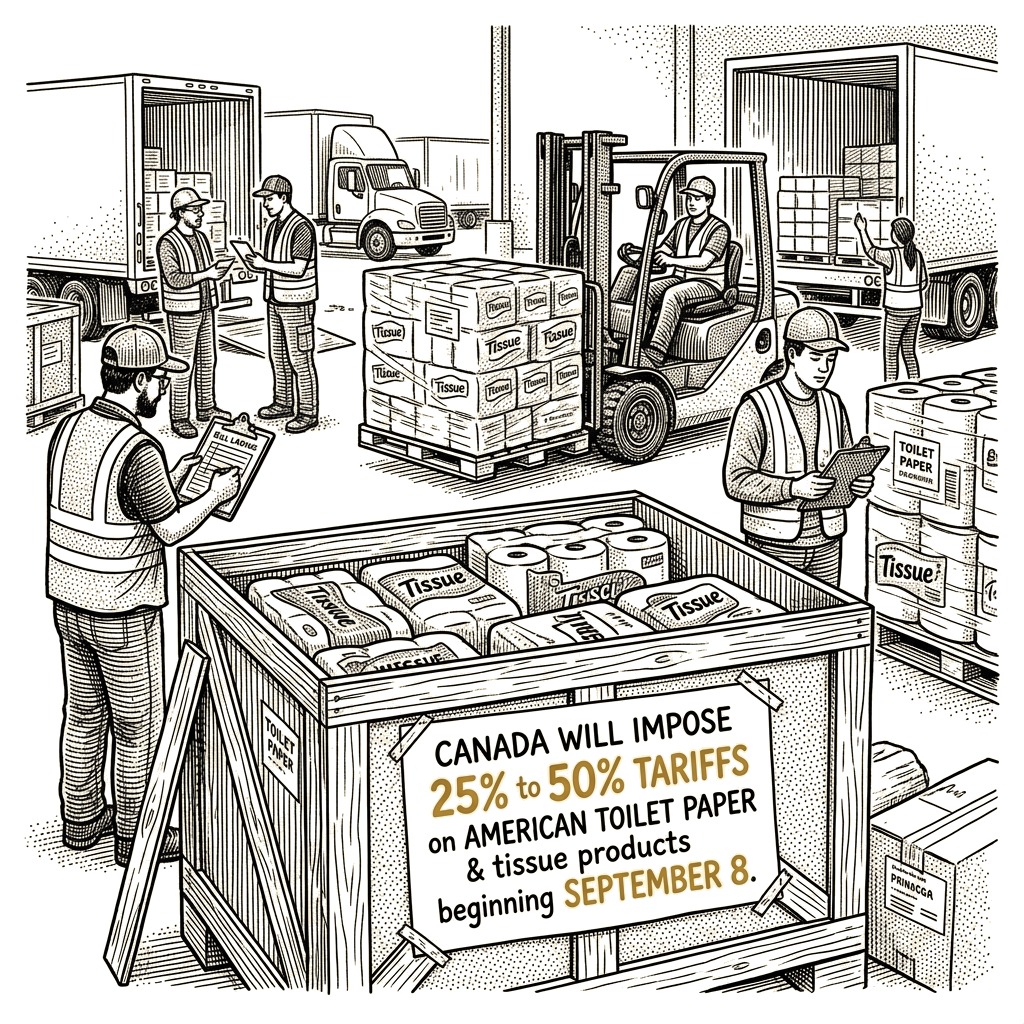
In a trade war, the goods listed on a retaliation schedule say less than the goods not listed but still implicated. Canada’s 25–50% tariff on US toilet paper, taking effect September 8 in response to a 50% US paper tariff hike, looks like a small-bore entry in a long retaliation roster — the US imported $328 million of toilet paper from Canada in 2024, per World Bank figures — until the supply chain behind the line item is read against the public record. Procter & Gamble, the manufacturer of Charmin, said last year it “would have to increase prices amid tariffs.” Costco is named as a major Canadian-sourcing retailer of paper products. The Canadian package sits inside Carney’s published list of nearly 900 American goods; the structural finding is that each spoke of that architecture is calibrated to the political sensitivity of the US-side exposure it triggers.
The temporal scaffold
Three dates structure the package and they should be read together. The triggering US move — a 50% paper tariff hike — has already happened. The next pre-committed round is Canada’s September 8 retaliation list, including the 25–50% paper tariffs. The conditional follow-on is Trump’s threatened doubling of auto tariffs to 50% by January 1, 2027, if no deal intervenes. Beyond those milestones, the source’s own statement that “it is unclear if or when the tariffs will be lifted” is the load-bearing uncertainty — it leaves the entire hub’s persistence open. The credibility analysis that follows reads against this three-date spine, and the test of Greer’s “no impact” claim runs from September 8 forward through the fourth quarter of 2026.
Why this frame matters on this story
The article’s center of gravity sits in the contrast between two on-record statements. USTR Greer told reporters “there’s no possible way” the dispute will affect US consumers, and added “The fundamentals are good. I don’t think this is going to affect anything.” P&G’s prior statement, that input tariffs would force price increases, sits in the same article. The two claims cannot both be true at once, and the supply-chain detail the article carries — Canadian lumber as a raw input for US tissue production, Costco’s Canadian-sourcing posture, 141 rolls per American per year — is the mechanism P&G named and Greer did not.
The tissue-consumption bridge runs in three steps. The US accounts for more than 20% of global tissue consumption while holding roughly 4% of the world’s population, a demand-elasticity profile in which even small per-unit cost pass-through aggregates into a politically visible consumer burden. American tissue runs disproportionately on northern bleached softwood kraft (NBSK) pulp, the specific grade Canadian boreal forests supply in concentrated volumes — most US toilet paper is virgin softwood pulp with negligible recycled content. Substitution to alternative supply — US Pacific Northwest or Scandinavian pulp — runs on a multi-year, capital-intensive horizon, because Canadian and Scandinavian softwood forests need forty to a hundred years to reach pulpwood maturity, sharply limiting the pace of new capacity addition. The mechanism is not contested in the source; it is the mechanism Greer’s denial leaves unaddressed.
The framing finding is that Greer’s “no impact” claim is mechanism-thin while the same article supplies the mechanism. The structural absence of procurement voices from the record is part of what makes that gap visible. US institutional tissue buyers — hospitals, schools, prisons, hospitality, office-property managers — represent a structural share of US tissue demand and would be the natural voices to land a documented consumer-burden claim, and they do not appear on the record. This is an accuracy-but-incomplete finding, not a false-finding: the article does not assert a contradiction between the two on-record statements, it places them side by side and lets the structural fact do the work.
How the retaliation architecture is built
The “dollar for dollar” pledge functions as a commitment device rather than a literal mirror. The published list of roughly 900 goods functions as the commitment, raising the political cost of walking any individual item back. Around that hub, the spokes are calibrated rather than uniform.
The paper spoke carries a 25–50% range, scaled toward the politically sensitive categories. The auto spoke carries a 25% rate with a threatened doubling to 50% by January 1, 2027 — a deadline that creates an opening for renegotiation rather than an immediate hike. The dairy spoke carries a 50% US tariff with a 25% Canadian counter on American cheese and an exemption on Canadian cheese — a carve-out that runs in both directions rather than a uniform mirror. The fish spoke carries a 25% tariff that includes frozen lobster, a line item that has produced one of the only on-record US political critics of the package in the article: Senator Susan Collins of Maine, who called the tariff action “a mistake” and faces a re-election contest in what the source describes as “lobster-capital” Maine.
Two dependency edges run through different channels and carry different substitution horizons. The lumber-to-tissue edge runs from Canadian softwood into US mills, with a multi-year substitution window bounded by the forty-to-hundred-year forest-maturity cycle. The Canadian auto-parts edge runs through just-in-time manufacturing inputs to US assembly lines, with a short substitution horizon and high switching cost. The asymmetry in switching cost is what makes the auto edge the more acute vulnerability under the threatened Jan 1 doubling, and is also what makes Carney’s choice to publish the list in advance — rather than let it surface in implementation — a piece of strategic information rather than a procedural one.
Whose account the strategic posture advances
Both governments are now operating in sequential-move mode, with the next pre-committed round already on the calendar. The US moved first with the 50% paper hike. Canada is responding with its September 8 package. Trump has pre-announced the conditional follow-on (the doubling to 50% on autos by Jan 1, 2027). Carney has published the retaliation list in advance. Each government has staked a different kind of credibility.
Carney’s is partial-commitment: the published ~900-goods list raises the political cost of reversal but is not irreversible, and provincial premiers — Nova Scotia’s Tim Houston on the question of US liquor back on shelves — have already signaled coalition stress. Greer’s is cheap talk in the strategic sense: no sunk cost, no institutional shadow, contradicted in the same on-record record by P&G’s prior statement. Trump’s announced Jan 1 doubling is an unverified-announced-move: a stated threat with no track-record evidence supplied.
The credibility asymmetry is the load-bearing finding of the strategic read. Carney is betting that each sector on the list generates a named domestic US critic, expanding the political surface area of the package over time. The US posture consolidates around Greer’s denial — a spokesperson delivering a line — rather than around counter-evidence, leaving the P&G-Charmin price signal as the operative test of the package through the next two quarters of retail data.
A bounded-rationality note attaches to Houston’s framing. His quote — “Whether Nova Scotians or Canadians will actually buy it when it’s back on the shelves, that’s a whole other discussion” — flags that retaliatory sentiment is endogenous to the game itself and persists past the formal tariff schedule. That sticky-sentiment constraint extends Canada’s effective commitment horizon without extending the formal one, and it is what hyperrational reciprocity models under-weight.
Who is named and who is not
The parties the article names sort into two registers — those with on-record stakes and those whose absence from the record is itself evidence. Carney and Trump are sovereign principals with high power and high interest, set in opposition across the dollar-for-dollar frame. P&G and Costco are US commercial principals with high power and high interest, exposed on the input side through Canadian lumber and on the retail side through member loyalty. Greer is a US official voice whose interest is derivative of administration posture, not personal stakes. Senator Collins and Premier Houston are elected officials whose interests are concentrated on re-election and provincial autonomy respectively, and whose unilateral power to alter the package is low.
The article is also structured by who is not on the record. US institutional tissue buyers — hospitals, schools, prisons, hospitality, office-property managers — are not quoted, despite representing a structural share of US tissue demand. The household frame in the source leaves institutional procurement absent. Indigenous forestry communities in Canadian lumber regions are entirely silent in the record, despite the structural exposure of mill-dependent employment to the retaliation cycle. US and Canadian auto-parts workers do not appear as named voices, despite the central threat to their sector from both the existing 25% auto tariff and the threatened Jan 1 doubling. The structural absence of procurement, household, and worker voices from the record is part of what makes Greer’s denial mechanism-thin: those are the voices where a documented consumer-burden claim would land, and they are not landing.
One vertical policy edge inside the package is worth surfacing. Canadian provincial alcohol bans — sub-national actions — became part of Trump’s stated legal justification for the new federal tariffs against Canada. Carney has now asked provincial leaders to consider putting American liquor back on shelves, an ask that reopens the coalition question Houston’s quote already named. The relationship runs one direction in the source: provincial action fed federal retaliation rationale, and federal negotiating posture now pulls the other way on provincial action.
Four questions a reader can carry to the next story
- Does retail pricing data through the fourth quarter of 2026 show Charmin or comparable brands moving in response to the September 8 tariff, and how does that movement land against Greer’s “no impact” claim?
- Does Trump’s threatened Jan 1, 2027 doubling of auto tariffs to 50% materialize, or does a bilateral deal intervene in the interim, and how does each Canadian provincial government handle US liquor through the negotiation window?
- Which lines on Carney’s published ~900-goods list move before September 8 — revised up, revised down, or pulled — and which spokes carry the most visible revisions?
- Which presently silent voices — US institutional tissue buyers, Canadian Indigenous forestry communities, US and Canadian auto-parts workers — appear on the record by the next reporting cycle, and what does that appearance pattern signal about the surface area of the package?
Analytical techniques used in this piece
This analysis applies the methods below. Each links to a short, plain-English explainer you can read and reuse.
- Relationship Mapping
- Extracts the network of ties among people, institutions, and entities.
- Stakeholder Mapping
- Charts the parties to a situation — their interests, power, and alignments.
- Strategic Interaction (Game Theory)
- Models a situation as a game — players, moves, payoffs, and likely equilibria.