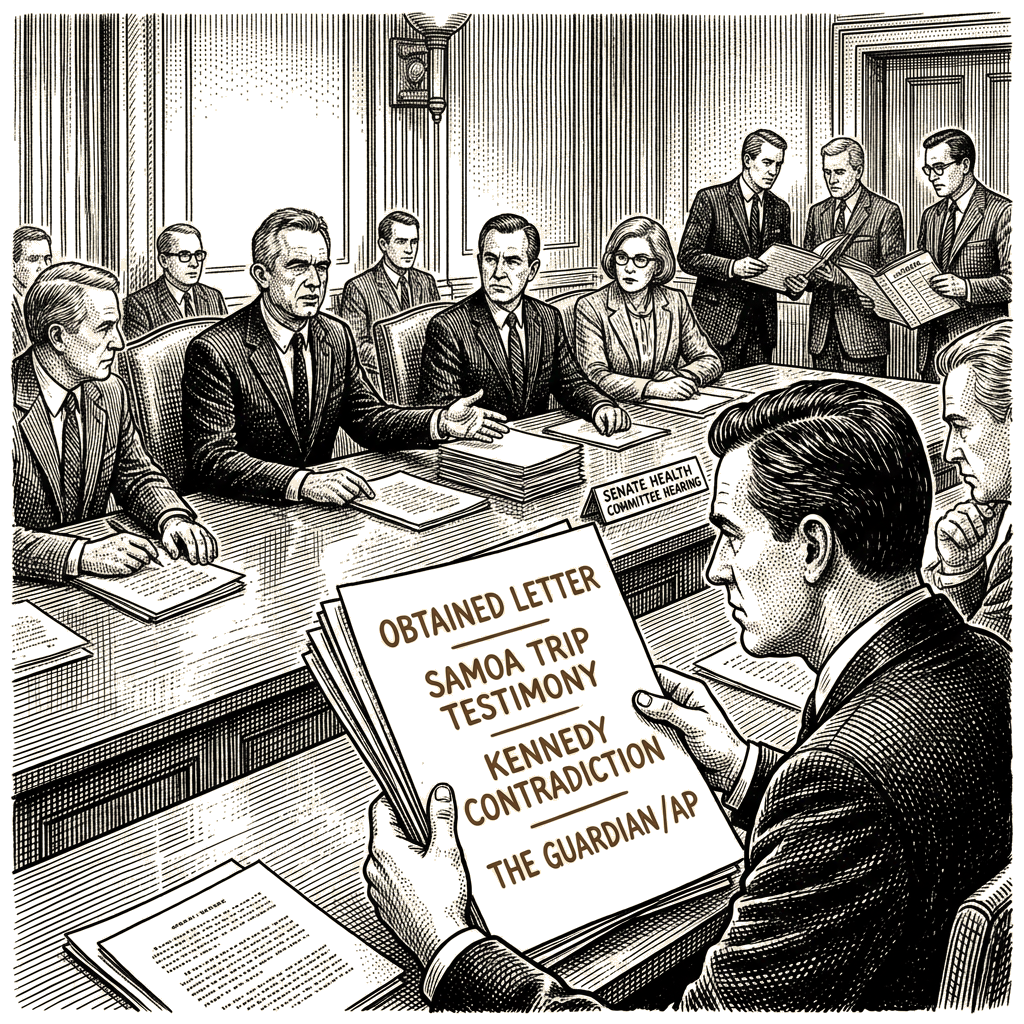
A January 20, 2019 letter on Children’s Health Defense letterhead from Robert F. Kennedy Jr. to Samoa’s then-prime minister used the word “vaccine” or “vaccination” eight times and proposed “detailed health informatics assessment in Samoa of what happened with your MMR vaccines.” That primary-source document sits in direct contradiction with statements Kennedy made under questioning during his Senate confirmation hearings — to Sen. Ron Wyden (D-OR) that the trip “had nothing to do with vaccines,” and to Sen. Edward Markey (D-MA) that “my purpose in going down there had nothing to do with vaccines.” Because Kennedy was not under oath during his two confirmation hearings, the operative federal statute for any false-statement referral is 18 U.S.C. § 1001 rather than perjury under 18 U.S.C. § 1621; a five-year statute of limitations applies and prosecution of either offense against executive-branch officials is rare. The most consequential parties in the underlying event — the families of 83 Samoan children who died in the subsequent measles outbreak, the two Samoan nurses convicted of manslaughter after the 2018 MMR-mixing deaths, and the unnamed Samoan health official whose public human-error finding Kennedy’s letter implicitly contradicted — carry no voice in the U.S. accountability frame that the new reporting now centers on.
The contradiction is real, the legal exposure is narrow, and the framing of the story does structural work that the new documents do not.
What the document shows
The letter is dated January 20, 2019, written on Children’s Health Defense letterhead, and addressed to Tuilaepa Sailele Malielegaoi, then Samoa’s prime minister. Kennedy wrote that he was writing “in the hope that we might be helpful to the people of your great nation” and proposed that his team “conduct detailed health informatics assessment in Samoa of what happened with your MMR vaccines.” In the letter, Kennedy speculated that the deaths of two children in Samoa after MMR vaccination may have resulted from manufacturing issues with different vaccine lots.
Malielegaoi replied a month later, writing: “It is certainly beneficial for Samoa to have the benefit of your Team’s independent health assessment of our MMR Vaccines and I would welcome with much anticipation your Team’s proposed visit to our islands.” A separate May 2019 email from Kennedy’s CHD colleague, Dr. Michael Graven, to Samoan officials described the team’s trip as a “vaccine-related mission,” according to the joint reporting.
Kennedy traveled to Samoa in May and June 2019 with his wife, Cheryl Hines, and Graven, meeting with anti-vaccine activists while there, the Guardian and AP previously reported.
What the testimony said
Under questioning during his Senate confirmation hearings, Kennedy told lawmakers that vaccines were not the purpose of his visit. Asked by Wyden, Kennedy said: “I went there, nothing to do with vaccines. I went there to introduce a medical informatics system that would digitalize records in Samoa and make health delivery much more efficient.” The following day, when Markey asked about it, Kennedy said: “My purpose in going down there had nothing to do with vaccines.” Under further questioning, Kennedy again denied the trip had anything to do with vaccines before adding: “My purpose in the trip was not to – I ended up having conversations with people, some of whom I never intended to meet.”
Kennedy also told senators he had never given “any public statement about vaccines” in Samoa and that “you cannot find a single Samoan who will say I didn’t get a vaccine because of Bobby Kennedy.” The Senate confirmed Kennedy on a 52-48 vote.
In a 2021 blog post on the CHD website, Kennedy said he went to Samoa to attend an Independence Day celebration and to discuss “the introduction of a medical informatics system” to track drug safety, and that Samoan officials “were curious to measure health outcomes following the ‘natural experiment’ created by the national respite from vaccines.”
The disclosure gap that kept this quiet for seven years
The contradiction surfaced only because The Guardian and the Associated Press obtained the January 2019 letter jointly; the documents sat in the trail held by CHD and Samoan officials for years. No statute requires nominees for HHS Secretary to disclose contemporaneous private-organization correspondence on matters within their prospective policy jurisdiction, and the Senate confirmation process accepts verbal denial without contemporaneous documentary cross-check: confirmation staff do not subpoena primary-source correspondence from outside the federal government. The only surfacing route under that procedural configuration is investigative journalism, and no HHS Inspector General trigger fires on testimony-versus-document contradictions after confirmation. The Guardian said it asked HHS to explain the contradiction between Kennedy’s claim that the trip had nothing to do with vaccines and his letter to the Samoan prime minister; HHS did not provide a response to that question. The White House did not respond to a request for comment.
That disclosure gap is the structural cause. Removing it requires Senate rules mandating that nominees for HHS Secretary disclose contemporaneous organizational correspondence on matters within their prospective policy jurisdiction, with confirmation counsel cross-referencing disclosed documents against hearing testimony. Until that exists, every future HHS nominee with a CHD-style organizational trail can repeat the pattern.
How the agency has responded
In a statement, an HHS spokesperson said: “Secretary Kennedy’s visit to Samoa in 2019 was unrelated to vaccines. Any claim or insinuation based on these letters that Secretary Kennedy lied under oath or to Congress is not only false but outright defamatory.” The spokesperson framed the story as a defamation matter rather than arbitrating the documentary contradiction. The spokesperson function within HHS is structurally defensive — it transmits administration position but does not arbitrate factual disputes; no Inspector General trigger fires on testimony-versus-document contradictions.
The federal false-statements statute
The article frames “knowingly giving material false testimony to Congress” as a federal crime. Per 18 U.S.C. § 1621, that framing applies to perjury, which requires an oath; 18 U.S.C. § 1001 covers false statements without oath. Because the article itself states Kennedy was not under oath during his two confirmation hearings, the operative statute — if any — is § 1001, not perjury. The five-year statute of limitations applies to both; prosecution of either offense against executive-branch officials is rare.
Attorneys with expertise in Senate procedure told the Guardian that if Democrats win control of the House or Senate in the November elections, they could use Kennedy’s statements as grounds for hearings, an impeachment inquiry, or other obstacles for the Trump administration. The federal statute of limitations for lying to Congress is five years, meaning a Justice Department under the next president in 2029 could theoretically investigate the case. Wyden, Markey, or their successors should reconvene Kennedy or his staff, place the January 20, 2019 letter, the February 2019 reply, and the May 2019 Graven email in the record, and refer the matter to DOJ under 18 U.S.C. § 1001 if material discrepancies are confirmed.
Kennedy has indicated he is open to pursuing criminal charges against congressional witnesses himself: he suggested last month that former health official Dr. Anthony Fauci could face perjury charges when called before a Senate committee to testify about Covid-19.
Whose record the framing privileges
The story’s stakeholder landscape organizes around a U.S. Congressional-truthfulness question — Kennedy against Wyden and Markey, with HHS as spokesperson and the Samoan prime minister’s office as document source. The most consequential parties in the underlying event sit outside that frame and are unnamed or only gestured at in the article’s body.
The unnamed Samoan health official who publicly attributed the 2018 deaths to human error before Kennedy arrived — and whose finding Kennedy’s “different vaccine lots” speculation implicitly contradicted — is never named in the article. The two Samoan nurses charged with manslaughter after the 2018 MMR-mixing deaths that triggered the 10-month vaccination halt appear in one clause (their guilty pleas). The families of the 83 Samoan children who died in the subsequent measles outbreak — mostly under five — appear in the public record only as a count and an age band.
The structural effect is to make this a Washington accountability story layered over a Pacific public-harm event. Absent Samoan voices in the U.S. accountability record, the historical record of the 83 dead will be settled by U.S. actors (the Senate, HHS, the courts) whose standing to do so is itself a stake. The text’s silence on Samoan voices is itself the salient feature of the framing.
UNICEF and U.S. State Department officials referenced as having privately discussed that the trip was about vaccines are cited as sources for prior reporting but are not given direct voice. Future American children whose vaccine exposure is governed by current HHS policy decisions Kennedy is now making — anchored to the article’s note that Kennedy “pledged to maintain vaccine policies that, once in office, he moved to change” — carry the policy-continuity stake without representation in HHS decision-making.
How the contradiction could play out
The contradiction sits at the intersection of two decorrelated axes: a political-legal axis (whether congressional committees convene hearings and DOJ pursues a § 1001 referral) and an epidemiological axis (whether U.S. MMR coverage stabilizes, rebounds, or continues falling below the 95% CDC herd-immunity threshold, after sitting at 92.5% in 2024–25 per CDC SchoolVaxView). Past false-statements referrals have not moved vaccination trends, and falling vaccination rates have not triggered congressional investigations of prior officials — the axes’ causal drivers are independent, but a single wild-card event could collapse them into one forcing function.
In a scenario of exposure without recovery, Democrats win the November elections, Senate HELP or House Energy and Commerce open hearings, the January 2019 letter enters the record against Kennedy’s hearing testimony, and a bipartisan § 1001 referral slow-walks under standard practice while ACIP — restructured after Kennedy terminated all 17 members on June 9, 2025 per widely-reported accounts — issues narrowed recommendations and CDC MMR coverage continues sliding below 92%. Institutional checks arrive after policy consequences have taken root.
In a scenario of late reckoning, Democrats win the November elections, DOJ opens a § 1001 review, and state legislatures tighten non-medical exemptions while professional medical society coordination and outbreak-driven parental behavior shift CDC coverage back toward 95%; Kennedy faces political and potential legal consequences, but federal-level policy damage is only partly reversed by state action and behavior change.
In a scenario of institutional drift, Republicans hold Congress, no investigation proceeds, Kennedy continues reshaping ACIP and HHS personnel, state responses are mixed, and CDC coverage continues declining; the statute-of-limitations cliff arrives in 2030 with no DOJ action.
In a scenario of quiet resilience, Republicans hold Congress, no federal investigation proceeds, but state legislatures, professional medical societies, and outbreak-driven parental behavior change stabilize or raise vaccination rates; federal policy damage goes unreversed even as population-level immunity partially recovers sub-federally.
A wild card sits across all four: a U.S. measles outbreak with pediatric fatalities comparable to Samoa’s 83 deaths would activate both axes simultaneously and override the matrix.
What is at stake through 2030
The November elections will determine whether any U.S. forum convenes to examine the January 20, 2019 letter against the hearing transcript — or whether the contradiction passes into the historical record unanswered. CDC MMR coverage, now at 92.5% and below the 95% herd-immunity threshold, will either stabilize through state-level action and professional society mobilization, or continue falling under federal drift. The documentary record of the 83 Samoan children who died in the 2019 outbreak will either include Samoan voices in any U.S. accountability proceeding, or be settled by U.S. actors whose standing to do so is itself the unresolved stake.
Analytical techniques used in this piece
This analysis applies the methods below. Each links to a short, plain-English explainer you can read and reuse.
- Root-Cause Analysis
- Traces a symptom back along its causal chain to the conditions that actually generated it.
- Scenario Planning
- Builds a small set of distinct, plausible futures to plan against.
- Stakeholder Mapping
- Charts the parties to a situation — their interests, power, and alignments.