Summary
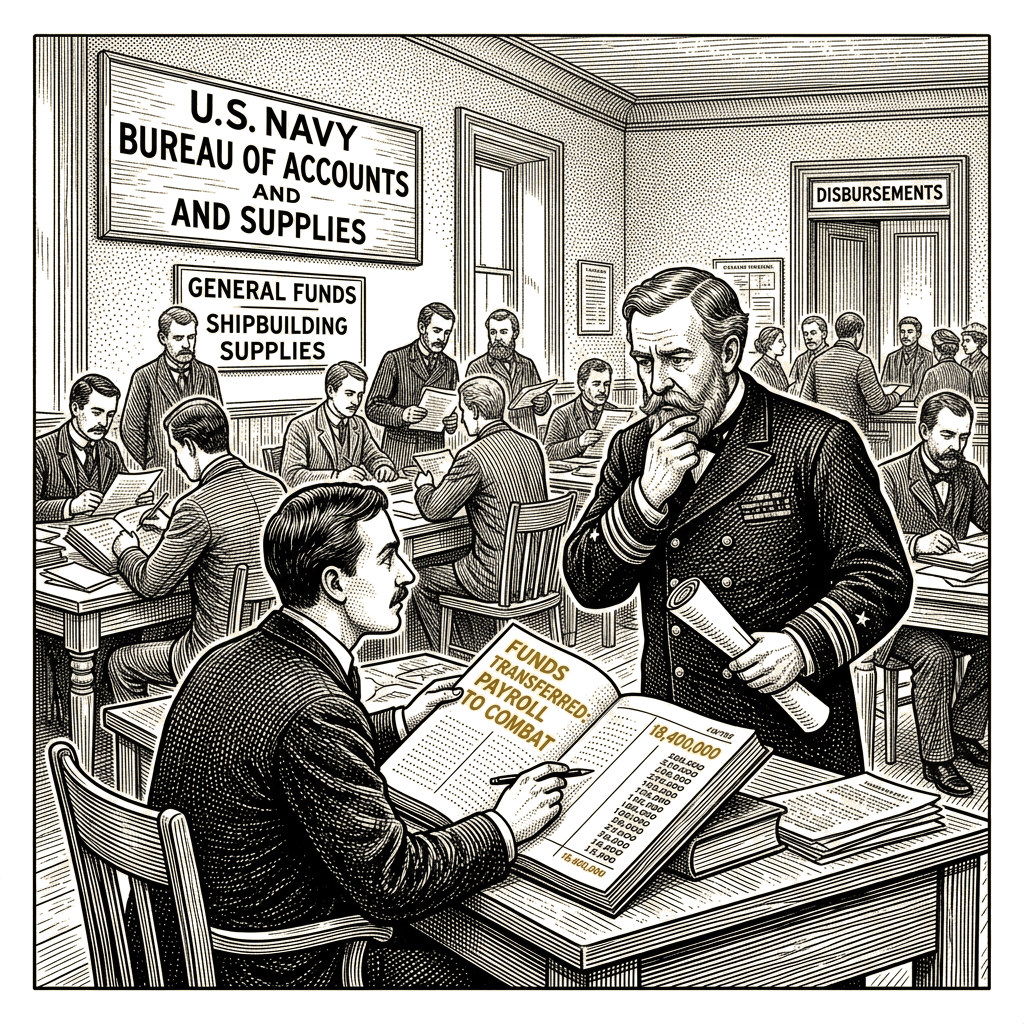
- Pentagon documents obtained by the Guardian show the Navy has transferred payroll funds to cover combat costs of Operation Epic Fury, a structural consequence of a pre-set FY 2026 budget colliding with a war that began after the budget was locked and lacks a congressional use-of-force authorization.
- Federal law’s limits on shifting money between Congressionally-divided budget categories — personnel, shipbuilding, weapons, operations and maintenance — force the Navy into improvised accounting, with payroll becoming the path of least resistance when combat costs spike.
- Defense Secretary Pete Hegseth told the Senate on 21 July that the war had cost $37.5 billion to date — an increase of nearly $8 billion since the May estimate — though it remained unclear whether that figure represents a complete accounting of the war’s costs; a separate $67 billion Defense emergency request inside an $87.6 billion total supplemental has not been enacted, and the House-passed $1.15 trillion defense bill and $73 billion war authorization are each unlikely to become law.
- The funding pressure carries documented consequences beyond the service’s accounts: shore-based maintenance has been deferred, Adm. Daryl Caudle’s May testimony warned of July trade-offs in exercises and routine operations, and individual sailors, defense contractors, and Gulf-state hosts hold stakes that appear in the article only by inference.
The US Navy is funding the Iran war by moving money out of its own payroll accounts. The visible transfers — money for sailors’ pay “robbed” to cover overseas contingencies and then “backfilled” with unspent appropriations — are the symptom. The condition that produced them is structural: the FY 2026 budget of $292.2 billion was partitioned by Congress into separate categories months before Operation Epic Fury began on 28 February, federal law restricts movement between those categories, and the war itself lacks the congressional use-of-force authorization that historically preceded funding for Iraq and Afghanistan. Each of those conditions is independently verifiable; the payroll transfers are where they intersect.
The constraint that produced the transfers
The Navy’s FY 2026 budget is divided by Congress into four statutory allocations: personnel, shipbuilding, specific weapons systems, and operations and maintenance (O&M) — the day-to-day running of the fleet and its bases. Federal law limits how money can be shifted between those categories. One official quoted by the Guardian described the result: money is “shifted around in imaginative ways” to keep pay flowing.
That statutory partition is the root mechanism behind the payroll transfers. A root-cause analysis of the episode traces the constraint through two further layers: the categories were designed to keep money from being moved freely between purposes, protecting long-term capital functions from short-term demands, and the protection mechanism itself now forces the service to “rob” payroll and “backfill” it with unspent money. The category boundaries are preserved; the budget integrity the categories were meant to guarantee is eroded.
Harlan Ullman, a retired naval officer and member of the National Commission for the Future of the Navy, summarized the result in two words: “The piggy bank is broken.” He added that he was not speaking on the commission’s behalf.
What Epic Fury has cost, and the chain it set in motion
Operation Epic Fury began on 28 February under the name given to the US-Israeli military operation. The conflict has depleted US munitions stockpiles and prompted retaliatory Iranian strikes that have wrecked strategic bases across the Middle East. Defense Secretary Hegseth told the Senate on 21 July that the war had cost $37.5 billion to date, an increase of nearly $8 billion since the May estimate, though it remained unclear whether the figure represents a complete accounting of the war’s costs.
A relationship map of the funding trail treats each link in this chain as a dependency edge: combat operations drove munitions depletion, depletion preceded the retaliatory strikes, and the strikes generated the costs the Navy is now absorbing. The same chain produces the present symptom — payroll transfers to backfill combat accounts — and the present risk, near-term solvency for the service.
In mid-May testimony before Congress, Adm. Daryl Caudle, the chief of naval operations, named the timing mismatch directly: “The FY ‘26 budget didn’t bake in Epic Fury.” His warning followed: “I do fear that I’ll have to start making decisions in the July timeframe on how I do force generation. That could make differences between how I do exercises, how I do routine operations in order to make sure that I … have the funds necessary to continue the war effort for Epic Fury.”
The Trump administration separately requested $67 billion in Defense emergency funds inside an $87.6 billion total supplemental, with $21 billion for munitions, $17.3 billion for operational costs, and the remainder spread across drones, cyber, classified programs, and readiness. The request did not break out how much would go to the Navy. The House passed a $1.15 trillion defense policy bill on 22 July along with a separate budget authorization providing $73 billion for the war in Iran, but the article reports neither is likely to become law.
Inside the service, the financial pressure is visible but not publicly acknowledged. A Pentagon memo about Navy funding seen by the Guardian warns of “shortfalls in payroll” accounts due to the department “raiding” them to fund combat operations. The same memo language contrasts with the public line from a Navy spokesperson, who said in a statement that maintenance and operations funds “have not been depleted” and that the Department “is actively managing its resources to meet current pay obligations on time.” Todd Harrison, a defense analyst at the American Enterprise Institute, accounted for the gap in disclosure: “They’re just not speaking publicly about it.” His framing characterizes the silence as tied to a war that is “becoming increasingly a political liability.”
Disclosure asymmetry and the parallel expansion track
The political coalition managing the war’s finances and the political coalition announcing naval expansion operate under opposite disclosure regimes. Combat costs are suppressed for political reasons per Harrison’s framing; expansion announcements flow freely. The Trump administration has announced plans for large “Trump class” battleships described as the largest in US history, has invoked the Theodore Roosevelt “Great White Fleet” parallel under the rebranded term “Golden Fleet,” and has directed the Navy to redesign an aircraft carrier so it launches jets with a steam and hydraulic catapult system rather than the electromagnetic system now in use — a preference Trump has restated publicly every year since 2017. The structural asymmetry between the suppressed war-funding track and the loudly announced expansion track sharpens the political-liability argument: the silence is selective, not uniform.
Why the emergency funding has stalled
A retired naval officer, Harlan Ullman, raised a constitutional question the stalled funding trail makes concrete: “There is no authorization to use force in this case. Is Congress obliged to pay for a conflict it did not authorize?”
Ullman’s framing is structural. The wars in Iraq and Afghanistan were authorized by use-of-force resolutions, and funding flowed more readily under those authorizations. The Iran operation lacks that grounding — H.J.Res.176, a 2026 Authorization for Use of Military Force Against Iran now pending in Congress, opens with the finding that “Congress has not declared war with respect to, or provided any specific statutory authorization for, hostilities involving United States Armed Forces against the Islamic Republic of Iran.” Senator Susan Collins surfaced the funding pressure at a 21 July hearing of the Senate Appropriations Committee: “I’m told some military services face near-term solvency challenges.” A staffer confirmed the Navy was among the services she was referring to.
The absence of authorization is therefore not merely a procedural gap but a structural feature — it converts what would ordinarily be a routine supplemental appropriation into a contested one, with the constitutional question unresolved.
Who else the funding pressure touches
A stakeholder map of the episode identifies parties whose interests the Navy-Pentagon-Congress frame leaves implicit. Three carry on-record stakes; several others are visible only by inference from the article’s silences. A power-and-salience mapping orders them as follows.
At the decision locus sit the Pentagon, Congress, the Trump administration, and the Navy institution — high power and high salience. Hegseth has pressed for the supplemental on the record; Collins has named the solvency problem; the House has passed its defense bill; Caudle has testified to the timing mismatch. These four are the parties whose choices shape the funding outcome.
Sailors, Navy civilians, and retirees are urgent and legitimate but institutionally weak — they hold the highest urgency and a direct earned-pay claim but lack the institutional power to extract concessions. One unnamed official briefed on the shortfall described the improvised arrangement in detail: “The money for payroll,” he said, “was robbed to pay for overseas contingencies and is being backfilled by money that hasn’t been spent. They are backfilling payroll so we get enough money in our paycheck.” Their fallback is limited — whistleblower channels, congressional complaint, veteran-service-organization contacts — and the article gives them no named advocate.
Defense contractors and the shipbuilding industrial base sit in the middle of the salience grid. One Navy contractor told the Guardian that non-emergency maintenance on shore-based facilities has been deferred because of the cash crunch. Shipbuilding primes face multi-year contract continuity risk; shore-maintenance contractors face current-quarter revenue loss from deferred work. Their fallback is to lobby Congress directly.
Gulf states hosting US bases sit at the edge of the frame: the article reports that retaliatory Iranian strikes wrecked strategic bases across the Middle East, but no Gulf-state government or population appears on the record. The host-sovereign relationship that depends on continuing US basing consent is implicated by the damage without being named.
Iran is named as the adversary whose retaliatory strikes generated the funding pressure; Israel is named only as the operation partner inside “US-Israeli military operation,” with no Israeli stake on the record.
Two future-looking constituencies are referenced through Adm. Caudle’s May testimony rather than through current reporting: the training pipeline that shortens if exercises are deferred, and the shore-based maintenance backlog that builds forward into readiness degradation. A former military officer now working for a Navy contracting company, briefed on the shortfalls, named the empirical anchor for those forward-looking stakes: “They’re fucked. They shot all their weapons; they trashed all their ships; they ran out of their money.”
What this leaves on the table
The structural diagnosis yields three institutional moves the next reporting cycle can test.
First, stand up an explicit contingency line in the FY 2027 budget process for unanticipated operations above a defined cost threshold, paired with a pre-approved transfer authority narrower than current category-shifting limits — so that a war beginning after the budget is locked no longer forces the service to choose between category integrity and operational solvency.
Second, resolve the constitutional question Ullman raised, through either a congressional authorization vote or a formal legal opinion, so the funding pathway for a conflict without use-of-force authorization is not improvised mid-conflict. H.J.Res.176 — a 2026 Authorization for Use of Military Force Against Iran — was pending in Congress at the article’s publication; its disposition would settle the question.
Third, establish a statutory disclosure rule that requires public reporting of internal fund transfers above a defined materiality threshold, so the gap between the Pentagon memo’s “shortfalls in payroll” language and the spokesperson’s “actively managing” language cannot recur in the same news cycle.
Analytical techniques used in this piece
This analysis applies the methods below. Each links to a short, plain-English explainer you can read and reuse.
- Relationship Mapping
- Extracts the network of ties among people, institutions, and entities.
- Root-Cause Analysis
- Traces a symptom back along its causal chain to the conditions that actually generated it.
- Stakeholder Mapping
- Charts the parties to a situation — their interests, power, and alignments.