Summary
- Three aviation safety experts told NPR that the FAA’s preliminary June determination that the proposed 250-foot Trump arch at Memorial Circle “likely would not be a hazard” leaves the operational risk of adding another stressor to an already-saturated airspace subject to a regulatory mechanism NPR’s reporting shows can be overridden by presidential waiver.
- The three experts — Ohio State aviation safety instructor Shawn Pruchnicki, retired NTSB and FAA accident investigator Jeff Guzzetti, and 30-year FAA air traffic control veteran Tom Lintner — each drew a different conclusion from the technical finding and differentiated two parallel vulnerability classes — fixed-wing obstacle proximity and helicopter and controller-workload stress — that NPR reported the regulatory “hazard” frame does not separately evaluate.
- The airspace around Ronald Reagan Washington National Airport exhibits a profile the experts told NPR is already operating beyond its design tolerances — designed for 15 million annual passengers in 1941 and now serving closer to 25 million, with one main runway surrounded by prohibited airspace and a Runway 19 “River Visual” approach requiring a 40-degree turn below 500 feet — and absorbing a documented pattern of incidents including the January 2025 midair collision that killed 67 people.
- The institutional pathway NPR identified — a regulator that lacks land-use authority, a “determination of hazard” Guzzetti said the president can instruct the transportation secretary to waive, and an obstruction-evaluation process whose timeline remains unclear while the administration proceeds to excavation — operates as a fragility the technical finding does not address.
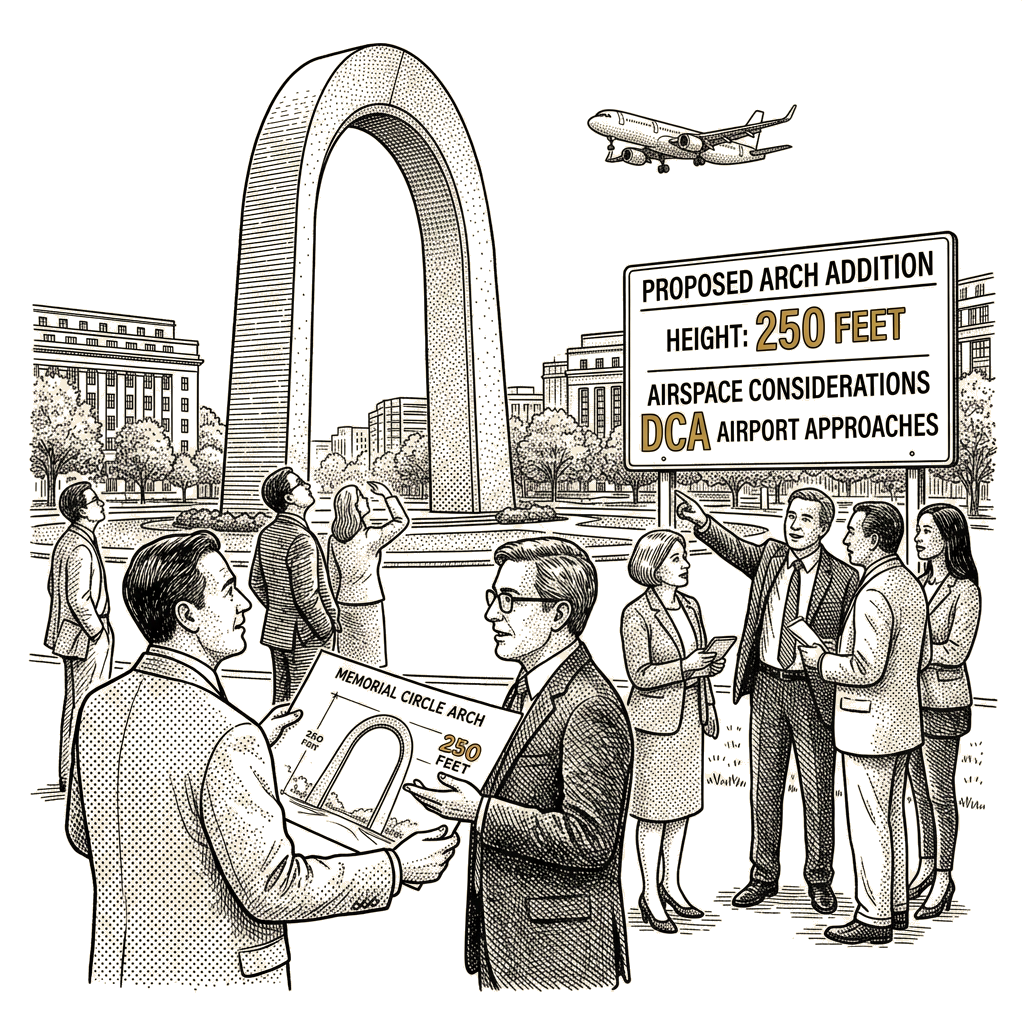
The Federal Aviation Administration’s preliminary June determination, NPR reported, found that the Trump administration’s proposed 250-foot arch at Memorial Circle — about two aeronautical miles from Ronald Reagan Washington National Airport’s main runway, along the Runway 19 flight path — “likely would not be a hazard” if fitted with blinking red obstruction lights. Three aviation safety experts — Ohio State aviation safety instructor Shawn Pruchnicki, retired NTSB and FAA accident investigator Jeff Guzzetti, and 30-year FAA veteran Tom Lintner — told NPR they agreed the technical finding was defensible, and each drew a different conclusion from it. The source reporting sustains a single analytical question across two findings: the technical determination, and the same reporting’s account that the regulator empowered to label the structure a hazard lacks land-use authority to block it and that the prospect of a presidential waiver is preserved at the executive level. The structural move the source reporting surfaces: a regulatory finding (“not a hazard”) is being asked to do the work of an operational claim (“the airspace is no more dangerous than it was”), when the two claims are not equivalent.
Airspace fragility: an already-saturated operational envelope
The airspace Ronald Reagan Washington National Airport occupies was, in Guzzetti’s reported characterization to NPR, “never meant … to have this amount of traffic.” The airport, which opened in 1941, was designed for roughly 15 million passengers per year; it now serves closer to 25 million. Because DCA is owned by the federal government, NPR reported, Congress regulates the number of flights, and lawmakers have historically wanted to facilitate travel to and from their home districts. Guzzetti described the operational configuration to NPR as “a small airport with one runway, nestled in a metropolitan area that’s surrounded by prohibited airspace [near the White House and U.S. Capitol].”
The Runway 19 “River Visual” approach compounds the constraint. According to NPR, pilots approaching via the River Visual must follow the Potomac River and then execute a turn as abrupt as 40 degrees at altitudes below 500 feet to avoid prohibited airspace. Some airlines, NPR reported, require special training to land at DCA or have designated the approach “captain-only,” meaning only the more senior officer flies the approach. U.S. Rep. Don Beyer (D-Va.), representing the Virginia side of the bridge, told NPR: “An enormous number of airplanes come over that site, basically every 45 to 60 seconds all day long ‘til 11 at night.” Pilots passing the Memorial Circle site, on Guzzetti’s account to NPR, would be roughly 60 seconds from touchdown when they execute the turn to final approach. Pruchnicki told NPR the approach “is even trickier in dark or windy conditions.”
The cumulative effect, on the source reporting, is a system absorbing per-element “no hazard” findings without a separate accounting for whether the airspace as a whole is operating within the margin its design assumed. The experts NPR interviewed, NPR reported, are most concerned about the challenge the arch could pose to planes that are landing, not taking off.
Two vulnerability classes the regulatory frame collapses
The three experts’ concerns, as NPR reported them, fall into two categories that the obstruction-evaluation mechanism does not separate. The first is fixed-wing obstacle proximity. The arch stands about two aeronautical miles from the airport’s main runway, along the flight path used by planes landing on Runway 19. Guzzetti told NPR that pilots are unlikely to mistake the structure: “It’s going to look imposing. It’s going to be dramatic. But a pilot is not going to mistake that or get too close to it.” Pruchnicki’s residual risk in this category, as he stated, was wind exposure — an aircraft inadvertently flying lower than it should be, facing strong easterly winds, “could easily get blown into” the arch. “If everything is working perfectly, I don’t see that it would be a significant problem,” Pruchnicki told NPR. “However, we all know, at all airports, things go wrong all the time.”
The second is helicopter and controller-workload stress. Lintner told NPR that helicopters operate below 500 feet in some areas near DCA and as low as 200 feet in others — lower than the proposed 250-foot arch. Lintner’s workload concern, in his words: “As the traffic gets denser and denser, you may find controllers having to make transmissions every five, six, seven seconds.” His conclusion: “There reaches a point where there aren’t enough seconds left to make the right decision.” Lintner called additional helicopter and workload stress “the last thing this area needs.” He published his concerns in a Substack post in August, based on what he described to NPR as “back of the envelope” math.
The two categories operate on different altitude bands, involve different actors, and are sensitive to different stressors. The 250-foot arch sits at the altitude-band boundary where it intersects the helicopter operating envelope. The experts NPR interviewed agreed on the operational baseline: Guzzetti told NPR, “This is just adding another hazard. Granted, it might not be significant, but still, it’s yet another … opportunity for exposure to something bad happening.” Pruchnicki, NPR reported, observed that “complications arise all the time in the tricky airspace near DCA.”
The institutional mechanism as a fragility the technical finding does not address
The obstruction-evaluation process NPR described contains a structural condition the technical finding does not touch. Under federal regulations, NPR reported, the FAA must be notified before construction of any structure over 200 feet tall or within a certain slope of airport runways, and the agency conducts an aeronautical study to determine whether the object would constitute a hazard. An FAA spokesperson told NPR over email in early September that “the standard obstruction evaluation process is under way,” both for the arch and the cranes that would be used for construction, which the administration has said could be up to 320 feet tall. Neither the FAA nor the White House, NPR reported, shared a timeline or further details about those reviews.
The agency could ultimately issue a “determination of hazard,” but the agency does not have land-use authority and its conclusion is not legally binding. “The president can simply instruct his [transportation secretary] to write a waiver for that, to ignore that,” Guzzetti told NPR. He added: “I can see that happening with this president.” The FAA both operates the U.S. air traffic control system and regulates aviation safety. Lintner, who spent 30 years in FAA safety roles including as an air traffic controller at New York’s LaGuardia Airport, told NPR: “Nobody’s watching the watchers … In other words, anybody who says, ‘Wait a minute, how do we know that’s safe?’ The answer is, ‘Well, the FAA decided it’s safe.’ But did they? What’s the checks and balances?” Sen. Tammy Duckworth (D-Ill.), in a June public letter, urged the agency “to be firm in rejecting any improper or irresponsible pressure from President Trump to prioritize the construction of his gaudy, vanity arch over the safety of the American people.” NPR reported that the White House did not respond to questions about perceived political pressure, and the FAA also did not respond.
The obstruction-evaluation timeline NPR assembled: the FAA’s preliminary June report found the structure “likely would not be a hazard” with red obstruction lights, similar to those on the 555-foot-tall Washington Monument; the public comment period ended on Sept. 3; and the comprehensive aeronautical study remains underway with an unclear conclusion date. Pruchnicki told NPR he has generally seen the obstruction-evaluation process take “anywhere from several months to nearly a year.” After the study concludes, the entity behind the proposed construction — in this case the National Park Service — has 60 days to agree to those conditions, terminate the study, or request further study; “further study includes opportunities to negotiate or propose mitigations, and the FAA may request public comment,” according to an informational FAA video NPR referenced. Guzzetti told NPR that, accompanying any construction, the FAA would ideally ensure that certain steps are taken: adding red lights to the arch, clearly labeling the structure on aeronautical charts, and monitoring any complaints from pilots and the public about planes getting too close.
The project’s stated rationale and the administration’s posture
According to NPR, the president originally said the arch was for himself; he has since characterized it as a tribute to the country’s 250th anniversary. The White House, in statements NPR reviewed, has said the structure will be “one of the most iconic landmarks not only in Washington, D.C., but throughout the world.” The administration has said it will “soon begin preliminary excavation work at Memorial Circle,” NPR reported, while questions about aviation safety and other concerns remain unanswered; the White House told NPR it continues “seeking final approval from all applicable entities.” The administration maintains, according to NPR, that the arch would not pose an additional risk. NPR reported that the White House did not respond to questions about the experts’ concerns.
Stressor inventory and recent incidents
The airspace around DCA has absorbed a documented pattern of close calls. In January 2025, an American Airlines regional jet and an Army Black Hawk helicopter collided midair near the airport, killing 67 people. The collision, NPR reported, “shed light on a pattern of close calls at DCA, resulting in a slew of rule changes and restrictions on helicopters.” Two Democratic Virginia senators introduced legislation to cap hourly arrivals at DCA and gradually reduce flights over a four-year window starting in 2028; Sen. Mark Warner (D-Va.), a co-sponsor, said in a statement, “Since the collision, there have been numerous near misses in DCA airspace.”
In early August, NPR reported, federal investigators found that “ongoing construction of the White House ballroom contributed to radio problems that prevented air traffic controllers from hearing a warning before a military helicopter carrying Trump briefly flew too close to a passenger jet departing DCA.” Guzzetti, cited by NPR, stated that the August incident exemplifies “the unique challenges and variables of D.C.’s airspace” absent the proposed arch. The arch’s contribution to this profile, on the source reporting, would consist of the structure itself (250 feet), the construction cranes (up to 320 feet), and the helicopter and controller-workload stress Lintner emphasized.
Competing framings of the project
NPR reported multiple framings of the proposed project in active circulation. The dominant-paradigm framing treats the project as a matter of technical aviation-risk management — obstacle height, obstruction lighting, and the FAA’s standard obstruction-evaluation process. A personal-memorialization framing is carried in Duckworth’s June letter and in Pruchnicki’s characterization of the project to NPR as “just for the sake of his personal needs.” A separation-of-powers framing, articulated by Lintner’s “Nobody’s watching the watchers” comment, turns on the FAA’s dual mandate to operate the air traffic control system and regulate aviation safety. A civic-memorial framing situates the 250-foot arch in relation to the 555-foot Washington Monument, which carries the same obstruction-lighting regime NPR reported the FAA’s preliminary finding to rely on.
Critics of the arch, NPR reported, have objected on additional grounds beyond aviation — the structure’s impact on Arlington National Cemetery, disruption of nearby historic sites, scale, purpose, and financial cost. Beyer’s framing of the proximate concern, as NPR quoted him: “The imminent concern, beyond his narcissism … is what it will do to transportation,” with “transportation” referring to both planes and cars. Pruchnicki’s fuller characterization, in NPR’s reporting: “This is an unbelievably ridiculous idea, to put this arch so close to this airport just for the sake of his personal needs. Why would the White House and the secretary of transportation ever think that is a good idea? Who is more important here? The public, perhaps?”
Three possible readings of the technical-versus-operational gap
Three hypotheses can account for the gap the source reporting identifies between the technical finding and the operational concern. H1 is that the arch is genuinely safe in both technical and operational senses, and the experts are being precautionary beyond the evidence. NPR reported that H1 is undermined by the convergence of three independent specializations represented by the experts; if H1 were correct, the experts would dismiss the concern rather than characterize it as “another hazard.” H2 is that the arch adds marginal risk that does not rise to the regulatory “hazard” threshold but accumulates with other factors in the airspace — Pruchnicki’s wind-exposure observation to NPR is consistent with H2. H3 is that the FAA process operates under structural conditions that would allow political pressure to influence findings, though NPR reported that the source material does not record any documented instance of pressure applied to this specific case. The support for H3, on NPR’s reporting, is procedural — the waiver-override pathway, the dual mandate, and unanswered questions about how findings are checked.
The diagnostic test the source reporting surfaces: if the final aeronautical study concludes “no hazard” without conditions, the outcome is consistent with all three hypotheses and does not, on its own, distinguish among them. The evidence that would support H3 against the others, NPR’s reporting indicates, is procedural rather than technical — specifically, evidence that the regulatory process operated under conditions that would allow pressure to influence determinations, whether or not that pressure has been documented in this case. If the study concludes “hazard” and the structure proceeds via a presidential waiver, NPR’s reporting indicates both H2 and H3 are supported — the technical finding is accurate, and the override pathway is exercised.
What happens next
The administration’s decision to begin preliminary excavation while the FAA’s aeronautical study remains open points toward a structural-institutional reading: under the arrangement NPR described, with a non-binding hazard determination subject to executive waiver, the project’s ultimate fate does not turn on the technical finding. Three alternative readings of the excavation timing are consistent with the evidence — a technical-anticipation reading (the administration is acting on the expectation the study will clear the structure); a purely political reading (which neglects the FAA’s preliminary conclusion); and a null reading (preliminary excavation is reversible and therefore not a substantive commitment, partially supported but understated in signaling effect). The combined reading — institutional structure, stated political preference, and a favorable preliminary finding — fits the available evidence without requiring any single factor to carry the explanation.
The FAA’s comprehensive aeronautical study remains underway with an unclear conclusion date. The arch has not yet received final approval from the National Capital Planning Commission, which has granted preliminary green lights and is expected to weigh final approval in the coming months; historic preservation experts told NPR the review process has been rushed. An ongoing lawsuit asserts the structure cannot be built without congressional authorization; NPR reported that Trump denies and has not sought such authorization.
Guzzetti’s framing of the principal available restraint, as NPR quoted him: “the best, and the most basic option is simply not to build it.” The helicopter restrictions that followed the January 2025 collision are an existing example of restraint-by-removal in effect. Second-best measures the experts told NPR should accompany any construction — red obstruction lights, aeronautical-chart labeling, monitoring of pilot and public complaints — do not alter the fragility classification of the underlying system.
What the source reporting composes
The reporting NPR assembled supports a single composition. The airspace around DCA is structured so that each per-element “no hazard” determination can enter a system multiple experts described as already operating near its tolerances, with no separate regulatory gate on cumulative effect; the system’s overall fragility, on that accounting, exceeds the sum of its individual “no hazard” outputs. The regulatory mechanism designed to surface those stressors is, on the same reporting, fragile to political override — the FAA lacks land-use authority, the “determination of hazard” the agency can issue is non-binding, and Guzzetti told NPR the president can instruct the transportation secretary to waive it. The two compose: the technical process can produce a “hazard” finding, and that finding can be set aside.
The narrower question the source reporting surfaces: whether the institutional arrangements surrounding a project of this kind — a regulator without binding land-use authority; the prospect of an executive waiver of the regulator’s hazard determination; an airspace designed for traffic volumes substantially below current operations; and a documented record of recent incidents the proposed project would join rather than resolve — are calibrated to the operational fragility of the airspace the project would enter. On the reporting NPR has assembled, the most consequential variable may not be the arch itself but the precedent set when a per-element “no hazard” finding becomes the basis for adding another stressor to an airspace multiple experts described as already saturated, and when the regulatory mechanism that produces those findings can be set aside if it produces an inconvenient answer.
Analytical techniques used in this piece
This analysis applies the methods below. Each links to a short, plain-English explainer you can read and reuse.
- Argument Audit
- A full structural audit of an argument’s premises, inferences, and load-bearing assumptions.
- Differential Diagnosis
- Lists the candidate explanations for a symptom and rules them out one by one.
- Fragility / Antifragility Audit
- Asks whether a system gains or loses from volatility, shocks, and disorder (Taleb).