FAA study underway; excavation set as safety questions remain
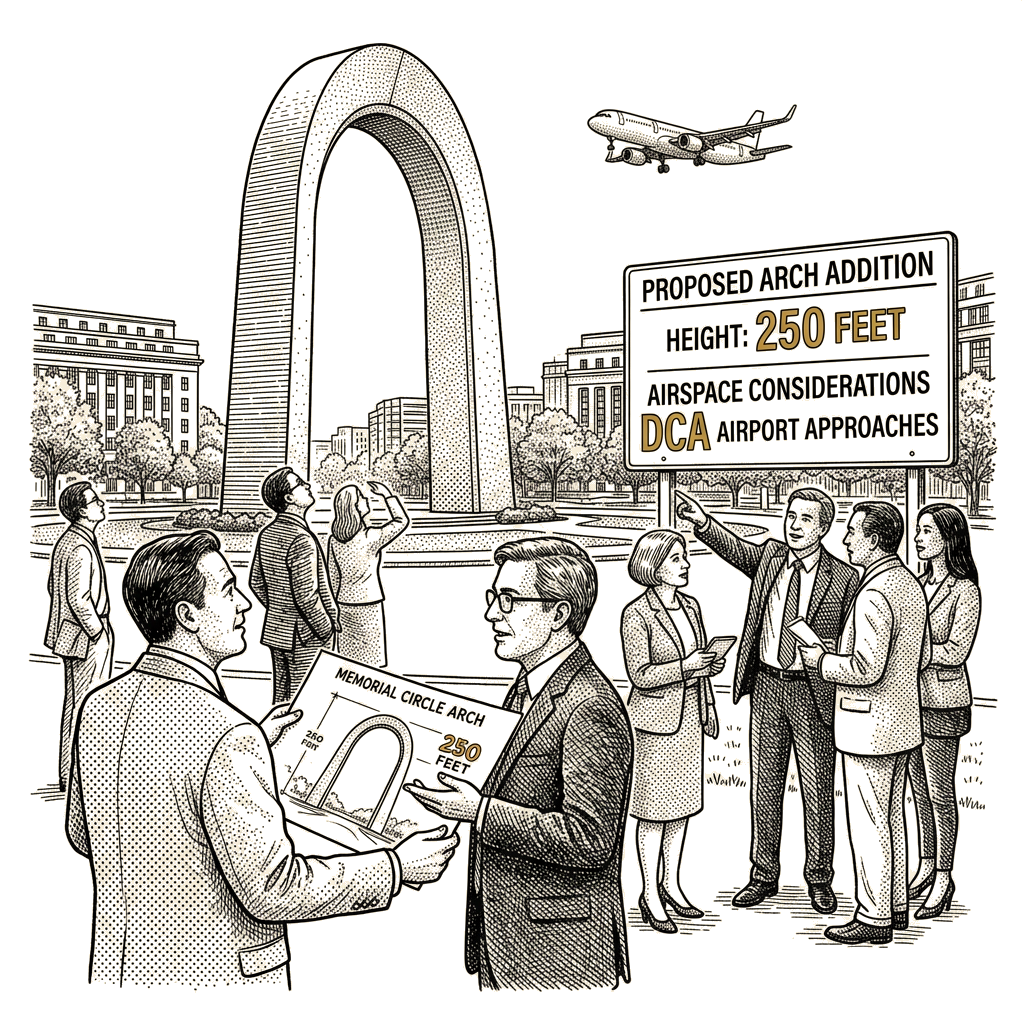
Three aviation safety experts told NPR that the Trump administration’s proposed 250-foot arch at Memorial Circle — a traffic island on the historic bridge connecting Washington, D.C., to Arlington, Virginia — would likely not pose a significant risk to most aircraft but would add yet another variable to a notoriously crowded and complicated airspace around Ronald Reagan Washington National Airport. Shawn Pruchnicki, a former airline pilot and accident investigator who now teaches aviation safety at Ohio State University, went further and called the project “inherently dangerous.”
The arch would stand about two aeronautical miles from the airport’s main runway, which is one of the busiest in the country and the destination of the Runway 19 “River Visual” approach. Pilots approaching Runway 19 via the River Visual must follow the Potomac River and then make a sharp turn — as abrupt as 40 degrees — at low altitude, below 500 feet, to avoid prohibited airspace near the White House and U.S. Capitol. Some airlines require special training to land at DCA or have designated it “captain-only,” meaning only the more senior officer can fly the approach.
The Trump administration said earlier this month it would soon begin preliminary excavation work at Memorial Circle, even though questions about aviation safety and other concerns remain unanswered. The administration maintains the arch would not pose an additional risk.
The president originally said the arch was for himself, though he has since characterized it as a tribute to the country’s 250th anniversary. The White House has repeatedly said in statements that the structure will be “one of the most iconic landmarks not only in Washington, D.C., but throughout the world,” and did not respond to NPR’s questions about the experts’ concerns.
Critics of the arch, of whom there are many, have objected on a range of grounds — from its impact on Arlington National Cemetery and disruption of nearby historic sites to questions about its scale, purpose, and financial cost.
“This is an unbelievably ridiculous idea, to put this arch so close to this airport just for the sake of his personal needs,” Pruchnicki said of Trump. “Why would the White House and the secretary of transportation ever think that is a good idea? Who is more important here? The public, perhaps?”
Tom Lintner, who spent 30 years in aviation safety at the FAA — including as an air traffic controller at New York’s LaGuardia Airport — focused his concerns on helicopters and controller workload. “As the traffic gets denser and denser, you may find controllers having to make transmissions every five, six, seven seconds,” Lintner said. “There reaches a point where there aren’t enough seconds left to make the right decision.” Lintner noted that helicopters operate below 500 feet in some areas near DCA and as low as 200 feet in others — lower than the proposed 250-foot arch. Lintner did what he calls “back of the envelope” math, which he outlined in a Substack post in August. Altitude-wise, he said the arch is unlikely to present a problem for airlines. But he said it could further complicate the airspace for helicopters, which he called “the last thing this area needs.”
Jeff Guzzetti, a retired accident investigator who worked at both the National Transportation Safety Board and the FAA, said the airport was “never meant … to have this amount of traffic.” The airport, which opened in 1941, was designed to accommodate about 15 million passengers a year but now serves closer to 25 million. Because DCA is owned by the federal government, Congress regulates the number of flights — and lawmakers have historically wanted to facilitate travel to and from their home districts. “It’s a small airport with one runway, nestled in a metropolitan area that’s surrounded by prohibited airspace [near the White House and U.S. Capitol],” Guzzetti said. “The best, and the most basic option, is simply not to build it.”
Landing at DCA is already notoriously difficult. Guzzetti said pilots passing the Memorial Circle site would be roughly 60 seconds from touchdown when they need to make that turn to the final approach. Guzzetti, like the other experts NPR interviewed, is most concerned about the challenge the arch could pose to planes that are landing, not taking off.
Pruchnicki, who flew the Runway 19 approach many times, said it is even trickier in dark or windy conditions. A plane inadvertently flying lower than it should be, facing strong easterly winds, “could easily get blown into” the arch, he said. “If everything is working perfectly, I don’t see that it would be a significant problem. However, we all know, at all airports, things go wrong all the time.” Pruchnicki said complications arise all the time in the tricky airspace near DCA, and questioned why the administration would want to build something that could “potentially put passengers’ lives at risk” in those moments.
Guzzetti said the arch itself is unlikely to confuse pilots who see it. “That arch is going to be just a few hundred yards, maybe two or three football fields to the right of where your flight path is,” Guzzetti said. “So it’s going to look imposing. It’s going to be dramatic. But a pilot is not going to mistake that or get too close to it.” The greater risk, the experts agreed, is in the additional variables introduced by another obstacle. “This is just adding another hazard,” Guzzetti said. “Granted, it might not be significant, but still, it’s yet another … opportunity for exposure to something bad happening.”
The concerns come against a backdrop of recent safety incidents at DCA. In January 2025, an American Airlines regional jet and an Army Black Hawk helicopter collided midair near the airport, killing 67 people. The January 2025 midair collision shed light on a pattern of close calls at DCA, resulting in a slew of rule changes and restrictions on helicopters. But some say those measures are not enough. In early August, federal investigators found that ongoing construction of the White House ballroom contributed to radio problems that prevented air traffic controllers from hearing a warning before a military helicopter carrying Trump briefly flew too close to a passenger jet departing DCA. Guzzetti said the August incident exemplifies the unique challenges and variables of D.C.’s airspace even without a 250-foot arch along the primary flight path.
Some aviation experts and one Democratic lawmaker have raised concerns that the FAA may face political pressure to approve the arch. Lintner pointed to a structural conflict: the FAA operates the U.S. air traffic control system while simultaneously regulating aviation safety. “Nobody’s watching the watchers,” Lintner said. “In other words, anybody who says, ‘Wait a minute, how do we know that’s safe?’ The answer is, ‘Well, the FAA decided it’s safe.’ But did they? What’s the checks and balances?” In June, Sen. Tammy Duckworth, D-Ill., wrote a public letter urging the FAA “to be firm in rejecting any improper or irresponsible pressure from President Trump to prioritize the construction of his gaudy, vanity arch over the safety of the American people.” The White House did not respond to NPR’s questions about perceived political pressure. The FAA also did not respond to NPR’s questions about that concern.
A preliminary FAA report in June said the structure would likely not be a hazard if it carried blinking red obstruction lights, similar to those on the 555-foot-tall Washington Monument. An FAA spokesperson told NPR over email in early September that “the standard obstruction evaluation process is under way,” both for the arch and cranes that would be used for construction, which the administration has said could be up to 320 feet tall. Neither the FAA nor the White House shared a timeline or further details about those reviews. The agency is conducting a more comprehensive aeronautical study that could lead it to label the arch “a hazard.” Under federal regulations, the FAA must be notified before construction of any structure — building, cell tower, crane — that would stand either over 200 feet tall or within a certain slope of airport runways, and the agency conducts an aeronautical study to determine whether the object would constitute a hazard. “They’ll actually put out a memorandum to indicate: ‘Yes, this is a hazard and it needs these types of lights’ … or ‘It’s no hazard, you can go ahead and build it,’” Guzzetti said.
At the study’s conclusion, the entity behind the proposed construction — in the case of the 250-foot arch, the National Parks Service — has 60 days to either agree to those conditions, terminate the study, or request further study. “Further study includes opportunities to negotiate or propose mitigations, and the FAA may request public comment,” an informational FAA video explains. An FAA spokesperson confirmed that the public comment period for the arch ended on Sept. 3. The rest of the timeline is unclear: Pruchnicki said he has generally seen this process take anywhere from several months to nearly a year.
The FAA could ultimately issue a “determination of hazard,” but because the agency does not have land-use authority, its conclusion is not legally binding. “The president can simply instruct his [transportation secretary] to write a waiver for that, to ignore that,” Guzzetti said. “I can see that happening with this president.” Either way, Guzzetti said, the FAA would ideally make sure certain steps are taken, such as adding red lights to the arch, clearly labeling the structure on aeronautical charts, and monitoring any complaints from pilots and the public about planes getting too close. “We all know that aviation involves risks any time you defy gravity,” Guzzetti said. “But it’s managing that risk which is the trick.”
The arch has not yet been approved by the National Capital Planning Commission, which has granted preliminary green lights and is expected to weigh final approval in the coming months. Historic preservation experts say the review process has been rushed. An ongoing lawsuit asserts the structure cannot be built without congressional authorization, which Trump denies and has not sought. The White House told NPR it continues “seeking final approval from all applicable entities.”
U.S. Rep. Don Beyer, a Democrat who represents the Virginia side of the bridge, told NPR he has yet to meet a constituent from his district — on either side of the political aisle — who wants to see the arch built. “An enormous number of airplanes come over that site, basically every 45 to 60 seconds all day long ‘til 11 at night,” Beyer said. “Just imagine the disaster that could happen with all of these airplanes coming right across a 250-foot-high arch.” “The imminent concern, beyond his narcissism … is what it will do to transportation,” he said, referring to planes as well as cars. In response to congestion, two Democratic Virginia senators introduced legislation last week to cap hourly arrivals at DCA and gradually reduce flights over a four-year window starting in 2028. “Since the collision, there have been numerous near misses in DCA airspace,” Sen. Mark Warner, a co-sponsor, said in a statement.