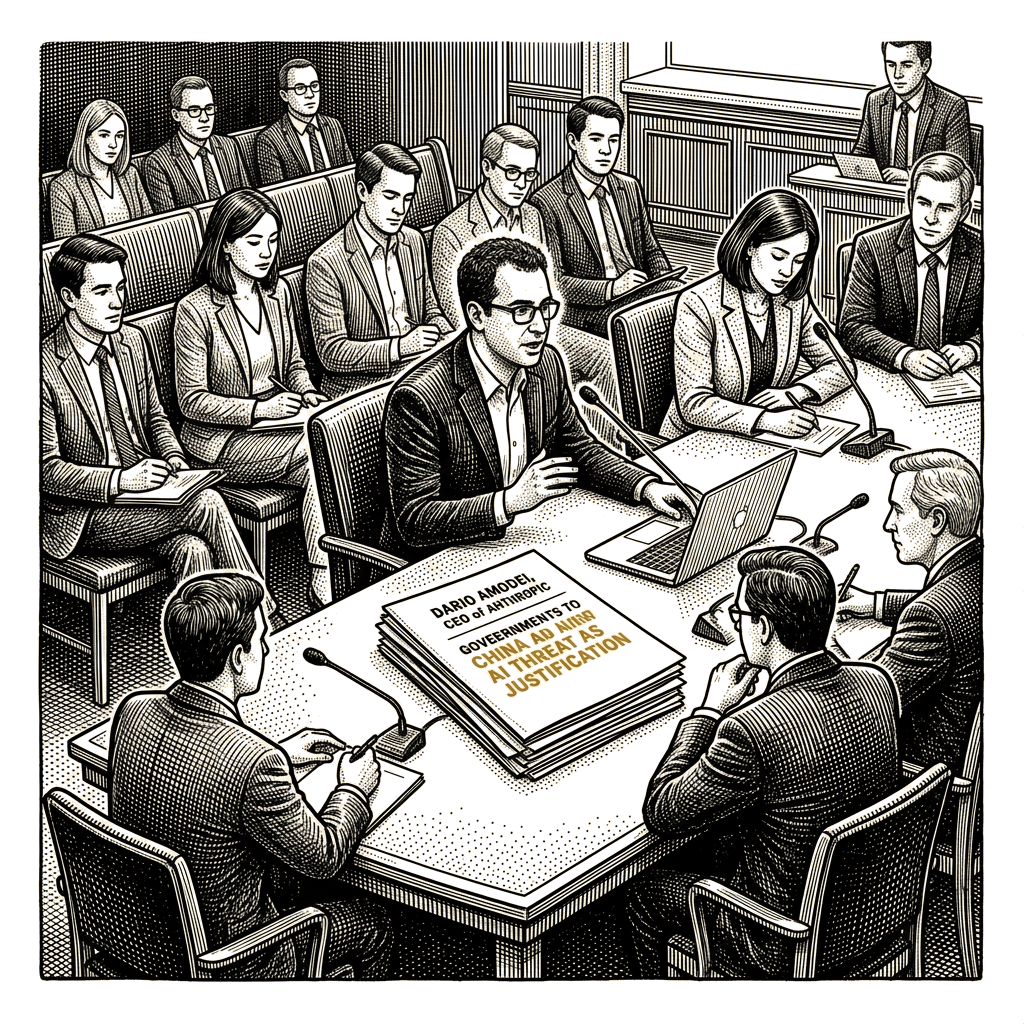
The article documents a frame currently shaping US AI policy debate. The frame links two previously distinct concerns — the alignment and safety of frontier AI systems, and US-China strategic competition — into a single race-for-democratic-AI narrative. Brookings Institution fellow Kyle Chan and Atlantic Council senior China fellow Kenton Thibaut have characterized Anthropic’s role in this synthesis as having “merged AI safety advocacy with hawkish China rhetoric,” according to The Guardian.
The synthesis can be audited on the four dimensions Robert Entman names for frames. On problem definition, the frame treats AI development as a zero-sum contest in which “the United States can only slow frontier AI development to the point where China could not catch up,” as Anthropic CEO Dario Amodei told reporters this week. On causal interpretation, the frame posits that if either side defects from restraint while the other complies, the defector gains “geopolitical dominance” — Amodei’s published warning reads: “if we greatly restrain our AI capabilities in the belief that China will do the same, and then China defects, AI could be so powerful that such a defection could lead to their geopolitical dominance.” On moral evaluation, the frame assigns valence to each actor: “basically a struggle between a world dominated by authoritarian AI versus democratic AI,” in Chan’s summary of Amodei’s view, and “run-the-table dominance and control of the most critical technologies and supply chains” by the Chinese Communist Party, per Anthropic’s head of national security policy Tarun Chhabra’s Senate testimony. On treatment recommendation, the frame prescribes maintaining the US lead, restricting Chinese access to advanced semiconductors, and accepting an arms-race posture — Sarah Heck, Anthropic’s head of public policy, summed the posture at a Politico event: “the United States needs to stay in the lead on AI and you cannot do safety from second place.”
The frame’s linguistic machinery includes the Manhattan Project metaphor (the US-China Economic and Security Review Commission’s top recommendation, per its annual report to Congress, was “establishing and funding a Manhattan Project-like program dedicated to racing to and acquiring an Artificial General Intelligence”), the Mutually Assured Destruction analogy repurposed as “Mutual Assured AI Malfunction” in a 2025 deterrence doctrine published by Eric Schmidt, Alexander Wang and Dan Hendrycks, and historical-supremacy imagery (“a nation with sole possession of super-intelligence might be as overwhelming as the Conquistadors were to the Aztecs,” per the Maim paper). Cold-war vocabulary — “defection,” “structural conflict,” the “foothills of a great-power hot war” in Matt Pottinger’s 2024 formulation — naturalizes a particular threat model.
A counterframe would treat AI safety as primarily a technical-alignment problem whose solutions (interpretability, robustness testing, international coordination on autonomous-weapons limits) are not contingent on which nation reaches AGI first. This counterframe selects in cooperation possibilities the operative frame selects out. The article documents one such possibility directly: “loss-of-control debates are relatively new in China, where the government’s primary concern is AI’s potential to fuel domestic social unrest,” per The Guardian. Thibaut is quoted saying the linkage “made it much harder to get the Chinese to want to talk about these things and not see it purely as a veiled way to slow them down,” and Chan said Anthropic “has played quite a strong role here in linking those issues together in a way that they maybe didn’t need to be linked.” The counterframe makes visible what the operative frame naturalizes — that a single policy instrument (US frontier acceleration combined with Chinese restriction) cannot simultaneously serve alignment (which rewards careful development) and competition (which rewards speed).
The thesis and the documented downstream effects sit in genuine tension. The documented downstream friction stands as a counterweight. Thibaut is quoted saying the linkage “made it much harder to get the Chinese to want to talk about these things and not see it purely as a veiled way to slow them down,” and Chan said Anthropic “has played quite a strong role here in linking those issues together in a way that they maybe didn’t need to be linked.” China’s state-backed media have characterized Amodei as running a “cold war playbook,” per The Guardian, and the US-China AI cooperation talks scheduled for this month are widely expected to yield limited agreement. The thesis’s defenders — and the article provides the substrate — point to the underlying security dilemma. Pottinger, the architect of Trump’s first-term China policy and Amodei’s co-author on a Wall Street Journal op-ed, has argued the United States and China are in the “foothills of a great-power hot war.” Amodei’s January essay “The Adolescence of Technology” states: “there are a number of possible arguments against the severity of these threats, and I wish I believed them, because AI-enabled authoritarianism terrifies me.”
Where the substrate contradicts the frame: the operative frame is correct that strategic competition is structural and that concentration of frontier capability in any one jurisdiction carries distinctively different governance implications — Pottinger, Chhabra, Anduril’s Palmer Luckey (whose firm projects must assume China launches hostilities against Taiwan in 2027), and Palantir’s Alex Karp (who told Axios “we are going to be the dominant player or China is going to be the dominant player”) all operate from this premise on the record. The frame is contradicted by the substrate it has itself produced: Chan and Thibaut’s documented observation that the linkage has impeded the very diplomatic opening that Anthropic’s stated safety concerns would require. What is preserved from the thesis: the seriousness of the geopolitical question and the legitimacy of treating frontier capability as a state-level concern. What is cancelled: the assumption that “winning” the race and addressing the underlying risks are the same problem solvable by one policy instrument. The same acceleration that purports to deliver safety from second place, on the substrate supplied, has also foreclosed the cooperation track that safety claims to require.
Four paradigms operate from incompatible premises. The realist/security paradigm (Amodei, Pottinger, Chhabra, Karp, Luckey) treats AI through national-power lenses. The longtermist/safety paradigm (Yudkowsky, Aschenbrenner, Hendrycks) treats alignment failure as the dominant risk and arrives at hawkish conclusions through different reasoning — Yudkowsky has written that “preventing AI extinction scenarios is considered a priority above preventing a full nuclear exchange,” and Aschenbrenner wrote in 2024 that “the free world’s very survival will be at stake.” The industry/competitive paradigm (Jensen Huang, Sam Altman, Mark Zuckerberg) emphasizes economic competition and treats export controls as counterproductive on their own competitive logic — Huang has “called export controls a failure” and urged Trump to ease restrictions. The Chinese strategic paradigm, as reported, treats AI primarily through domestic-stability and developmental lenses and reads the US safety-and-competition merger as a containment strategy.
Cross-paradigm tension: each paradigm produces a different prescription. None of them, on the substrate supplied, treats as central the consensus Thibaut reports — “we don’t win if we develop the killer robots first. Nobody wants killer robots.” Amba Kak, co-executive director at the AI Now Institute and former senior adviser on AI for the Federal Trade Commission, is quoted warning that “you can go ahead and wield the China arms race argument, but at some point this industry will also have to deal with the consequences of fueling a race to the bottom.” The claim that holds across paradigms is that unilateral acceleration produces risks none of them individually endorse. That claim is recognizable to each paradigm on its own terms. It sits in unresolved tension with the operative frame’s recommendation that the same acceleration is the principal remedy.
Analytical techniques used in this piece
This analysis applies the methods below. Each links to a short, plain-English explainer you can read and reuse.
- Dialectical Analysis
- Holds thesis against antithesis and works toward a higher synthesis.
- Frame Audit
- Surfaces the frame an argument adopts and what that framing quietly includes or excludes.
- Worldview Cartography
- Maps the clashing worldviews underlying a dispute.
- Confirmation Bias
- Seeking and overweighting the evidence that confirms what one already believes.
- Prisoner’s Dilemma
- Individually rational choices leave everyone worse off than cooperation would.