Summary
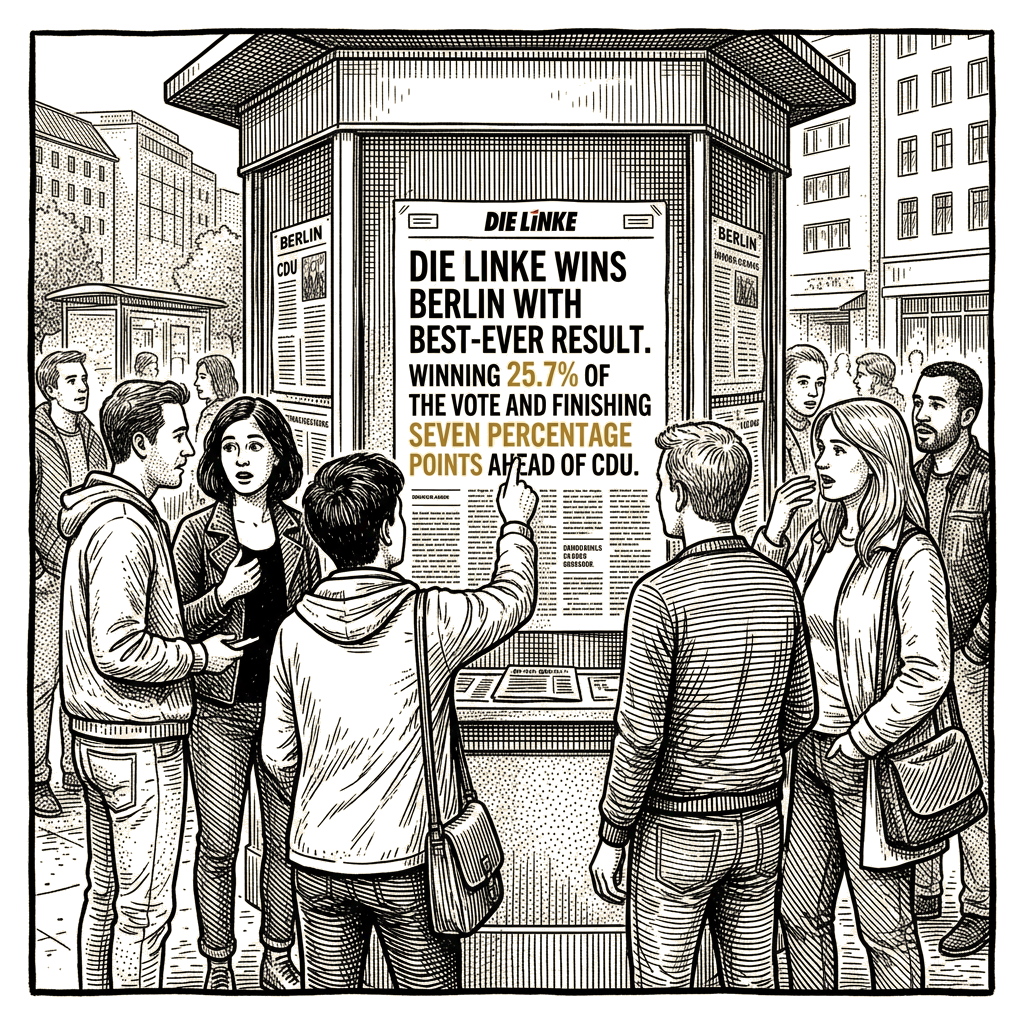
- Sunday’s state-election results, reported by NPR on September 21, 2026, exposed structurally distinct problems at each political pole: Die Linke, which NPR describes as far-left, recorded its strongest result on record at 25.7% in Berlin; the Alternative for Germany, which NPR describes as far-right, captured 38.2% in Mecklenburg-Western Pomerania; and the CDU fell to 4.9% in MWP — below the threshold for state-parliament entry and, as NPR reports, the party’s worst result in any state since World War II.
- The CDU’s three consecutive state defeats — Saxony-Anhalt two weeks earlier, then Berlin and MWP Sunday — constitute a state-level cascade rather than a single-night story, per NPR reporting.
- Cost-of-living grievances appear to have channeled through a fragmented party system: Die Linke’s rent-cap and apartment-seizure pledges addressed Berlin’s housing-affordability vote; the AfD drew from rural northeastern consolidation patterns.
- Coalition arithmetic excludes the largest vote-winners from governing in both states — Eralp needs at least two additional Berlin coalition partners, and the AfD is, per NPR, “unlikely to find coalition partners willing to join it in government” in MWP.
- Chancellor Merz’s announced federal reform agenda — tax and welfare changes framed, per NPR, as “the antidote to the poison of authoritarianism” — faces the diagnostic question of whether a unified federal remedy can address two structurally distinct regional problems.
Sunday’s state-election results, reported by NPR on September 21, 2026, delivered the Christian Democratic Union its second and third state-level defeats in two weeks. In Berlin, Die Linke, which NPR describes as far-left, recorded its strongest result on record at 25.7% — seven points ahead of the CDU — under leader Elif Eralp, whose parents fled Turkey after the 1980 coup d’état. Eralp pledged to introduce a rent cap and to seize apartments owned by large corporate real-estate developers, a platform NPR linked to New York Mayor Zohran Mamdani’s housing agenda. In rural northeastern Mecklenburg-Western Pomerania, the Alternative for Germany, which NPR describes as far-right, captured 38.2% of the vote, while the CDU received 4.9% — below the threshold for state-parliament entry and, per NPR, the party’s worst result in any state since World War II. AfD federal leader Alice Weidel told public broadcaster ARD that “Friedrich Merz is the wrong chancellor for the CDU” and that her party benefits the more he “digs in his heels.” Chancellor Merz scrapped a planned trip to the United Nations General Assembly to address supporters from the CDU’s Berlin headquarters, calling the night a “disaster” for the political center but dismissing resignation talk and announcing he would push ahead with federal tax and welfare reforms. The analytical claim the rest of this analysis develops: the night’s significance lies less in uniform center weakness than in structurally distinct problems at the two flanks — and in the institutional coalition math that excludes both extreme winners from government while leaving the federal chancellor to defend a unified reform agenda.
Who benefits, who is exposed
The night’s results, per NPR reporting, positioned two distinct beneficiaries at the two political poles and exposed two distinct sets of incumbents.
Die Linke and its Berlin leader Elif Eralp, whose parents fled Turkey after the 1980 coup d’état, advance from Berlin’s leading vote-share as government-builder. Eralp’s signature pledges — a rent cap and state seizure of apartments owned by large corporate real-estate developers — enter coalition negotiations as stated demands rather than negotiable margins; NPR reported the plan “could prove contentious as she enters coalition negotiations this week.” Her statement, as quoted by NPR, that “in our city, love and justice have triumphed over hate,” anchors a framing pitched against the AfD’s 16.3% Berlin share.
The AfD, under federal leader Alice Weidel, gained a state-level consolidation in MWP that the article positions as federal target. Weidel’s ARD interview, in which she characterized Merz as “the wrong chancellor for the CDU” and stated her party benefits the more he “digs in his heels,” functions as a strategic signal that continued Merz-led CDU weakness is the AfD’s operative target. The article reports the AfD is “telling the mainstream parties it is waiting in the wings for the next federal election.”
Berlin tenants are the high-urgency, high-legitimacy, low-power constituency the rent cap explicitly addresses. Large corporate real-estate developers in Berlin carry power and urgency under the proposed seizure, with legitimacy contested by the policy itself.
Chancellor Friedrich Merz is the most exposed figure, holding federal executive power and electoral legitimacy, with urgency on both his reform agenda and his own position. Sudha David-Wilp of the German Marshall Fund, quoted in the article, framed the institutional constraint: “Merz himself has wanted to be chancellor for so long that he is probably loath to throw in the towel, and he also knows the bar is very high to oust a chancellor in Germany.” Merz’s response — scrapping a planned United Nations General Assembly trip to address supporters from party headquarters, calling the night “disaster” for the political center, and announcing he would push ahead with federal tax and welfare reforms — is documented by NPR as an unusual move for a federal chancellor commenting on state election results, signaling federal-level alarm exceeding ordinary reaction.
SPD Governor Manuela Schwesig in MWP finished second at 35% but, per NPR, is “expected to remain in office” through a coalition arrangement under which the AfD will not find coalition partners. The SPD’s federal leadership sits in a structurally analogous position of coalition-tethered exposure to voter dissatisfaction, though the article does not document equivalent direct pressure on SPD federal leadership for the MWP result.
Why the results diverge
Five candidate explanations carry varying diagnostic weight against three features the article documents: both extremes gained while both mainstream parties lost across Berlin and MWP; a third mainstream-party loss occurred in Saxony-Anhalt two weeks earlier; and the coalition arithmetic excludes the largest vote-winner in MWP while requiring multi-party deals in Berlin.
The leading candidate — cost-of-living grievance channeled through a fragmented party system — finds support in the policy concentration of the winning parties. Die Linke’s signature proposals concentrate on affordability (rent cap, apartment seizure), and the AfD’s parallel gains fit the same channel at a different demographic and geographic price point. Both extremes moved up while both mainstream parties moved down, and the specific policy content of the winning parties addresses affordability.
A second high-diagnostic-value candidate — structural party-system fragmentation — is supported by three concrete features the article documents: Eralp must build a coalition that includes at least two additional parties to take office in Berlin; the AfD is, per NPR, “unlikely to find coalition partners willing to join it in government” in MWP; and Weidel positions the AfD for the next federal election. David-Wilp, cited in the article, characterized “an increasingly fragmented political landscape” that “produces unstable coalitions with parties blocking each other from implementing policy.” This candidate explains both extremes’ gains and the institutional fact that the AfD can win a state plurality without governing.
East-West divergence carries medium diagnostic value. The AfD’s 38.2% in rural northeastern MWP contrasts with its 16.3% in Berlin; the CDU’s sub-threshold 4.9% in MWP has no parallel in Berlin. The candidate locates AfD gains in a specific regional base but does not, by itself, explain Die Linke’s Berlin strength, which sits outside the East-West frame.
A more granular reading — housing-cost grievance in Berlin, eastern-consolidation patterns in MWP — points toward different policy responses for each flank, against the unified federal reform agenda Merz is currently advancing. The article does not establish that the two flanks share a single cause.
The coalition-fragmentation constraint, also of medium diagnostic value, places CDU losses as downstream of coalition arithmetic that constrains any chancellor’s room for maneuver. NPR reported that Merz’s federal coalition with the SPD has found consensus “difficult to maintain even with just one coalition partner,” consistent with the constraint operating across both contests.
A second-order-election reading — the two state contests as referenda on the federal coalition rather than autonomous local expressions — is not falsified by the single Sunday. Under this reading, the Berlin leftward shift reflects federal-coalition unpopularity being absorbed by Die Linke rather than the SPD as junior partner; the MWP result reflects the same federal-coalition disapproval being absorbed by the AfD in the east. The article’s “waiting in the wings” framing is consistent with this reading.
The null hypothesis — that the results reflect normal cyclical state-election volatility and the CDU will recover at the federal level — is weak on three grounds: David-Wilp’s observation that the bar is “very high to oust a chancellor in Germany” suggests institutional stickiness; the SPD’s loss to the AfD in MWP extends the pattern beyond Merz personally; and the article documents a third mainstream-party loss in Saxony-Anhalt two weeks earlier.
Working synthesis. The two high-value candidates combine: cost-of-living grievance channeled through a fragmented system that allows the extremes to capture state-level votes while institutional coalition math keeps them out of government. Under this synthesis, the cascade’s predictive signal is which flank Merz’s reform agenda fails to address first. If the synthesis holds, the Berlin housing-cost grievance and the MWP eastern-consolidation pattern are not the same problem, and a unified federal remedy will not reach either.
What happens next
Immediate horizon (this week to month). Eralp’s Berlin coalition negotiations will determine whether her rent cap and apartment-seizure proposals enter the governing agreement or are bargained away — a determination that, per NPR, “could prove contentious” given coalition arithmetic requiring at least two additional partners. In MWP, Schwesig’s coalition formation proceeds under the documented AfD-exclusion constraint. Merz’s response from party headquarters, framing his tax and welfare reforms as “the antidote to the poison of authoritarianism,” commits the federal government to a unified reform agenda in the immediate aftermath of three state losses.
Short-term horizon (months to one year). The Berlin outcome will produce either a governing test of the housing agenda, with possible constitutional review if operative law triggers property-rights challenges, or a negotiated dilution that may itself become a political liability for Die Linke among its base. The federal CDU-SPD coalition will face strain if the three recent state losses are read within the SPD as evidence that Merz’s reform strategy is electorally costly. The housing and real-estate sector will respond to Berlin coalition signals through investment, lending, and development-pipeline decisions whose reach extends beyond Berlin’s borders.
Medium-term horizon (one to five years). Sustained fragmentation raises the probability of an early federal election. Weidel’s framing — that the AfD benefits the more Merz “digs in his heels” — suggests the AfD’s strategy is structured around continued Merz-led CDU weakness, functioning as a self-reinforcing dynamic if the structural-divergence diagnosis holds. EU policy coordination, particularly on fiscal rules and migration, faces friction if Germany’s internal coalition arithmetic impedes decisive federal positions. Eralp’s fallback if coalition partners refuse her apartment-seizure commitment is a minority arrangement or renewed election, neither of which protects those policy anchors. The AfD’s fallback if the next federal election is delayed is continued opposition positioning.
Long-term horizon (five years and beyond). Consolidated state-level gains at both poles may point, though the article does not establish this comparison, to a realignment of the German party system on a scale the article does not measure. The political center is at minimum structurally reduced rather than cyclically weak at this data point.
Power, legitimacy, urgency
The night crystallized a stakeholder geometry that will shape the months ahead.
Chancellor Merz holds all three attributes — federal executive power, electoral legitimacy as federal chancellor, and urgency on both his reform agenda and his own position. The article documents his announced posture: a call for backbone, steadfastness, and patience, tracking a grinding path through the legislative cycle.
Eralp holds all three attributes — apparent Berlin government-builder power, leading-vote-share legitimacy, and urgency on coalition negotiations and her housing agenda. Her biographical anchor (parents fled Turkey after the 1980 coup d’état, per NPR) potentially informs her standing with Berlin’s Turkish-diaspora and migrant communities.
Weidel carries power and urgency, with legitimacy contested: NPR’s “far-right” descriptor and the documented refusal of mainstream parties to coalition with the AfD in MWP both indicate institutional limits.
Schwesig holds all three attributes at reduced urgency — she is, per the article, “expected to remain in office.”
Large corporate real-estate developers in Berlin carry power and urgency under the proposed seizure; legitimacy contested by the policy itself.
Berlin tenants are the high-urgency, high-legitimacy, low-power constituency the rent cap explicitly addresses.
Stakeholders absent from the immediate frame but bearing on the trajectory include SPD federal leadership, on whom coalition arithmetic with the CDU determines whether Merz’s tax and welfare reforms proceed; Germany’s constitutional court, whose latent salience rises if Eralp’s apartment-seizure proposal moves from campaign pledge to operative law and encounters property-rights doctrine; and EU partners, on whom any German fiscal-policy shift bears through framework coordination.
Unintended consequences
Two consequences follow from the structure rather than from any actor’s stated plan.
First, Merz’s framing of his reform agenda as “the antidote to the poison of authoritarianism” may consolidate his base while hardening the perception among cost-of-living voters that the federal government is unwilling to engage the channel through which both extremes are gaining.
Second, the institutional exclusion of the AfD from coalitions in MWP — maintaining the cordon sanitaire in the short term — may deepen the AfD’s positioning as opposition-of-principle rather than opposition-of-compromise, a status the article does not document a trajectory for but which the structural exclusion from government in MWP and likely other eastern states reinforces over subsequent cycles.
A symmetry check
The article documents losses for both mainstream parties — the CDU and the SPD, with the SPD’s Schwesig finishing second to the AfD in MWP. Weidel’s critique applies to Merz by name; David-Wilp’s observation that the bar is very high to oust a chancellor in Germany is sourced to her. The article does not document equivalent direct pressure on SPD federal leadership for its MWP result, though the federal coalition arithmetic places the SPD in a structurally analogous position of coalition-tethered exposure to voter dissatisfaction. Merz, per the article, intends to push ahead with his agenda regardless.
Analytical techniques used in this piece
This analysis applies the methods below. Each links to a short, plain-English explainer you can read and reuse.
- Consequences & Sequels
- Plays a decision forward to its first- and second-order consequences.
- Differential Diagnosis
- Lists the candidate explanations for a symptom and rules them out one by one.
- Stakeholder Mapping
- Charts the parties to a situation — their interests, power, and alignments.
- BATNA
- Your best alternative to a negotiated deal — the walk-away that sets your leverage (Fisher & Ury).