Merz calls night a ‘disaster’ for political center, dismisses resignation talk
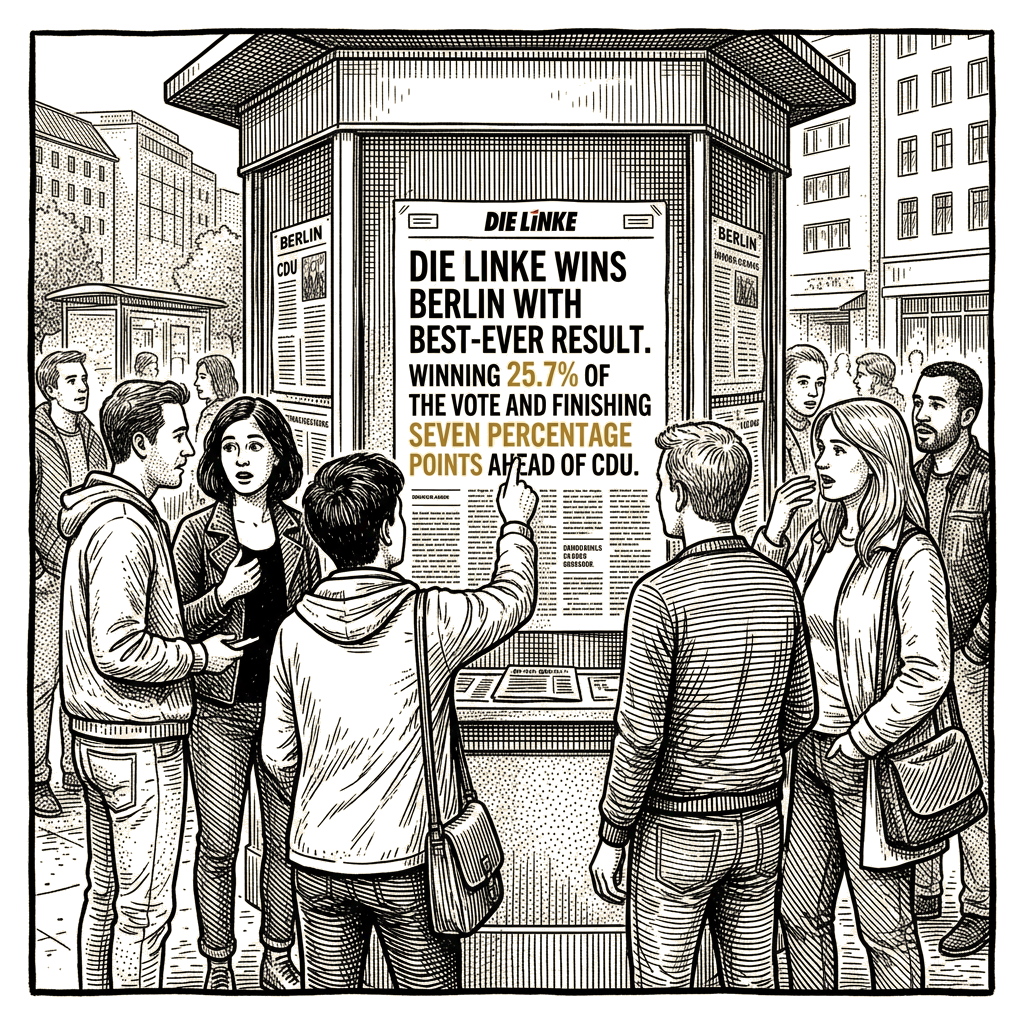
Die Linke, which NPR describes as far-left, recorded its strongest result on record in Berlin’s state election Sunday, winning 25.7% of the vote and finishing seven percentage points ahead of Chancellor Friedrich Merz’s Christian Democratic Union. Die Linke leader Elif Eralp, whose parents fled Turkey after the 1980 coup d’état, pledged to make Berlin affordable again, proposing to introduce a rent cap and to seize apartments owned by large corporate real-estate developers. She drew comparisons with New York Mayor Zohran Mamdani. Taking to the stage as the results came in, Eralp said that Berliners will not tolerate the AfD’s policies, adding that “in our city, love and justice have triumphed over hate.”
In a parallel setback in the rural northeastern state of Mecklenburg-Western Pomerania, the Alternative for Germany, which NPR describes as far-right, captured 38.2% of the vote while the CDU received just 4.9% — below the threshold meant to keep fringe parties out of the state parliament and the CDU’s worst result in any state since World War II. The AfD made significant gains in both states since the last state elections there in 2021 and 2023. In Berlin, the AfD received 16.3%.
The dual losses for Merz’s party came two weeks after a similar CDU defeat in the state of Saxony-Anhalt and left the chancellor under pressure as the AfD told the mainstream parties it was waiting in the wings for the next federal election. Merz, who had been scheduled to travel to New York for the United Nations General Assembly, addressed supporters from his party’s Berlin headquarters as the exit polls came in. He conceded that the night spells “disaster” for the political center but said he would push ahead with his federal agenda of tax and welfare reforms, describing them as “the antidote to the poison of authoritarianism.” He said implementing those reforms “require backbone, steadfastness and patience” and that he would “demonstrate this” as “chancellor of our country.”
Merz quashed talk within the press and his own party about his possible resignation despite the losses. It is unusual for the German federal chancellor to comment so promptly on state election results, particularly for two states with relatively small electorates, but the setbacks are starting to reflect poorly on him, NPR reported.
In Mecklenburg-Western Pomerania, the AfD also beat Merz’s federal coalition partner, the Social Democrats (SPD). Incumbent SPD Governor Manuela Schwesig, who finished second with 35%, is nevertheless expected to remain in office, because the AfD is unlikely to find coalition partners willing to join it in government.
In Berlin, which functions as both a city and a state, for Eralp to take office as mayor she must form a government with at least two other parties. Germany’s electoral system combines winner-take-all and proportional representation, requiring parties to assemble coalition partners to reach a parliamentary majority. Eralp’s plan to seize corporate-owned apartments could prove contentious as she enters coalition negotiations this week, NPR reported. On the federal level, Merz — whose CDU co-governs with the SPD — has found that kind of consensus difficult to maintain even with just one coalition partner.
Alice Weidel, the federal leader of the AfD, said the more Merz “digs in his heels,” the more her party benefits. “Friedrich Merz is the wrong chancellor for the CDU,” Weidel said in an interview with public broadcaster ARD, “and he is dragging the party down with him.”
Sudha David-Wilp of the think tank German Marshall Fund told NPR that despite talk of replacing him, Merz will counter any political reckoning by standing his ground. “Merz himself has wanted to be chancellor for so long that he is probably loath to throw in the towel,” David-Wilp said, “and he also knows the bar is very high to oust a chancellor in Germany.”
As an increasingly fragmented political landscape produces unstable coalitions with parties blocking each other from implementing policy, the AfD is telling the mainstream parties it is waiting in the wings for the next federal election.