Summary
- Macron’s reported 22 September UN address functioned as the rhetorical anchor for middle-power coalition formation around a “values-based realism” frame, with 27 leaders signing onto the Finland-Norway AI safety initiative and additional coalitions forming on West Bank sanctions, according to Guardian columnist Steve Bloomfield.
- Bloomfield documents that the coalition rests on four unresolved structural constraints: Macron’s lame-duck status since France’s 2024 snap election, UK non-accession to the AI initiative, EU-Canada “associate membership” still under discussion, and the gap between coalition signature and enforcement capacity.
- The frame’s organising vocabulary, attributed by Bloomfield to Finnish President Alexander Stubb and echoed by Canadian Prime Minister Mark Carney, treats the post-2017 erosion of the rules-based order as a rupture requiring middle-power coordination rather than great-power stewardship.
- Bloomfield identifies Trump’s UN speech as the contrast that activates the frame: economic and military boasting, musing over whether to “annihilate the Islamic Republic and do it quickly” regarding Iran, and a worldview Bloomfield characterises as the world “there to be ruled — and ruled only by the US.”
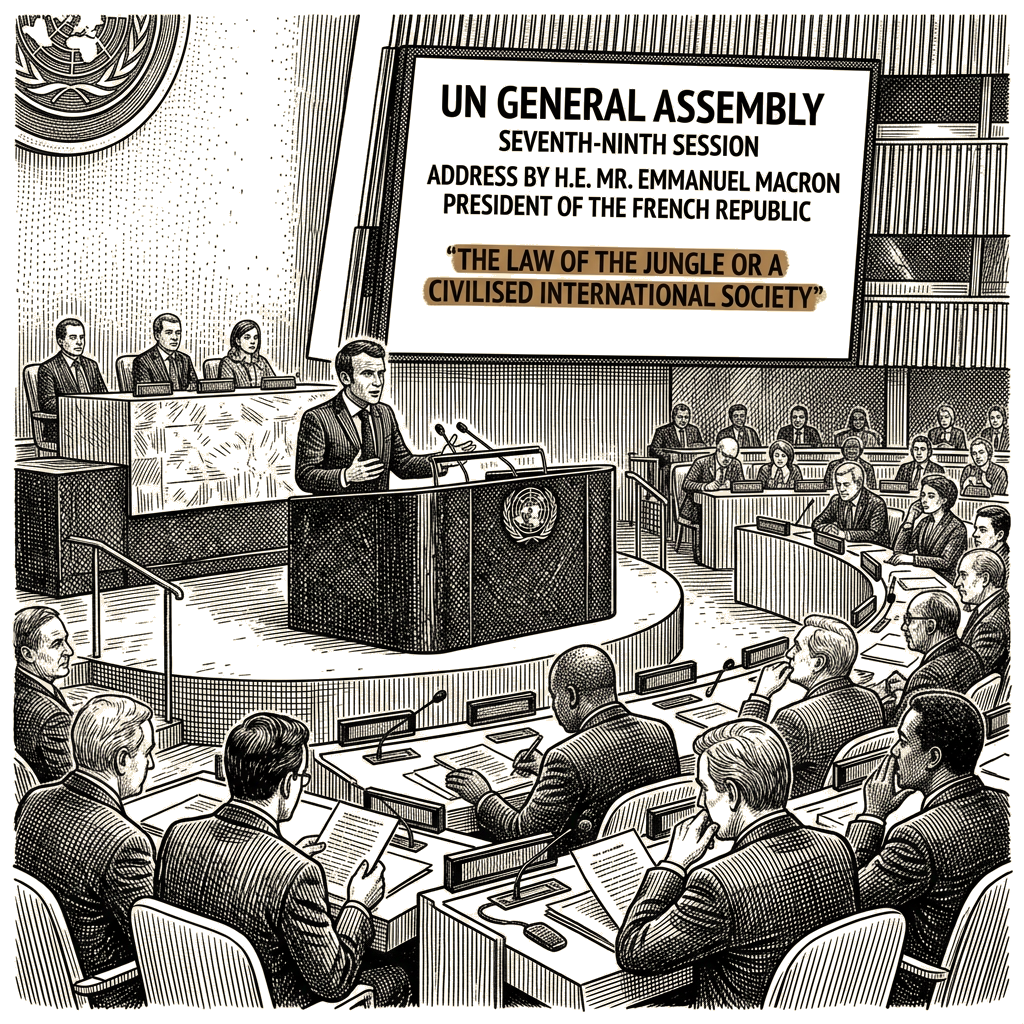
French President Emmanuel Macron’s 22 September address to the UN General Assembly — expected by Guardian columnist Steve Bloomfield to be Macron’s final speech before he steps down as president next spring — supplied the rhetorical scaffolding for a middle-power coalition that organised during the assembly week around what Bloomfield terms “values-based realism.” Hours after US President Donald Trump took the same podium to describe the US economy as “the envy of the world” and the US military as “the most powerful on Earth,” and to muse over whether to “annihilate the Islamic Republic and do it quickly” regarding Iran, Macron framed the choice as “the law of the jungle” or “a civilised international society.” Bloomfield’s central analytical claim — that Macron gave other leaders “the guts to stand up to Trump” — converted from rhetorical gesture into operational coalition-formation: Finland and Norway launched a 27-signatory call for an international AI safety body; the United Kingdom organised a coalition to impose sanctions targeting Israel’s “unlawful occupation” of the West Bank; the European Union and Canada discussed “associate membership.”
How the frame operates
Bloomfield’s column constructs a contrast structure that activates the “values-based realism” frame as the column’s organising lens. Entman’s documented framing functions populate across the column. Problem definition identifies the rules-based international order established after 1945 as breaking down, with Bloomfield writing that “the start of the break up of the rules-based order that had guided the west since the end of the second world war” coincided with Trump’s January 2017 inauguration four months before Macron’s own arrival. Causal interpretation locates agency in Trump, Russian President Vladimir Putin and Israeli Prime Minister Benjamin Netanyahu, whom Bloomfield characterises as having “ushered us into an age of impunity.” Macron’s reported framing of the moment as “a new era of barbaric acts” supplies the rhetorical vehicle. Moral evaluation runs through Macron’s self-critical line — “How many times have we heard that people’s sovereignty has value in Europe, but if we look at the Middle East and Africa, it is less valuable. No, that is unacceptable … A life is a life. Peace and security are indivisible, and everyone has a right to them” — and through Bloomfield’s columnist assessment that Macron has “consistently been one of the only western leaders with a morally intelligent analysis of what Europe and the world should look like.” Treatment recommendation points to middle-power coalition-formation as the operational vehicle, realised through three specific initiatives documented below.
The frame’s rhetorical architecture relies on a documented concession-then-reframe structure. Macron’s stated acknowledgement of the West’s “permanent temptation to espouse double standards” absorbs the most predictable accusation against his position and converts it into a credential for moral authority, as Bloomfield reports the speech. The lexical activation of metaphorical schema — “law of the jungle” presupposes a state-of-nature baseline, “civilised international society” presupposes a constructed political alternative — supplies the dichotomous choice Bloomfield presents as Macron’s central framing. Iyengar’s episodic-versus-thematic distinction is visible in the contrast Bloomfield constructs: Trump’s reported remarks are episodic (Iran as target, military as boast-worthy, economy as boast-worthy); Macron’s reported remarks are thematic (rules-based order as system, double standards as structural critique, the jungle-versus-civilisation choice as long-horizon framing).
Sociological mechanisms documented in the column. Goffman’s frame analysis identifies the “values-based realism” label — attributed by Bloomfield to Finnish President Alexander Stubb and echoed by Canadian Prime Minister Mark Carney, who “arguably … lit the ‘middle powers’ spark in Davos earlier this year” when he spoke of the “rupture” in the world order caused by Trump — as a primary framework organising a heterogeneous set of national positions into a coherent actor. Bloomfield reports Australian Prime Minister Anthony Albanese stating that “the UN mission cannot be entrusted solely to the great powers, or the biggest countries, or even the loudest voices alone,” and Spanish Prime Minister Pedro Sánchez stating that he sought to “defend what so many are trying to destroy” and called on countries to fight “political actors and governments that want to take us back to a dark past.” Goffman’s frame analysis would identify these as keyings: the ceremonial reframing of routine diplomatic remarks into commitments with raised stakes.
Media-studies mechanisms. Bloomfield reports the selection-and-salience structure of the UN General Assembly week performing Entman’s documented functions. Gitlin’s institutional-routinisation reading explains why coverage of UN General Assembly weeks reliably surfaces US-versus-rest framing — the structural fact that Macron’s speech followed Trump’s by hours, and that Bloomfield organises the column around the contrast, illustrates the point. Tuchman’s “news net” constitutive activity is visible in Bloomfield’s pattern of treating Macron’s remarks as responses to Trump rather than as autonomous French foreign-policy statements.
Propaganda-analysis mechanisms. The Herman-Chomsky manufacturing-consent lens fits Bloomfield’s characterisation of Trump’s speech as containing “false boasts” directed at a domestic audience. Bloomfield reports Trump’s UN remarks as functioning less to inform than to integrate the domestic audience around dominance signalling; Bloomfield describes the speech as “disturbingly familiar” and “a litany of false boasts and odd tangents, peppered with grim military threats against a variety of nation states.” Stanley’s “not-at-issue” terminology names the Finnish-Norwegian AI safety initiative’s reported framing as “a direct challenge to Trump, who has called concerns about AI safety a ‘hoax’” — aligning the initiative with a moralised opponent rather than letting the technical case for AI safety stand on its merits.
Snow-Benford’s frame-alignment taxonomy is partially visible in Macron’s address. The diagnostic frame names impunity; the prognostic frame points to “new alliances to support the crumbling old ones,” per Bloomfield’s phrasing; the motivational frame relies on moral universalism. The translation from speech to coalition — the AI safety initiative with 27 signatories and the UK-led West Bank sanctions coalition — illustrates Snow-Benford’s frame-alignment process on the West Bank coalition, with diagnostic, prognostic and motivational agreement across signatories. On the AI track, the documented misalignment is visible: Bloomfield reports the UK has so far not joined the Finnish-Norwegian initiative, “perhaps for fear of invoking Trump’s wrath” — a frame-alignment failure the substrate names but the column does not resolve.
Counterframes constructed to make the operative frame visible as a frame. From a US executive-branch vantage, the same events could be named “selective multilateralism pursued by traditional US allies” or “assertion of liberal institutional hegemony by declining powers”; from a non-Western Global South vantage, the frame’s appeal to universal rules can be heard as continuity of the post-1945 Western-managed order, with Macron’s stated acknowledgement of “double standards” reinforcing rather than dissolving that critique. Neither counterframe refutes the operative frame; both expose what it selects in (great-power restraint, institutional rule-following) and selects out (the West’s own enforcement record, structural asymmetries the rules-based order codified).
Whose interests the positions serve
Bloomfield’s column identifies positions; the underlying interests require inference from the documented conduct, and the same inference-vs-confirmation standard applies across actors.
For Macron, confirmed positions include defense of multilateralism, push for European strategic autonomy, and the public acknowledgment Bloomfield attributes to him that NATO “could no longer rely on the United States” — the position that, in Bloomfield’s reporting, anchored his subsequent advocacy and that was, in Bloomfield’s characterisation, unique among major leaders during Trump’s first term. The most narrowly substrate-supported inference is legacy consolidation at the end of a tenure constrained by parliamentary weakness since the 2024 snap election; Bloomfield reports Macron has been “in effect … a lame duck for the past two years.” A procedural interest in preserving the UN-based order that legitimises French diplomatic posture is documented through Macron’s reported advocacy; broader speculation about post-presidential positioning goes beyond what the substrate establishes.
For Trump, confirmed positions, via Bloomfield’s characterisation of the 22 September speech, include: the world is “there to be ruled — and ruled only by the US”; the US economy is “the envy of the world”; the US military is “the most powerful on Earth”; and on Iran, “annihilate the Islamic Republic and do it quickly.” The interest profile Bloomfield’s reporting supports is dominance signalling, security pursuit of the seven-month war with Iran, and procedural disinterest in multilateral constraint — evidenced by the reported characterisation of AI safety concerns as a “hoax” and the reported prospective G-20 invitation to Putin.
For middle-power signatories — Albanese, Sánchez, Carney, Merz, Stubb — confirmed positions, per Bloomfield’s reported quotations, include defense of UN principles against “great powers,” “the biggest countries” and “the loudest voices”; a “rupture” diagnosis of the world order; and the “values-based realism” formula. The interest profile Bloomfield’s reporting supports is institutional survival of the multilateral architecture that codifies their influence, niche leadership in agenda-setting (Finland-Norway on AI; Canada on middle-power coordination; Australia on UN principle defense), and procedural interest in establishing decision rules before the US administration can shape them.
For the United Kingdom, confirmed position is the formation of a coalition on West Bank sanctions. Confirmed non-position is non-accession to the Finland-Norway AI initiative, with Bloomfield’s hedged attribution that the absence reflects “perhaps … fear of invoking Trump’s wrath.” The interest profile the substrate supports is balance between transatlantic alliance maintenance and values-positioning, with the column leaving open which side of that balance AI safety sits on. The fact that the UK has nonetheless formed a coalition on West Bank sanctions indicates that some constraints on US alignment have already been crossed.
For Iran, Israel and Russia, the column’s coverage is compressed relative to that for Macron, Trump, the middle powers and the UK — an asymmetry that reflects Bloomfield’s column coverage rather than analytical priority. For Iran, the interest profile Bloomfield’s reporting implies is existential: Trump’s reported musing about whether to “annihilate the Islamic Republic and do it quickly” places regime survival at the top, with secondary interest in avoiding the demonstrations of US military capability Bloomfield reports as a feature of Trump’s UN remarks; no documented middle-power coalition is reported to be organising against US action on Iran. For Israel, the substantive interest Bloomfield’s reporting identifies is maintaining the West Bank occupation against a sanctions coalition Bloomfield describes as targeting “Israel’s unlawful occupation.” For Russia, the procedural-institutional interest Bloomfield flags is G20 inclusion — a move that would partially offset the diplomatic isolation Bloomfield reports has been building through the broader sanctions regime; the post-2014 G8-to-G7 transition is a relevant reference class for how the US administration balances inclusivity claims against the existing sanctions architecture.
An integrative-move candidate sits beneath the AI safety governance question: US-headquartered AI firms have commercial and reputational incentives aligned with at least some elements of safety regulation, a structural opening the column does not develop but on which the AI initiative’s durability depends. A distributive — and therefore unresolved — interest conflict sits beneath the West Bank sanctions coalition, where Israeli governmental interests and US executive-branch tolerance diverge from the European-Canadian-Australian position the column reports.
What the coalitions make probable
The substrate supports a falsifiable forecast on the Finland-Norway international AI safety initiative: the probability that it produces a common AI-safety standard with reporting-and-monitoring obligations on signatories, as distinct from continued joint statements, within 24 months of the assembly.
Reference classes for international bodies created to govern emerging-technology or cross-border risk include the International Atomic Energy Agency (statute approved 1956, entered into force 1957, roughly three years from the 1953 “Atoms for Peace” proposal to statute); the International Civil Aviation Organization (1944 Chicago Convention, transitional PICAO from 1945, becoming a UN specialised agency in October 1947 — roughly three years to standing secretariat); and the UN Secretary-General’s High-Level Advisory Body on AI, announced in late 2023 with its final report following within approximately a year, per available reporting. Treaty-body formation in technology governance has historically required two to five years from political launch to functioning secretariat; the formation interval for newer AI governance initiatives appears to have shortened, with compliance substance varying.
Reference classes for middle-power coordination durability include: post-2014 sanctions coalitions on Russia (coalitions of convenience that held for several years but fractured when member states’ economic exposure diverged from US exposure); the Cold War non-aligned movement (durable rhetorical convergence without binding multilateral action); the post-2015 Joint Comprehensive Plan of Action (a binding agreement among a smaller group of states that did not include the United States after US withdrawal — a partial analogue for AI safety governance, in which the US administration’s reported position would be analogous to JCPOA withdrawal); and MIKTA (earlier middle-power coordination that operated as a low-stakes consultative forum without binding outputs). The chosen anchor is the JCPOA reference class for the AI safety initiative and the post-2014 Russia reference class for the West Bank sanctions coalition; the Cold War non-aligned and MIKTA reference classes apply more loosely and are noted as benchmarks for what durable rhetorical convergence without binding outputs looks like.
Base rates: roughly 60–70 percent of formally announced multilateral technology-governance initiatives reach a functioning secretariat within five years, conditional on head-of-state-level signatures at launch; within 24 months, the base rate drops to roughly 35–45 percent, with wide variance depending on whether host institutions have prior treaty-body infrastructure. The middle-power sanctions coalition on Israel’s West Bank occupation faces a different reference class (UN General Assembly ES-10 resolutions; ICJ Advisory Opinion follow-through) with a base rate below 20 percent on behaviour-change outcomes within 24 months.
Inside-view adjustments to the AI safety forecast. First, the column reports that the UK — the jurisdiction hosting several of the leading AI laboratories — has so far not signed, and that the EU and Canada are still discussing “associate membership”; both absences shrink the prospective compliance constituency (subtract roughly 10 points). Second, the column reports Trump has characterised AI safety concerns as a “hoax,” which raises the probability that US-headquartered firm operations will sit outside the body; this reduces compliance pressure but does not block formation. Third, 27 head-of-state signatures and the Macron-Carney-Merz-Albanese anchor is heavier than the typical technology-governance launch (add roughly 10 points). Net adjustment: zero, leaving the inside-view estimate in the 35–45 percent range, with modest downward skew toward 30–40 percent given UK absence and EU-Canada deferral.
Probability range. A functioning secretariat with a published initial instrument within 24 months: roughly 30–40 percent, with the upper bound conditional on UK accession within six months and the lower bound conditional on the initiative stalling at the proposal stage through 2027. The 30–40 percent range is sensitive to UK accession; Bloomfield’s hedged attribution (“perhaps for fear of invoking Trump’s wrath”) does not establish a baseline probability for that accession, and the lower bound could compress by roughly five points if no UK move materialises. The probability that the initiative produces a published statement of principles within the same window is materially higher — perhaps 55–65 percent — because such statements require less institutional plumbing.
If the AI safety initiative tracks closest to the JCPOA — smaller coalition, technical subject matter, US administration reportedly opposed — the probability of durable binding governance depends on whether the 27 signatories Bloomfield reports include states with the technical and regulatory capacity to enforce standards unilaterally; the technical depth of the commitment will determine whether the initiative produces binding rules or another declaratory register. If the West Bank sanctions coalition tracks closest to the post-2014 Russia sanctions pattern, durability will depend on whether member-state exposure to US retaliation remains manageable — a condition Bloomfield’s reporting indicates is the live constraint on UK participation in the AI initiative as well.
Leading indicators that would update the forecast: any US retaliation against a signatory state, which would test the security-interest calculation Bloomfield reports middle powers making; the EU-Canada “associate membership” track Bloomfield reports is under discussion, which would convert a coalition into an institution; any UK decision to join the AI safety initiative, which would signal that the “fear of Trump’s wrath” constraint Bloomfield reports has weakened; on the G20 question, any US movement on Russia’s reported prospective invitation; on the Iranian question, any signatory of the AI safety initiative declining to respond to an Iran-related US escalation on the grounds Bloomfield reports Macron implicitly rejecting, that “peace and security are indivisible.”
The forecast-relevant question on Iran — whether Macron’s general appeal to indivisible peace and security translates into a coalition response if US military action against Iran escalates — is the most consequential single absence in the column: no documented middle-power coalition is reported to be organising against US action on Iran.
What the column does not establish
Bloomfield’s central analytical claim — that Macron, appearing to deliver his final UN speech before stepping down next spring, has given other leaders “the guts to stand up to Trump” — captures one dimension of the assembly (rhetorical alignment around “values-based realism”) but, on the substrate’s own evidence, understates four documented structural constraints.
First, Macron’s domestic position. Bloomfield reports the French president has been without a parliamentary majority since the 2024 snap election, leaving him “in effect … a lame duck for the past two years.” His previous big speeches have rarely led to substantial change — his 2017 call for EU reform was in essence scotched by then-German Chancellor Angela Merkel, who praised his “passion” and “verve” but failed to back the substance, Bloomfield adds.
Second, France’s two biggest European allies have been on the slide during Macron’s time in office, Bloomfield reports. Macron has worked with three German chancellors (the most recent two less popular than their predecessors) and is now on his sixth British prime minister. Trump had taken office four months earlier than Macron, Bloomfield writes, “signalling the start of the break up of the rules-based order that had guided the west since the end of the second world war.”
Third, the UK has so far not joined the Finnish-Norwegian AI safety initiative, “perhaps for fear of invoking Trump’s wrath”; the column left open questions for British politicians Andy Burnham and Ed Miliband about which emerging groups the United Kingdom should join.
Fourth, another unresolved issue Bloomfield identified is how to respond to Trump’s reported desire to invite Putin to the Group of 20.
The substrate does not establish: the contents of any AI safety instrument, the timetable for its drafting, or the compliance mechanisms signatories would accept; whether the Macron-Albanese-Sánchez-Carney-Merz coordination reflects an ongoing institutional arrangement or a one-week assembly alignment; whether Trump will or will not engage with any of the announced initiatives; whether Putin’s reported prospective G-20 invitation by Trump will materialise; or a quantitative base-rate source for multilateral technology-governance body formation rates. The 60–70 percent (five-year) and 35–45 percent (24-month) base rates are presented as approximate reference-class figures without confirmed source attribution.
These gaps constrain the forecast and the interest-map: both should be read as conditional on Bloomfield’s reporting rather than as settled findings. Whether the announced initiatives translate into functioning bodies is, on the substrate’s own evidence, an open question that the next twelve months will resolve.
Analytical techniques used in this piece
This analysis applies the methods below. Each links to a short, plain-English explainer you can read and reuse.
- Frame Audit
- Surfaces the frame an argument adopts and what that framing quietly includes or excludes.
- Interest Mapping
- Separates parties’ stated positions from their underlying interests (Fisher & Ury).
- Probabilistic Forecasting
- Puts calibrated probabilities on what happens next.