Summary
- The Guardian’s September 26, 2026 reporting documents what four named analysts describe as Donald Trump’s eroding political cover coexisting with intact executive authority, generating competing projections of presidential behavior in the final two years of the term.
- Rick Wilson, Bill Galston, Allan Lichtman, and Charlie Sykes frame the configuration from distinct analytical positions, with Wilson’s coalition-based reading and Lichtman’s institutionalist reading yielding divergent predictions about whether court-imposed constraints will hold.
- Wilson’s reference to a “29% approval rating in some polls” is the strongest quantitative evidence cited; the article does not specify the pollster, sample size, margin of error, or date for the figure.
- The article surfaces three analytical lenses — institutionalist, coalitional, and personalist — without committing to a synthesis, and the substrate does not authorize a stronger claim than the configuration it documents.
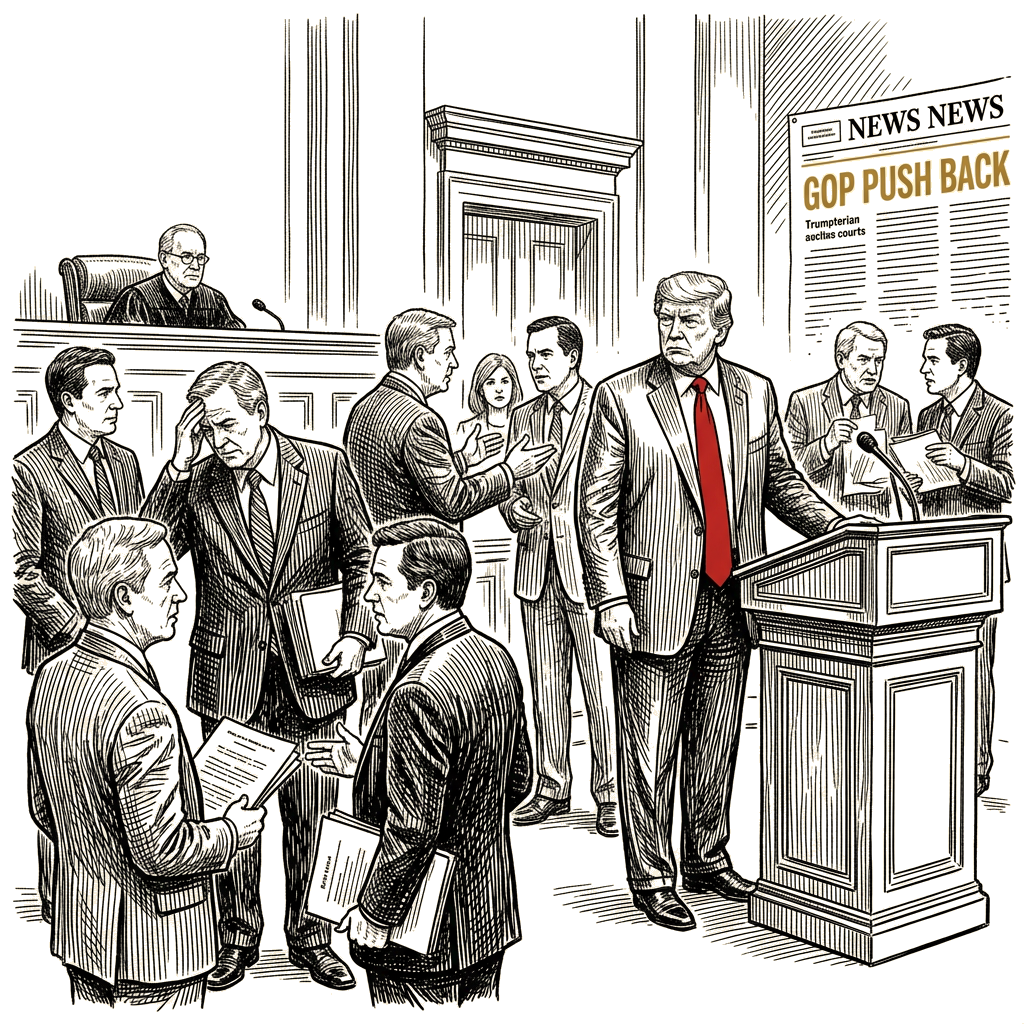
The Guardian reported on September 26, 2026 that President Donald Trump’s political standing is showing “fresh signs of erosion from multiple directions.” The substrate documents judicial setbacks on press access, mail-in ballots, the Kennedy Center, and Federal Reserve independence; Republican candidate behavior including Byron Donalds’s removal of Trump references from his Florida gubernatorial campaign website and Rep. María Elvira Salazar’s advertisements declaring federal immigration enforcement had “gone too far”; and voter sentiment that Rick Wilson, identified as a co-founder of the Lincoln Project and a longtime Republican strategist, characterized as “unparalleled since Jimmy Carter.” Wilson described the moment as “the beginning of the end” and “the decline.” Charlie Sykes, identified as a conservative author and broadcaster, named the paradox: “the weaker he gets, the more dangerous he gets.” The substrate’s central analytical feature is a juxtaposition the article does not reconcile: the same sources that document what they call “shrinking influence” also assert that Trump retains, in Allan Lichtman’s quoted words, “enormous power” — that “he doesn’t care about the courts and doesn’t care about the Congress” — and that his “last refuge” will be “the unchecked use of executive authority, a politicised Justice Department and a sweeping pardon power.” The configuration the substrate documents — diminished political cover with intact institutional tools — generates competing predictions that the named analysts frame from distinct vantage points without convergence.
What the substrate documents
The article’s central claim is that Trump’s political standing shows “fresh signs of erosion from multiple directions.” The substrate contains a structural tension the headline frame leaves undeveloped. The same sources that document “shrinking influence” also assert that Trump retains institutional capacity and that his “last refuge” will be the unchecked exercise of executive power. The configuration the substrate documents is a leader facing diminished political cover while retaining intact institutional tools.
Evidentiary threads
Three categories of evidence appear in the substrate.
Federal court orders against administration actions: a federal judge ordered the administration to “immediately return, reinstate and restore” press access for CNN, MS Now, and Politico after a White House ban; the Supreme Court blocked new mail-in ballot restrictions for the November midterms; the Federal Reserve defied the president on interest rates; another judge prevented Trump from adding his name to the Kennedy Center, prompting him to threaten demolition of the arts complex.
Republican candidate behavior: Florida gubernatorial candidate Byron Donalds “quietly scrubbed most Trump references from his campaign website”; Rep. María Elvira Salazar aired advertisements stating that federal immigration enforcement had “gone too far” and that Latino voters “feel betrayed.”
Voter sentiment: Wilson cited polling showing the president “at 29% approval rating in some polls.” Wilson said: “Now it’s reached the point where the magic doesn’t work any more… There’s no political upside from a president who is at 29% approval rating in some polls, has presided over a disastrous war, and has ended up raising energy prices and food prices – all the things that they can’t spin away.”
Two competing readings
The shrinking-influence frame treats judicial pushback as evidence of weakness: courts are constraining the president, therefore the president is being reduced. The unchecked-tools frame treats judicial pushback as a constraint the president will route around: courts are blocking discrete actions, therefore the president will rely on the powers courts cannot easily reach. The two readings generate different predictions about what happens in the final two years of the term. The article does not reconcile them; it juxtaposes them.
Political cover versus institutional tools
The synthesis the substrate supports is more specific than either pole. What is shrinking is Trump’s political cover — the willingness of co-partisans to absorb political costs on his behalf and the reservoir of public approval that legitimizes executive action. What is not shrinking is the institutional toolset — the pardon power, federal prosecutorial discretion, agency rulemaking, and commander-in-chief authority that do not depend on coalition permission. The two are not the same thing, and the article’s sources, when read together, distinguish them.
The antithesis to the shrinking-influence thesis runs as follows. Court orders constrain discrete executive actions but do not reduce the aggregate institutional capacity of the office; the Federal Reserve’s independence, the Supreme Court’s mail-in ballot ruling, and the press-access order are specific institutional checks rather than a general reduction in presidential power. Approval ratings measure public sentiment, not institutional authority. Republican candidate behavior — Donalds’s website edits, Salazar’s advertisement — constitutes campaign tactics within an intact coalition rather than coalition rupture. Wilson’s “gazelles wandering the savannah” metaphor, narrated with what he says “needs a David Attenborough voiceover,” assumes herd behavior; political parties operate as coalitions with internal factional dissent that has been a persistent feature of both major parties. The Carter analogy is rhetorically weighted but structurally weak: Carter lost reelection after one term; Trump won reelection in 2024.
Where the named analysts locate power
Three analytical lenses appear across the substrate’s sources, each traceable to the named sources’ framings.
The institutionalist lens, visible in Lichtman’s quoted remark that “never underestimate the power of the president” and that Trump retains “enormous power,” locates authority in formal offices. From this vantage, the presidency’s institutional capacity is largely indifferent to approval ratings and coalition standing. The relevant variable is what the office can do, not who approves of the officeholder.
The coalitional lens, visible in Wilson’s savannah metaphor and the documented behavior of Donalds and Salazar, locates power in the willingness of partisans to defend a leader. From this vantage, primary challenger risk, advertising choices, and website edits are the operative indicators, and the question is whether coalition discipline holds through the midterm cycle.
The personalist lens, visible in Galston’s “his oxygen” framing, Sykes’s observation that “Donald Trump fears irrelevance more than anything,” and Lichtman’s remark that “he cannot stand not being the centre of attention,” locates power in the individual leader’s command of attention. From this vantage, the presidency is an extension of personal will, and the relevant variable is the leader’s internal motivation under conditions of diminished external validation.
The lenses disagree on whether court-imposed constraints will hold. The institutionalist treats courts as a durable constraint on executive action. The personalist treats courts as obstacles the leader will route around. The coalitional treats courts as a dependent variable whose enforcement depends on whether partisan allies support or undermine judicial orders. The article does not resolve this disagreement, and the substrate does not supply the resolution.
How the named arguments are structured
Wilson’s domain alignment with intra-party Republican sentiment and electoral dynamics is direct. Galston’s alignment with presidential psychology and prospective 2028 dynamics is direct. Lichtman’s alignment is direct on historical-comparative claims, partial on forward-looking behavioral claims. Sykes’s alignment is partial on psychological-profile claims. The article does not surface counter-positioning from polling analysts, presidential historians, or Republican strategists who contest these characterizations.
The article’s argumentative structure treats Donalds’s website scrubbing, Salazar’s ad-buy, and the press-access order as observations from which a larger political condition is inferred. The substrate does not separately test whether the website scrubbing and ad-buy might reflect candidate-level positioning in competitive Florida races that operates independently of broader Trump retreat.
The analogies structure the framing: Wilson’s gazelle metaphor, Lichtman’s “second term curse” placement of Trump alongside Richard Nixon, Bill Clinton, and George W. Bush, and Wilson’s “unparalleled since Jimmy Carter” extension. The substrate does not surface counter-cases — second-term presidents who faced pushback but did not experience what the article characterizes as a “graveyard of presidential ambition.” For the Nixon/Clinton/Bush mapping, each prior presidency operates on a different mechanism than the political-capital-erosion-plus-retained-executive-instruments pattern described for Trump: Nixon faced constitutional crisis over executive misconduct, Clinton faced impeachment over personal conduct, Bush faced a war that lost public support. The Carter analogy is asserted without defending it against the structural disanalogy that Trump won reelection in 2024.
Cross-paradigm prediction
The cross-paradigm prediction the article’s sources converge on: a leader with diminished political cover and intact institutional tools will deploy those tools more aggressively, and courts will be the principal remaining constraint precisely because they are the institution whose operation is least dependent on coalition permission. Whether that constraint holds is the variable the substrate does not resolve.
Wilson’s observation that “the more he becomes a liability, the more he acts out” describes a leader compensating for lost cover through intensified unilateral action. Bill Galston, a senior fellow at the Brookings Institution and a former domestic policy adviser to Bill Clinton, locates the friction in attention rather than power: “Nothing will drive him crazier than the shift of the spotlight away from him. The prospect of passing the torch, giving up the spotlight, is intensely painful for him. It’s his oxygen. Will he be able to breathe, spiritually and emotionally speaking, without it?”
If the synthesis holds, then the institutional responses documented in the article function not as resolution but as the leading edge of a period during which a president with “nothing to lose in his final two years” might exercise executive authority in ways unconstrained by either courts or congressional majorities. The article’s own evidence base supports this conditional reading; it does not support the stronger reading that institutional pushback will itself resolve the question of executive-power use in the period ahead.
The article cites Nixon’s Watergate downfall, Clinton’s impeachment, and Bush’s war in Iraq as second-term reference points, with Lichtman naming the pattern a “second term curse.” The shared feature across these precedents is not the presence or absence of coalition drift — it is the convergence of weakened political cover with intact institutional tools in a leader facing incentives to deploy those tools unilaterally. The substrate supports the claim that this configuration has appeared before; it does not support a confident prediction about how the current instance will resolve, because the personalist variable — the individual leader’s choices under conditions of perceived irrelevance — is not predictable from institutional or coalitional indicators alone.
Counter-positioning and asymmetric weight
The article’s White House response, attributed to spokesperson Davis Ingle, is preserved: “President Trump is the unequivocal leader, best messenger, and unmatched motivator for the Republican Party, and he is committed to maintaining Republican majorities in Congress.” Ingle is quoted listing administration accomplishments including “tax cuts, lower prescription drug costs, border security, reduced violent crime, an energy revolution, job creation and record-high 401(k) balances.”
The article reports, attributing to The Guardian, that Democrats, “if [they] gain control of the House next year,” plan to launch investigations into how Trump has “allegedly abused his office to enrich his family, grant favors to supporters, hollow out the federal government and carry out expensive construction projects.” The conditional (“if”) and the modifier (“allegedly”) are preserved as they appear in the source.
The populist-sovereignty framing visible in the White House statement and the analyst commentary are reported with structurally unequal weight: the analyst commentary is foregrounded, while the White House statement is reported and bracketed. The Ingle statement treats the 2024 election as a continuing mandate rather than as a moment now receding.
What the substrate does not supply
The strongest single piece of quantitative evidence cited is Wilson’s reference to a “29% approval rating in some polls.” Wilson’s hedge about the polling source is preserved; the article does not specify the pollster, sample size, margin of error, or date for the figure Wilson cites. The article does not establish several facts the analysis depends on for full specificity: the identity of the polls producing the 29% approval figure; the specific war referenced by Wilson as “disastrous”; the current procedural status of any of the court orders beyond what is reported; the resolution pattern of the “second term curse” in cases other than the three named.
Additional considerations
The article exhibits compression: a single day’s reported events are knitted into a coherent declension arc in a way that pre-outcome uncertainty is not preserved. The publication date of September 26, 2026 situates the analysis within an active election cycle, and the inclusion of contemporaneous polling references and real-time reporting indicates the framing is constructed from ongoing data rather than from outcome data already known.
Trump’s appearance at the United Nations on September 22, 2026, at which he was reported to have threatened to “annihilate” Iran, provides the news peg. Trump was questioned by CNN anchor Kaitlan Collins: “I’m surprised that CNN is here covering me… You should not be here covering me.” The exchange followed the White House ban on CNN, MS Now, and Politico; a federal judge has since blocked the ban. Trump’s self-belief is described in the substrate as having “not wavered through past trials”: he “faced four criminal cases and two assassination attempts before winning the 2024 election.” He “has lived by a mantra of ‘it will all work out well in the end’ while his supporters wear hats that state: ‘Trump was right about everything.’”
Analytical techniques used in this piece
This analysis applies the methods below. Each links to a short, plain-English explainer you can read and reuse.
- Argument Audit
- A full structural audit of an argument’s premises, inferences, and load-bearing assumptions.
- Dialectical Analysis
- Holds thesis against antithesis and works toward a higher synthesis.
- Worldview Cartography
- Maps the clashing worldviews underlying a dispute.
- Prisoner’s Dilemma
- Individually rational choices leave everyone worse off than cooperation would.