Summary
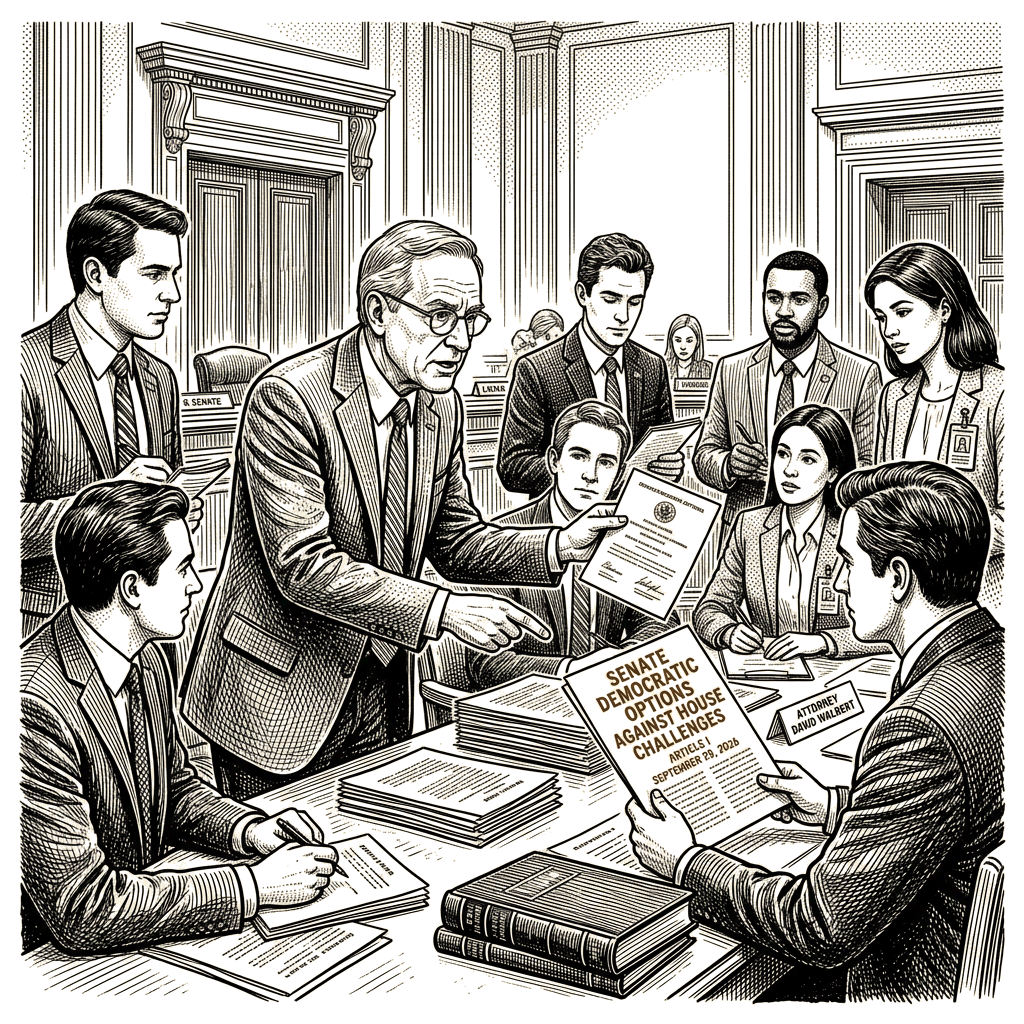
- Election lawyer David Walbert published a Guardian opinion column on September 29, 2026, arguing Senate Democrats hold a procedural counter-move against a contested January 3, 2027 House seating via Riddick’s Senate procedure.
- Walbert cites a 34-31 Democratic carryover advantage in the Senate on January 3, 2027 — 32 Democrats plus independents Bernie Sanders and Angus King, versus 31 Republicans — as the constitutional basis for refusing to seat close-election Republicans, contingent on Republican action that Walbert characterizes as overturn.
- The proposed remedy rests on the same Article I chamber-discretion clause Walbert identifies as the source of the House-side threat, a structural tension the column does not address.
- Three load-bearing claims — a 150-year SCOTUS partisan-voting pattern, the modern applicability of Riddick’s procedure, and the “regularly elected” federal statute’s interpretation — remain unverified in the source material.
An opinion column by election lawyer David Walbert, published September 29, 2026 in The Guardian’s Comment is Free section, lays out a constitutional procedure Senate Democrats could invoke if Republicans attempt to overturn close House midterm results on January 3, 2027. Walbert’s argument rests on Article I of the Constitution, which he quotes as making each chamber the “Judge of the Elections [and] Returns … of its own Members.” He frames his proposed Senate counter-move as “defensive retaliation contingent on Republican action,” characterizes the prospect of a House-Senate standoff as a “doomsday standoff” he hopes would deter Republican action, and writes that “very little is inconceivable with Trump in the White House and in control of the Republican party.” The column’s analytical content is constitutional procedure; its stated strategic purpose is deterrence.
The procedural architecture Walbert builds
Walbert dates the procedural trigger to January 3, 2027, when the new Congress convenes and the House clerk swears in representatives-elect. According to Walbert, federal statute requires the clerk of the current House to “make a roll of the Representatives-elect,” and the new Congress’s initial membership derives from that roll. Walbert argues that candidates whose elections face ongoing disputes may not satisfy the statute’s requirement that credentials “show that they were regularly elected in accordance with the laws of their states respectfully, or the laws of the United States” before that date.
Walbert cites concerns raised by Jeffrey Toobin and retired Judge Michael Luttig that a Republican-led House could install a “loyal clerk — a ‘GOP toady,’ in Toobin’s words — who would prepare a fraudulent list of representatives-elect.” He canvasses additional House-side pathways: expedited current-Congress election contests, Department of Homeland Security lists of “approved” citizen voters in at least 27 states following an unnamed recent Supreme Court ruling, federal ballot seizures, and state-level certification refusal. He acknowledges that some scenarios he describes would probably be illegal while arguing that the threat of litigation could itself delay certification.
The mechanism Walbert invokes is Riddick’s Senate procedure, whose text the column quotes verbatim: “After the name of a Senator-elect is called, while the question of swearing him in is pending the consideration of a resolution to refer his credentials to a committee and to deny him the right to take his oath of office in the meantime is privileged and takes precedence over swearing him in.” Walbert acknowledges that Vice President JD Vance, in his constitutional role as president of the Senate, could attempt to rule such motions out of order. The column argues that Vance’s authority is “strictly limited by the will of the Senate” and that Democrats would have the votes to overturn Vance’s rulings. Walbert characterizes the Democratic maneuver as contingent on Republican action: “if Republicans are subverting House elections, what would they have to lose?”
Competing hypotheses on what the column represents
The source material supports several non-mutually-exclusive readings of the column’s strategic function.
One reading treats the column as a single election lawyer’s opinion piece with no coordinated messaging or operational uptake by Senate Democratic leadership; the package does not establish coordination. A second reading places it within a coordinated messaging ecosystem in which election-law specialists prepare audiences for contested outcomes, supported by Walbert’s documented credentials and his citation of independent commentators Toobin and Luttig; the package does not document coordination. A third reading treats the column as deterrence signaling in the Schelling sense — making the procedural threat publicly visible so costs of triggering it become legible to the would-be mover. Walbert’s “defensive retaliation contingent on Republican action” framing and his “doomsday standoff” characterization are direct signals. A fourth reading treats the column as advocacy presented in news-compatible analytical register, supported by placement in The Guardian’s “Comment is Free” opinion section and titling; the originating fact piece reports it in news format, which is itself an editorial choice that flattens the distinction. A fifth reading — included for completeness — treats the column as market-positioning disclosure intended to seed a procedural option into public discourse at a moment when derivative political-risk actors may be calibrating to contested-midterm scenarios; the package provides no supporting evidence. A null reading holds that the column is what it appears: one commentator’s articulation of a constitutional procedure he believes is available, with no broader strategic function; this cannot be distinguished from the second or third readings on available evidence.
The single most diagnostic indicator would be public endorsement, adaptation, or acknowledgment of Walbert’s framing by a Senate Democratic leader — the Senate Majority Leader, the Democratic Senatorial Campaign Committee, the ranking Democrat on the Rules Committee, or the Senate Democratic Caucus — in operational planning. If such endorsement appears in subsequent reporting, the first and null readings weaken and the coordinated-messaging and deterrence readings strengthen. If such endorsement does not appear, the column is most defensibly read as one election lawyer’s strategic memo published in opinion format, with possible deterrence value but unclear operational uptake.
Structural tensions and verification gaps
The column carries a structural tension it does not address: the proposed Democratic credentials refusal depends on the Article I discretion Walbert identifies as the source of the Republican threat. The remedy and the threat mirror each other. Walbert never reconciles the fact that the proposed remedy uses the same constitutional latitude he warns about, and the column does not run a pre-mortem on its own remedy.
The 150-year SCOTUS partisan-voting pattern Walbert invokes is consequential for his deterrence thesis. He writes that “[p]artisan affiliation has been a near-perfect predictor of Supreme Court justices’ votes in cases that involved a presidential candidate’s claim to the office,” a pattern he traces back 150 years to the disputed 1876 Tilden-Hayes presidential election. Applied to the current Court, that pattern would predict a Republican-leaning response to a Democratic credentials fight — a tension Walbert does not name. Without external verification, the column’s premise that courts are predictable along partisan lines remains anchored only to Walbert’s assertion.
Three claims inside the column are load-bearing for Walbert’s argument and are not independently verified in the package. First, the 150-year SCOTUS pattern claim: the package provides no independent empirical verification, no enumeration of cases, and no acknowledgment of counterexamples. Second, the modern applicability of Riddick’s procedure: the package does not document whether Riddick’s compendium has been judicially or academically tested in a contested modern case, nor whether the procedure has been deployed in any contested seating since the text was last revised. Third, the federal statute’s “regularly elected” interpretation: the package does not document the statute’s actual application in prior contested seatings or any controlling judicial interpretation.
Additional unverified material: the 34-31 Senate carryover count depends on Senate class composition not independently grounded in the package; the 27-state DHS-list figure and the unnamed “recent Supreme Court ruling” remain unverified; and the book publication date, consistent with the source article, is not independently confirmed.
Cui bono and symmetric scrutiny
Walbert’s column attributes strategic intent to Republicans and Trump-aligned officials — describing the aim as creating “confusion and doubt about close elections” and “hav[ing] the members of the House decide congressional election contests to determine who will be seated” — without reciprocal attribution of strategic intent to the Senate Democratic response he advocates. The procedural asymmetry he proposes is framed as defensive.
The procedural mechanisms Walbert canvasses for the House side — clerk manipulation, expedited election contests, DHS-list disparities, federal ballot seizure — are the very ground on which a Republican-aligned counterpart column would likely focus, and the package does not canvass that perspective. The package does not address whether Republican-aligned lawyers have published parallel procedural-mechanism analyses; the absence of Republican-aligned counterparts in the source reporting is itself a gap.
Walbert also notes that DHS is preparing lists of “approved” citizen voters in at least 27 states following a recent Supreme Court ruling. He argues that election officials loyal to Trump could use disparities between DHS lists and county rolls as grounds to refuse certification of Democratic wins, though he acknowledges such a refusal would probably be illegal. The column’s stakeholder map does not separately analyze whether DHS-list challenges would produce uniform or divergent behavior across the 27 states.
What happens next
The pathway Walbert sketches depends on conditions the record does not yet establish: a contested House outcome in the November 2026 midterm elections, Republican action of the kind Walbert characterizes as overturn, and the procedural moment of January 3, 2027 when the new Congress convenes. Absent those conditions, the column’s procedural counter-move remains theoretical. The procedural pathway would face its first empirical test, if at all, on January 3, 2027, when the House clerk prepares the roll of Representatives-elect and the new Senate convenes with its 34-31 carryover composition. Until then, the column functions as a strategic artifact rather than as an actionable development.
Walbert situates the scenario historically, writing that nothing “this extreme has happened outside of Civil War-era elections,” though there have been “serious credentials fights before.” He distinguishes congressional election contests — the formal mechanism by which Congress judges its own members’ elections — from the 2020 court cases, noting there have been “hundreds of congressional election contests in the country’s history, beginning with the very first Congress in 1789.” He argues the 2020 court cases were decided under rules of evidence that exclude “conspiracy theories, unproven allegations, and bogus ‘expert’ opinions,” but “that kind of sham ‘evidence’ could drive congressional decisions determined by politics, not facts.”
How the column is being framed
The Guardian published the column as opinion in its Comment is Free section rather than news reporting. Walbert frames the scenarios he describes as constitutional possibilities rather than predictions. His proposed Senate counter-move depends on November producing a close House outcome and a contested certification — neither of which has occurred. The originating fact piece reports Walbert’s column in news format, an editorial choice that flattens the distinction between opinion and news reporting; the fact piece’s headline (“Election lawyer lays out Senate Democratic options against House challenges”) frames the column as procedural expertise rather than advocacy.
Additional considerations
The package’s stakeholder coverage is weighted toward visible political actors: Senate Democrats (34 in the carryover count Walbert cites), House Republicans as the current majority, House Democrats as a possible incoming narrow majority, Vice President JD Vance in his constitutional role as Senate president, the House clerk as a focal point for January 3, 2027 administration, federal courts and the Supreme Court as potential emergency-petition venues, and the Department of Homeland Security as the entity preparing citizen-voter lists.
Absent or under-covered: state-court judges who would adjudicate pre-January 3 challenges to certification; county-level election administrators who would actually implement any DHS-list-to-county-roll comparison; the 35 senators whose seats are up in November 2026, whose exclusion from the carryover count is what produces Walbert’s 34-31 advantage; institutional defenders of certification norms such as the National Association of Secretaries of State or the Election Center; legal-academic constitutional-procedure scholars whose assessments would shape whether Walbert’s Riddick’s reading survives scholarly scrutiny; and DHS personnel responsible for compiling the voter lists in the 27 states Walbert cites.
Editorial choices available to the publication include soliciting an opposing procedural-options column from a Republican-aligned election lawyer; publishing a procedural-verification piece from a non-partisan constitutional scholar on whether Riddick’s procedure applies as Walbert reads it; publishing a historical-comparative piece on contested House elections including 1876, 1878, and 1961; or deferring substantive coverage until November midterm results and any subsequent certification disputes are concrete. The defer-and-monitor alternative would treat the column as a strategic artifact rather than as an actionable development; the procedural-verification alternative would directly address whether Riddick’s text supports the application Walbert proposes.
Supporting indicators for the column’s strategic function: post-publication Senate floor statements on credentials procedure; Senate Democratic counsel hires specializing in credentials disputes; the absence of operational signaling through November 2026; and the publication of a competing Republican-aligned procedural-mechanism column in an equivalent outlet, which would test the symmetric-scrutiny claim.
Analytical techniques used in this piece
This analysis applies the methods below. Each links to a short, plain-English explainer you can read and reuse.
- Analysis of Competing Hypotheses
- Scores rival explanations by how well each fits the evidence, weighting the diagnostic items (Heuer).
- Decision Architecture
- Designs the structure of a high-stakes decision — sequencing, gates, and what to settle first.
- Decision Clarity
- Articulates the real stakes, stakeholders, and interests behind a decision facing a third party.
- Mutually Assured Destruction
- Deterrence by guaranteeing that any attack is suicidal for the attacker.
- Nash Equilibrium
- A standoff where no party can do better by moving alone, so the stalemate holds.