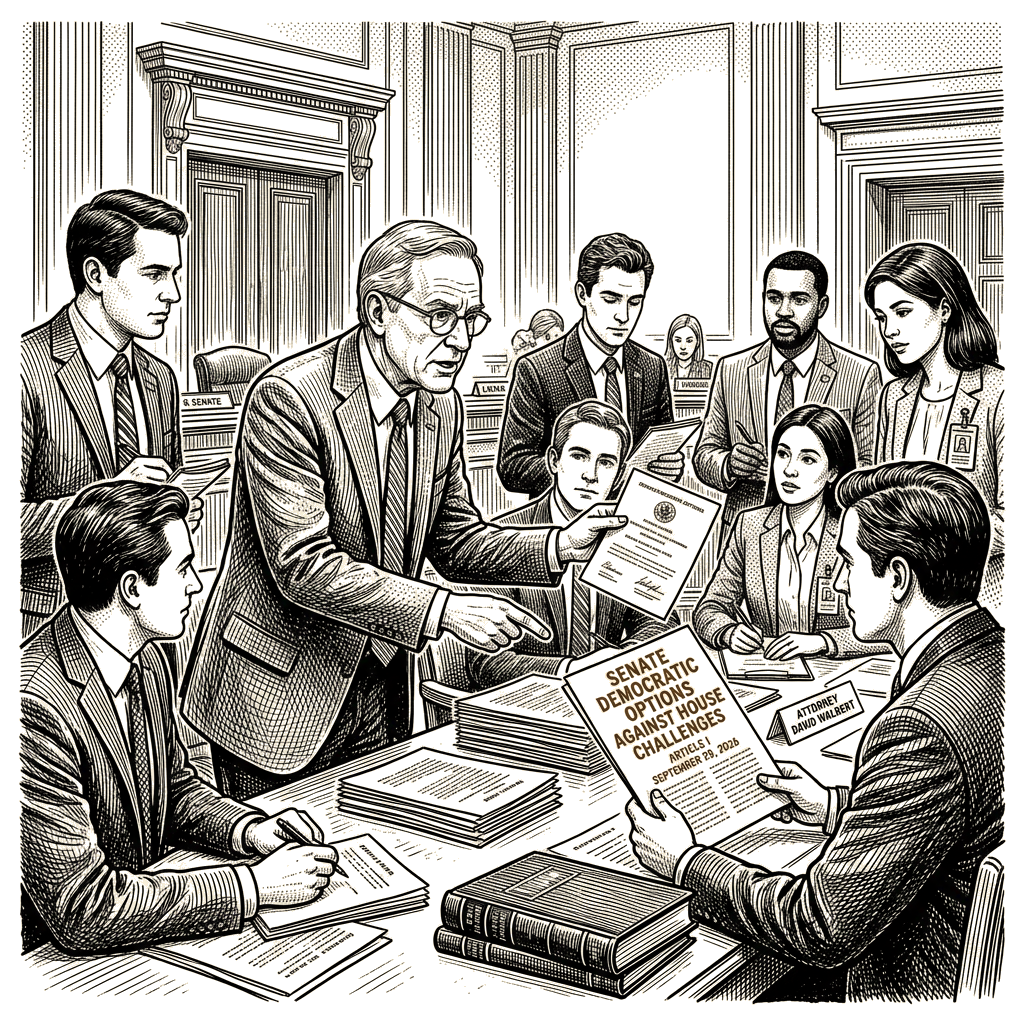
Walbert identifies January 3, 2027 swearing-in as procedural trigger for credentials fights
The Guardian published Walbert’s column in its Comment is Free opinion section on September 29, 2026, under the headline “How Senate Democrats can stop Trump from stealing the midterms.” Walbert has litigated dozens of election cases including matters before the Supreme Court, taught constitutional law, and testified before Congress on voting legislation. His book “Stealing Elections, American Style” was published by Bloomsbury on September 3.
Walbert opens the column by citing what he describes as Trump’s recent loss in his mail-in ballot case and his expectation that Trump “will likely resort to ever more extreme ways to try to hold a Republican Congress in November’s elections.” Walbert recalls a prior column of his describing how the 2020 effort to “count Joe Biden out” — having Republicans “investigate” states Biden narrowly won, allege fraud in those states, and then reassign those states’ electoral votes to Trump — could be repurposed against a narrow Democratic House majority in the midterms.
Walbert builds his procedural argument on Article I of the Constitution, which he writes makes each chamber the “Judge of the Elections [and] Returns … of its own Members.” That provision, Walbert argues, means “no matter who state officials or courts say won, Congress has the final word on who will be seated.”
That framework, Walbert writes, gives Trump a potential path to “corrupt the congressional election — create confusion and doubt about close elections, challenge the results, and have the members of the House decide congressional election contests to determine who will be seated.” Trump’s 2020 electoral-vote effort “was stopped in 2020 when the attorney general and other officials refused to join his effort, but they’ve been succeeded by people loyal to Trump, not the law,” Walbert writes.
Walbert distinguishes congressional election contests — the formal mechanism by which Congress judges its own members’ elections — from the 2020 court cases. There have been “hundreds of congressional election contests in the country’s history, beginning with the very first Congress in 1789,” and they are “very different from the 62 election cases Trump and his Republican allies brought and lost in 2020.” The 2020 cases were decided by judges operating under rules of evidence that exclude “conspiracy theories, unproven allegations, and bogus ‘expert’ opinions,” but “that kind of sham ‘evidence’ could drive congressional decisions determined by politics, not facts,” Walbert argues.
Walbert dates the procedural moment to January 3, 2027. For the scenario to work, Republicans would have to have an initial majority in the House when the new Congress is seated, “since that initial majority will control who else is seated.” On that date, “all now-seated representatives lose their status as members of Congress,” and candidates who won in November “don’t become representatives simply because of the election returns.” Federal law requires the clerk of the current House to “make a roll of the Representatives-elect,” and that roll determines the new Congress’s initial membership.
Walbert cites concerns raised by Jeffrey Toobin and retired judge Michael Luttig that a Republican-led House could install a “loyal clerk — a ‘GOP toady,’ in Toobin’s words — who would prepare a fraudulent list of representatives-elect.” Walbert acknowledges that some commentators have dismissed the threat but says those observers are “overly optimistic” and underestimate the role of politics in litigation. The federal statute directing the clerk, Walbert writes, requires candidates to be listed only if their “credentials show that they were regularly elected in accordance with the laws of their states respectfully, or the laws of the United States.” Candidates whose elections face ongoing disputes may not satisfy that standard before January 3, he argues.
Walbert adds that the Department of Homeland Security is preparing lists of “approved” citizen voters in at least 27 states following a recent Supreme Court ruling. He notes that while no secretaries of state complied with Trump’s demands to falsify the vote in 2020, election deniers have since “gained more state and county offices,” on top of “the hardcore election deniers and Trump loyalists who now hold many election-related positions with federal agencies.”
Election officials loyal to Trump, Walbert writes, could use disparities between DHS lists and county rolls as grounds to refuse certification of Democratic wins. While such a refusal “would add uncertainly, confusion and chaos — perennial Trump favorites — and give cover to Republicans demanding a congressional election contest to decide the winner,” Walbert acknowledges the move would probably be illegal but argues the threat of litigation could itself delay certification.
Walbert sketches a still more severe scenario: “An even uglier case would involve federal agents seizing ballots from one or two Democratic precincts. Many judges would issue injunctions to stop that, but others might not.” He adds that how the Supreme Court would rule on an emergency petition is unknown — “The justices have ruled for Trump in dubious cases and split 5-4 and 6-3 in cases that should have been unanimous rulings against Trump.” A complicit state or county, he writes, might “acquiesce in a federal seizure and even concede the presence of fraud in order to delay certification of a Democratic win. Again, some have argued that the law prohibits this possibility, but the law is not so certain with today’s supreme court.”
Beyond the clerk, Walbert writes, the current Trump-controlled House could expedite pending election contests before its term ends and rule in favor of enough Republicans to keep their initial majority in the new Congress. Since the clerk is an officer of the House, he does not have discretion to ignore a congressional directive. Walbert distinguishes that action from dictating to the next Congress how to rule in election contests for its own members — the current Congress would “only” be dictating to its clerk how he should act now.
Because the Senate is a continuing body, Walbert turns to the upper chamber. The 65 senators not up for election in 2026 will retain their seats on January 3, 2027 — 32 Democrats plus the two independents Bernie Sanders and Angus King, who caucus with Democrats, versus 31 Republicans, an initial 34-31 advantage that does not depend on the November results.
If “Trump and his allies try to steal the House, Senate Democrats can retaliate in kind and guarantee their control of that chamber, regardless of the election outcome, by refusing to seat a few Republicans who had close elections,” Walbert writes. He frames the strategy as defensive retaliation contingent on Republican action.
The mechanism Walbert invokes is Riddick’s Senate procedure, the authoritative compendium of Senate precedents. The text states: “After the name of a Senator-elect is called, while the question of swearing him in is pending the consideration of a resolution to refer his credentials to a committee and to deny him the right to take his oath of office in the meantime is privileged and takes precedence over swearing him in.” Walbert notes that Vice President JD Vance, in his constitutional role as president of the Senate, could attempt to rule such motions out of order and try to administer the oath to a challenged senator. Vance’s authority, Walbert argues, is “strictly limited by the will of the Senate,” and Democrats would have the votes to overturn Vance’s rulings.
Walbert acknowledges the political weight of the maneuver. “Democratic Senators would have to play very serious hardball to do this,” he writes, “but if Republicans are subverting House elections, what would they have to lose?” He notes that a filibuster by the Republican minority is a possible reaction to this process, but the Senate would remain under control of the Democratic majority.
Walbert situates the scenario historically. He writes that nothing “this extreme has happened outside of Civil War-era elections,” though there have been “serious credentials fights before.” In his book, Walbert writes, “[p]artisan affiliation has been a near-perfect predictor of Supreme Court justices’ votes in cases that involved a presidential candidate’s claim to the office” — a pattern he traces back 150 years to the disputed 1876 Tilden-Hayes presidential election.
Walbert concludes by characterizing the prospect of a House-Senate standoff over the true election winners as a “doomsday standoff” he hopes would deter Republicans from attempting to overturn House results. He writes that “very little is inconceivable with Trump in the White House and in control of the Republican party,” and asserts that “Trump is willing to destroy the country’s hold on democracy and fair elections to retain power.”
The Guardian published the column as opinion rather than news reporting, and Walbert frames the scenarios he describes as constitutional possibilities rather than predictions. His proposed Senate counter-move depends on November producing a close House outcome and a contested certification — neither of which has occurred.