Marc Elias’s team combats alleged interference across 87 lawsuits
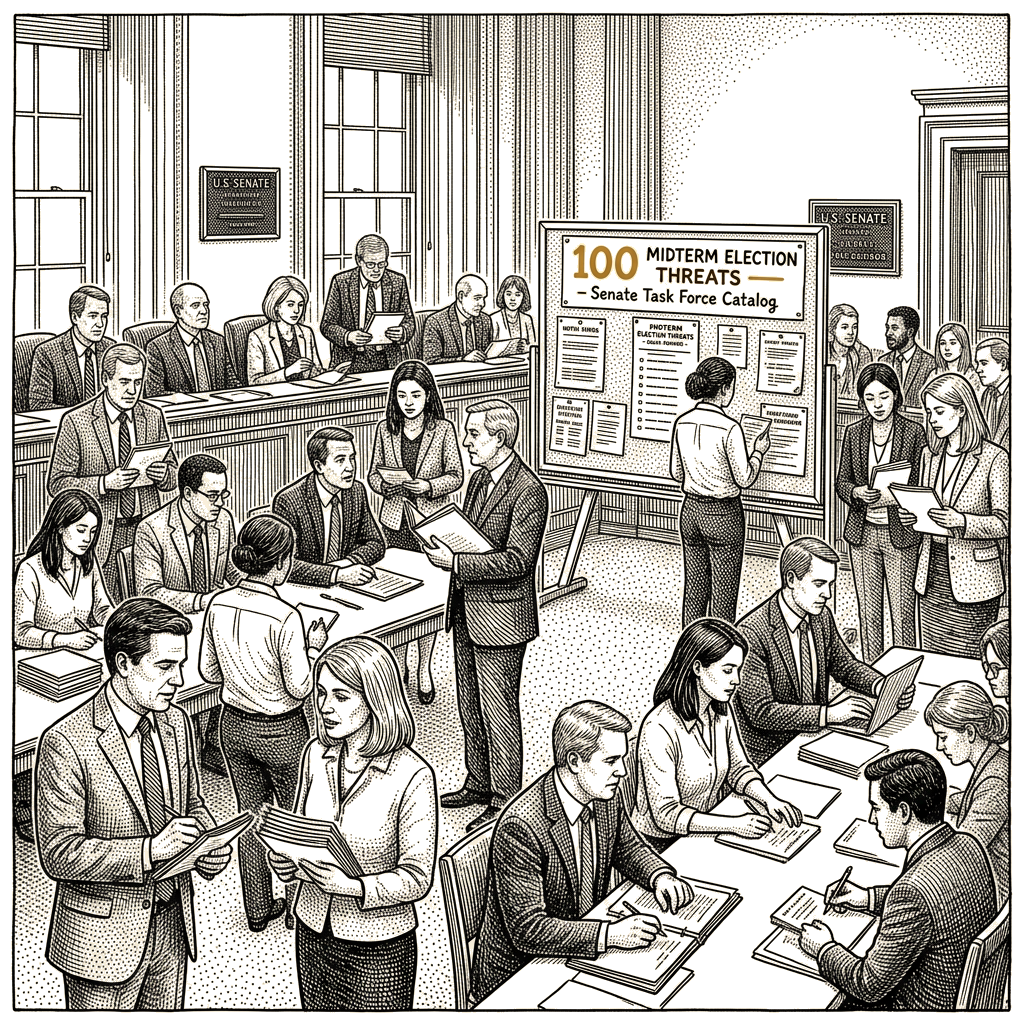
A Senate Democratic task force announced in April by Minority Leader Chuck Schumer has grown to at least 11 senators and roughly 30 staff coordinating preparations for potential White House interference in the November midterm elections, according to NPR reporting published Friday.
Schumer unveiled the initiative at the Capitol on April 29. “The goal of our task force is to ensure that every vote counts, and every American can participate in our democracy without coercion, intimidation or threats from Donald Trump or anyone else,” Schumer said at the time. Roughly 30 Democratic Senate staff affiliated with the task force have been meeting weekly to coordinate their efforts and update a shared list of election threats, according to the account, which was based on interviews with more than a dozen lawmakers, staff, election litigators, and outside experts in academia and nonpartisan good-governance organizations.
The conversations reflected an establishment determined to avoid what multiple participants described as a “failure of imagination” that prevented lawmakers from anticipating the Jan. 6 attack on the Capitol. Members have already played a central role in challenging preelection maneuvers by the administration — including efforts to obtain state voter rolls and limit mail-in voting — even as they collectively prepare for an array of scenarios over the roughly 10 weeks remaining before Election Day.
Task force staff have assembled a list of roughly 100 possible threats. Among the scenarios the task force is preparing for: a national election emergency declaration from the White House, and the presence of federal troops and law enforcement at polling locations. Justin Vail, a leader at Protect Democracy who previously served as a special assistant to President Joe Biden, characterized the administration’s approach as a three-step playbook.
“First, he deceives Americans, manufacturing false claims about voter fraud and the security of our elections,” Vail said. “Second, he seeks to disrupt the normal state and local management of elections, in an attempt to coerce them to enact policies that threaten the eligible voters’ access. And if that’s all not enough, Trump is prepared to outright deny election results that he doesn’t like.”
Election litigator Marc Elias, a member of the task force, said his team has been combating what he views as the early stages of an election interference effort across 87 lawsuits in 43 states. Elias framed the election protection effort as a continuum. “It begins with voter registration, then you have people voting, then you have Election Day,” Elias said. “You have tabulation of ballots, you have local certification, and ultimately you have seating. History has shown that Donald Trump is willing to weaponize power against all points of that process. This is not something that we wait until election subversion has taken place.”
The administration has pursued state voter data through 31 federal lawsuits, according to a tally by the State Democracy Research Initiative at the University of Wisconsin-Madison. States have largely refused to comply, citing privacy laws and the Constitution, which expressly delegates election administration to the states subject to congressional oversight. The 23 district courts that have ruled on the cases have all dismissed the administration’s lawsuits, the initiative found. DHS said in a statement that it “is continuing to review voter records to determine whether the evidence supports a criminal investigation and, where appropriate, refers the matter to the Department of Justice (DOJ) for prosecution.”
Trump in March signed an executive order directing DHS to develop state lists of adult U.S. citizens and requiring the Postal Service to deliver mail-in ballots only to registered voters on those lists. The administration this week secured an interim win at the Supreme Court related to the order, though court challenges are ongoing. Staff from the office of Sen. Alex Padilla, D-Calif., pointed to court fights over state voter roll data and mail-in balloting as the initial front in what they expect to be an ongoing effort to shape the election.
Members of the Democratic task force say the executive order, federal investigations into 2020 election ballots, and Trump’s July White House remarks should be understood as a coordinated effort to make voter fraud — which studies and investigations have found to be vanishingly rare — seem plausible.
In a July 16 address from the East Room, Trump pressed Congress to pass the SAVE America Act, a package of changes that would require voters to show proof of citizenship when registering and a photo ID before voting. “How easy is that to do, unless you want to cheat?” Trump said. “The only reason you wouldn’t do it is you want to cheat because your policies are so bad, and your candidates are so pathetic that you can’t get away or can’t get elected any other way.”
White House spokeswoman Lauren Bis defended the legislation in a statement to NPR. “Every American should be asking why Democrats are fighting against the SAVE America Act which includes commonsense election integrity measures, like Voter ID, that are strongly supported by the vast majority of Americans,” Bis said. “This legislation will make sure Americans, and Americans only, decide our elections. President Trump has been clear and he is absolutely right: we fix this now, or we lose our country.”
With Democrats in the congressional minority, the task force has limited ability to act legislatively on election matters. Eric Holder, who served as attorney general under President Barack Obama and now consults with the task force as chair of the National Democratic Redistricting Committee, said lawmakers can play a role through “organizing, consciousness raising, being ready to fight that which the Trump administration is going to do both legally and then tactically, all in service of fairness.”
Senate Democrats are also gaining a new oversight tool: the chamber’s first-ever election observer program, announced by Padilla, the top Democrat on the Senate committee that oversees election administration. “I am committed to using every tool to protect free and fair elections, and the new Senate Election Observer Program will do just that,” Padilla said. Staff designated by lawmakers of both parties can be dispatched to observe voting and tabulating locations; volunteers will not advocate for candidates, participate in vote counting, or interfere with voters or election staff. Staff for Sen. Mitch McConnell, R-Ky., who chairs the committee, did not directly address whether Republican staffers would participate.
Multiple task force members described preparing for worst-case scenarios in places where election officials may have echoed the president’s election denial rhetoric, where results are expected to be close or slow to count, and where Trump has focused scrutiny in the past, including California, Illinois and New York. In those locations, members are prewriting legal briefs and identifying key contacts.
Trump has signaled openness to direct federal involvement in the November vote. On Truth Social last August, he wrote: “Remember, the States are merely an ‘agent’ for the Federal Government in counting and tabulating the votes. They must do what the Federal Government, as represented by the President of the United States, tells them, FOR THE GOOD OF OUR COUNTRY, to do.” In a May interview with PBS News, he refused to rule out sending federal agents and servicemembers to polling locations — which would be illegal — saying: “I’d do anything necessary to make sure we have honest elections.” A Department of Homeland Security official told NPR that “ICE is not planning operations targeting polling locations.”
Neither DHS nor the Trump administration addressed questions from NPR seeking information about a national election emergency declaration or other possible election-related actions, declining to engage in what the administration described as hypotheticals.
Vanita Gupta, formerly Biden’s associate attorney general and now director of the Center for Law and Public Trust at New York University’s law school, said civil society groups are also preparing. “Hundreds of nonpartisan organizations have been preparing over the past year to do everything in our power to protect the integrity of our elections,” Gupta said. “Maybe the process of getting from here to a new Congress may be messier than any of us would like, perhaps filled with a lot more litigation and organizing than we might have thought was necessary, but we are going to have free and fair elections so long as people don’t take for granted their right to vote.”