Summary
- The Senate’s Wednesday discharge of Labor’s bill reducing the over-65 private health insurance rebate leaves the bill’s $3 billion distributional case resting on two assumptions that Health Department modelling and state health ministers’ recorded statements each reject: that over-65 policyholders will absorb the higher premium costs without exiting private cover, and that retained over-65 policyholders’ continued private utilisation does not generate additional demand on state public hospital systems.
- Cui bono analysis identifies three structural roles: private health insurers as the structural beneficiary of the rebate’s persistence, the federal budget as the structural beneficiary of the cut, and state public hospital systems as the cost-shift target under the cut.
- The Greens’ stated carve-out alternative would concentrate both the modelled drop-out cohort and the residual fiscal yield on non-pensioner over-65s, since the source documents no per-policyholder adjustment to maintain the $3 billion target.
- Frame audit finds Butler’s “political stunt” framing and Shoebridge’s “attack on pensioners” framing operating as competing political vocabularies over a cross-party distributional alignment the source documents across the Greens, the Coalition, state health ministers of both major parties, and the Council on the Ageing Australia — indicating convergent distributional objections rather than a single coalition’s tactical manoeuvre.
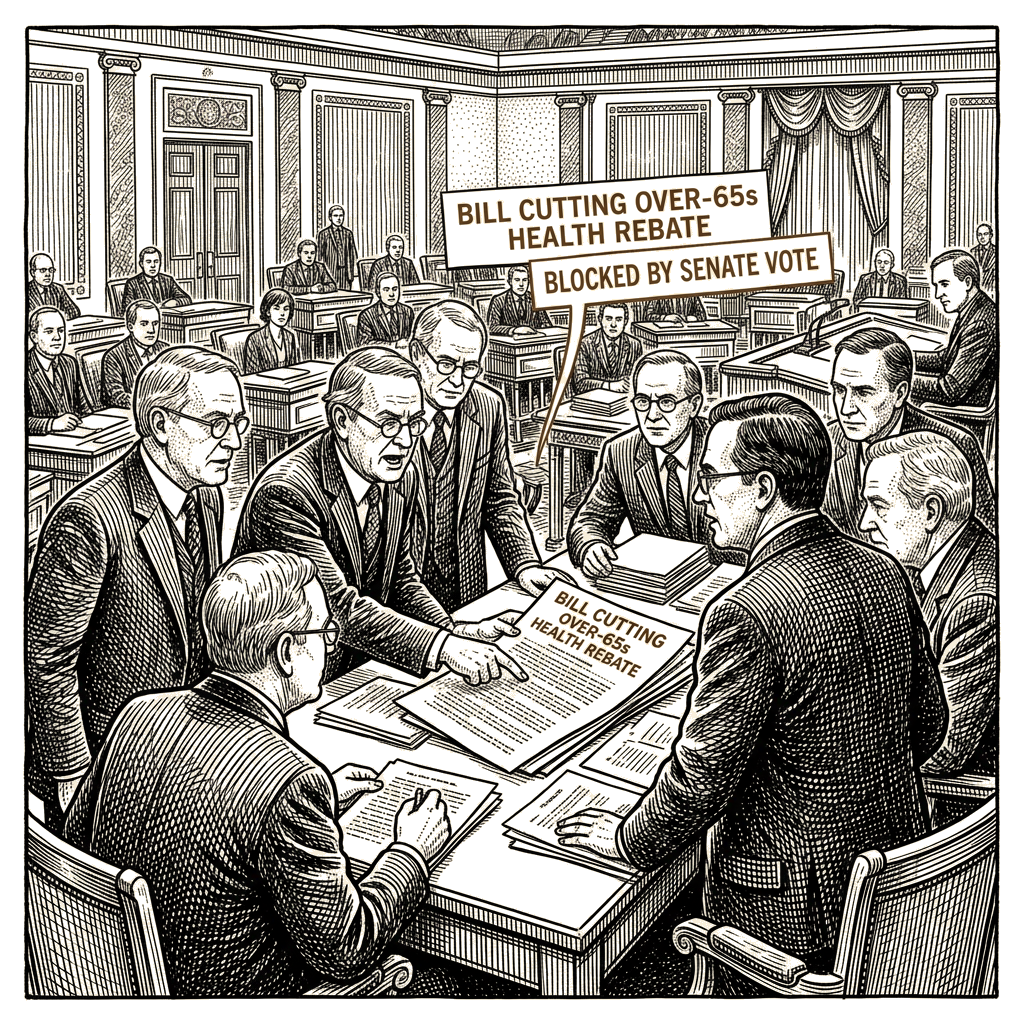
The Australian Senate on Wednesday discharged the Albanese government’s bill to reduce the higher private health insurance rebate paid to Australians aged 65 and over, through a procedural motion combining the Greens, the Coalition and crossbench senators. The bill had been projected in the source to deliver about $3 billion in federal budget savings over the forward estimates, with planned commencement April 2027. Department of Health and Aged Care modelling released under freedom-of-information laws and cited in the source projects that almost 80,000 older Australians will drop their private health cover by 2028-29 as a direct consequence of the rebate cut. Health Minister Mark Butler said in the source that the government intended to reintroduce the same bill to parliament on Thursday, characterising the discharge as a denial of proper debate rather than as a substantive defeat. The analytical claim developed below is that the bill’s distributional case rests on two unstated assumptions, both of which are rejected by the empirical material the source documents.
The procedural discharge and its fiscal arithmetic
The discharge procedure recorded in the article is described in the source as a rare procedural move combining the Greens, the Coalition and crossbench senators in the upper house. The bill as drafted differed from a standard private health rebate reduction by targeting only the higher subsidy paid to those 65 and over, with those 70 and over entitled under the existing arrangement to an even higher subsidy. Greens leader David Shoebridge conditioned his party’s support on a carve-out for the 1.2 million Australians in receipt of the age pension, stating in the source: “We say to Labor, if you want to bring this bill back … carving out 1.2 million pensioners from this attack … come and talk to us.” He added: “We will pass it in a heartbeat.” He framed the policy in the source as “an attack on older Australians during the cost-of-living crisis” and said the Greens “will not be joining with Labor to punch down on pensioners in the middle of a cost of living crisis.”
Health Minister Mark Butler, in the source, framed the discharge as a denial of parliamentary debate, stating: “it is important that the parliament have a proper debate, that these really important questions for older Australians are not held hostage to political stunts, but instead that the elected members of the House of Representatives and elected senators take these issues seriously and debate them properly.” Butler accused the Greens’ new leadership in the source of having “spied a political opportunity” to team up with the Coalition.
The defeat is the second major cost-saving measure the government has lost in the parliamentary term according to the source, which records an earlier backdown on a plan to cap veterans’ allied health payments calculated at $748 million over three years. Combined nominal value across the two defeated measures, calculated from the source’s individually sourced figures, is approximately $3.748 billion. The source does not quantify the aged-care funding exposure if neither measure passes.
The two unstated assumptions in the bill’s distributional case
The bill’s distributional case rests on two assumptions, neither of which is made explicit in the legislation as described in the source.
The first assumption is that pensioners and near-pensioners absorb the loss in private premium costs and remain privately insured at a marginally lower subsidy level. The Department of Health and Aged Care’s freedom-of-information-released modelling cited in the source rejects this assumption for approximately 80,000 policyholders, projecting almost 80,000 older Australians dropping their private health cover by 2028-29 as a direct consequence of the rebate cut. This projection, on the modelling, transfers a portion of the over-65 cohort onto the public hospital system, leaving the private health insurers’ premium base intact among those who remain insured but reduced proportionally among those who exit.
The second assumption is that those who remain privately insured do not, by their continued private utilisation, generate demand on public hospitals. The state and territory health ministers whose positions the source records — Victorian minister Ingrid Stitt, NSW minister Ryan Park, Queensland minister Tim Nicholls, and Tasmanian minister Bridget Archer — each reject this softer version of the same assumption. Stitt stated in the source that “any commonwealth savings shouldn’t come at the expense of older Victorians or simply shift pressure on to our public hospitals.” Park referred to NSW as already under “significant pressure” because of the commonwealth’s “failure to provide enough aged care placements,” adding in the source that “this is not good for [the aged] and they deserve better.” Nicholls warned in the source that “additional pressure will come at the expense of the thousands of older Australians already stuck in hospitals right across the country.” Archer stated that the federal government is “already refusing to provide solutions to get aged care patients out of hospital and this dog of a policy will make things even worse.”
Together, these two rejections — both empirical, both available to the bill’s drafters, neither internalised in the legislation’s distributional case — leave the federal budget’s claim that the $3 billion saving funds aged-care expenditure without off-setting demand transfer onto state public systems as the unsupported analytical assertion in the bill’s distributional case.
Cui bono: who benefits and who pays under each forward-facing state
Under the status quo, two structural beneficiaries are identified in the source materials: the private health insurance sector, which retains the over-65 premium base that the higher subsidy underwrites, and current over-65 policyholders, who continue to receive the larger subsidy priced into their policies. The federal budget, on any reading, is the structurally identified beneficiary if the cut proceeds. State public hospital systems are the structurally identified cost-shift target if the cut proceeds, by inference from the state health ministers’ recorded statements. The source does not name private health insurers as a party whose position is recorded, and the source names aged-care recipient cohorts downstream of the savings pathway only at the “aged-care system” level without itemising which aged-care programs or recipient cohorts would absorb the redirected $3 billion.
Under the Greens’ stated carve-out alternative, the residual fiscal yield would shrink proportionally to the share of over-65 policyholders on the age pension, requiring a larger per-policyholder cut on the remaining cohort to meet the same $3 billion target. The source does not record what that per-policyholder adjustment would be. The cui bono asymmetry under the carve-out alternative would concentrate both the modelled behavioural response (the almost 80,000 drop-offs) and the residual fiscal saving on non-pensioner over-65s. The modelling the source cites — projecting almost 80,000 older Australians dropping cover by 2028-29 — attaches to the bill as introduced, not to a carved-out version.
Patricia Sparrow, chief executive of the Council on the Ageing Australia, stated in the source: “older Australians shouldn’t have to choose between protecting their health and paying for everyday essentials.” She added: “nor should they be asked to choose between affordable healthcare and a properly funded aged care system.” Her framing is reported in the source as a distributional statement the article does not extend to the downstream cohort of aged-care recipients whose funding the source records as the savings’ destination.
How the positions are being framed
For Labor and Butler, the source records the stated interest as fiscal repair and aged-care funding, with Butler’s recorded argument framing the discharge as a denial of parliamentary debate rather than a substantive defeat. Butler’s characterisation of the Greens’ “new leadership” as having “spied a political opportunity” to team up with the Coalition is reported in the source as Butler’s framing of the cross-party alignment.
For the Greens, the source records the stated interest as protecting pensioners during a cost-of-living period and securing a concession. The “attack on older Australians” framing and the “punch down on pensioners” framing are political vocabulary Shoebridge used; the carve-out, by contrast, is a specific parameter change the bill’s economics can absorb or reject.
For the Coalition, the source records the stated interest as preserving the existing subsidy and attributing the savings target to broader fiscal laxity. Shadow health minister Anne Ruston stated in the source: “The idea that a government would have to cut the health system to need to pay for the aged care system … just reflects the fact of how much this government has lost control of their budget bottom line.” The source additionally reports Ruston as alleging that the policy “would have hit up to 1.5 million pensioners” and accusing the government of “using the health system to plug gaps elsewhere in the budget” — both framed in the source as Guardian narrative summary of Ruston’s position rather than as Ruston’s verbatim direct speech.
For the state and territory health ministers whose positions the source records, the stated interest is preventing additional demand on already-strained state public hospital systems. Their recorded statements are detailed in the section above. What neither the Coalition critique nor Sparrow’s broader framing addresses is a third question — for what purpose the $3 billion was earmarked. The substrate does not confirm an allocation: Ruston’s framing places aged-care funding as the implicit destination by implication rather than by ministerial statement; Butler’s “proper debate” framing does not address the question. Whether the saving was destined for aged care specifically or for consolidated revenue more broadly, the source documents no ministerial confirmation of an earmarked purpose.
The cross-party distributional alignment the source documents — Greens, Coalition, state health ministers of both major parties, Council on the Ageing Australia — indicates that the structural objection to the bill’s distribution is not a single coalition’s tactical manoeuvre. The convergent position recorded across these actors is that the over-65 cohort is the wrong target for the fiscal adjustment given the modelled behavioural response and the state-system cost shift.
What happens next: the Thursday reintroduction and the disclosure gap
The source documents three forward-facing states whose fiscal pressure the framing does not stress-test.
Under the bill as introduced, the modelling projects a behavioural response of almost 80,000 drop-outs by 2028-29 that, if accurate, transfers cost to state public hospital systems whose health ministers have already warned in the source that they are operating under existing pressure. The second-order effect the source documents through Stitt, Park, Nicholls and Archer is a state-level cost shift that the federal fiscal saving does not net out. Butler’s recorded “proper debate” argument is a procedural argument that does not address the named cost-shift projection.
Under the Greens’ stated carve-out alternative, the source does not record the fiscal arithmetic of a carved-out bill. Modelled behavioural response and residual fiscal saving concentrate on non-pensioner over-65s, and the per-policyholder adjustment required to meet the $3 billion target on the smaller residual cohort is not documented in the source.
Under the status quo, the source records the parliamentary term’s two cost-saving defeats at approximately $3 billion (aged rebate, blocked) and $748 million over three years (veterans’ allied health, walked back), combined to approximately $3.748 billion calculated from the source’s individually sourced figures. The source does not quantify the aged-care funding exposure if neither measure passes. The status quo also retains the modelled behavioural response at zero — no rebate cut, no modelled drop-off — but foregoes both the federal saving and any redirected aged-care funding.
The source records the government’s stated intention to reintroduce the same bill to parliament Thursday. If reintroduced and passed in identical form, the source’s recording of party positions indicates the same voting coalition would form against it: the Greens’ stated condition (carve-out) has not been accepted; the Coalition’s stated position is reported in the source as unconditional against the bill; the crossbench’s recorded position is in favour of the discharge. The source documents no counter-proposal from any party that would meet the $3 billion target through an alternative mechanism. Butler’s recorded accusation that the Greens’ new leadership had “spied a political opportunity” to team up with the Coalition is a counter-position statement that, on the source’s own terms, does not propose an alternative path to the savings.
The departmental modelling and the state-system warnings now sit on the public record ahead of the reintroduced bill’s Thursday debate. The carve-out question is the visible negotiating point. The downstream question — where alternative funding lands if the saving does not proceed — is sharpened by a source-attested specific gap: the source reports that Butler has signalled the government will reintroduce the same bill on Thursday, with no new modelling disclosure and no allocation of the saving to a named aged-care expenditure attached to it. The persistence of that disclosure gap is the structural problem the Thursday debate now has to absorb, in addition to resolving the visible carve-out question.
Analytical techniques used in this piece
This analysis applies the methods below. Each links to a short, plain-English explainer you can read and reuse.
- Cui Bono — Who Benefits
- Asks who gains and who pays from a state of affairs, decision, or claim.
- Interest Mapping
- Separates parties’ stated positions from their underlying interests (Fisher & Ury).
- Red-Team Assessment
- Models a capable adversary probing a plan for the seams they would exploit.