Summary
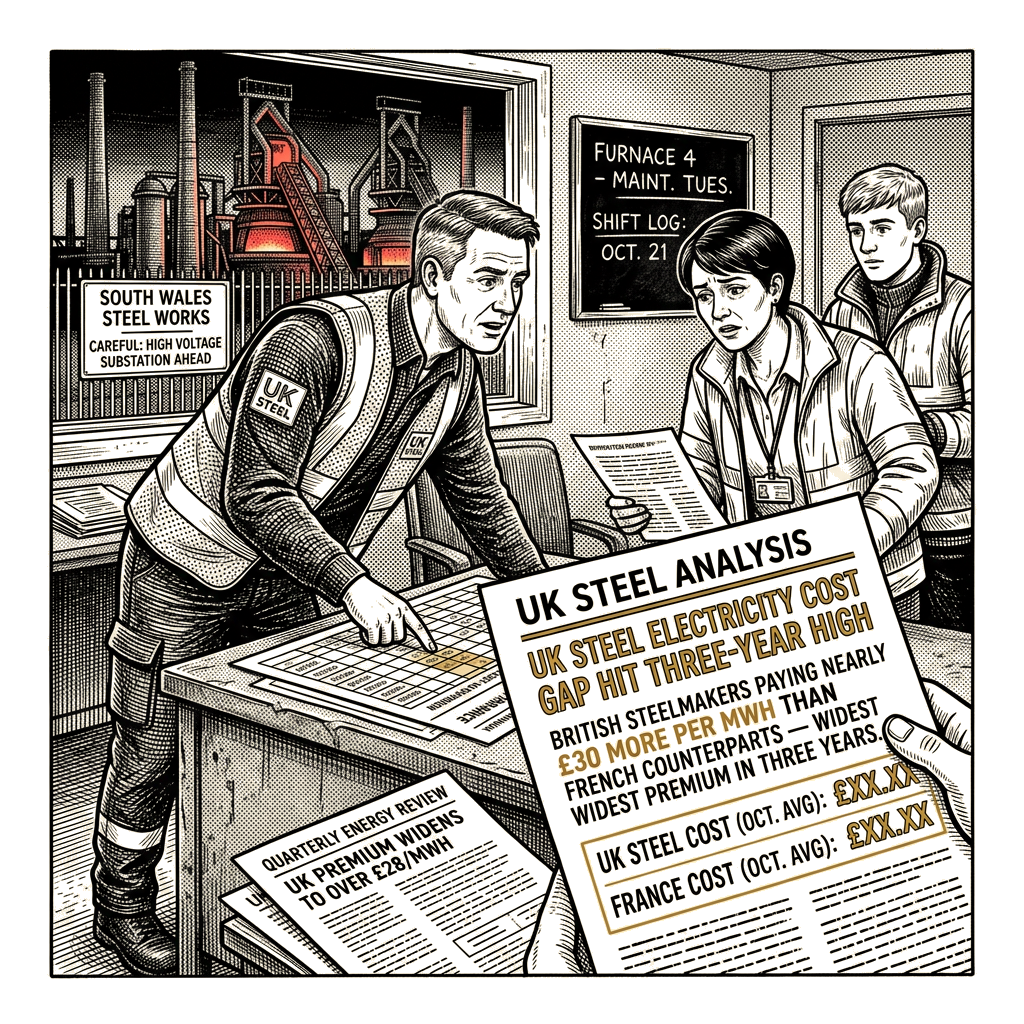
- UK Steel reports British steelmakers paid nearly £30 per megawatt-hour more for electricity than French counterparts — the widest such premium in three years — and attributes the widening to gas-fired generation setting British wholesale prices during a global gas-price increase UK Steel links to Iran’s Strait of Hormuz closure following what the lobby characterised as “Donald Trump’s bombing campaign.”
- The British merit-order market clears every generator at the price set by the marginal unit, so the gas-cost surge passes directly into every industrial electricity bill, including those of electric-arc-furnace steelmakers for whom electricity is the dominant input.
- UK Steel director general Peter Brennan proposed a £51 million annual price cap under which the government would pay the difference when electricity prices rise above a threshold and the industry would pay the government when they fall below.
- A UK government spokesperson cited existing relief including up to 25 percent electricity-bill reductions for more than 10,000 manufacturers and roughly £1 billion a year of relief for electricity-intensive businesses.
- Comparisons with France, whose electricity is largely set by nuclear reactors, and Germany, whose mix still leans on coal, locate the gap in the British gas-anchored merit order rather than in any generic European market feature, with approximately 75 percent of UK steel exports worth roughly £3 billion going to European Union member states.
The trade lobby UK Steel reported on Monday that British steelmakers paid nearly £30 per megawatt-hour more for electricity than their French counterparts in the most recent quarter, the widest such premium in three years, with the lobby attributing the widening to a global gas-price increase flowing through the British wholesale market, where gas-fired generation sets the clearing price for every source on the grid. UK Steel identified Iran’s closure of the Strait of Hormuz, in response to what the lobby characterised as “Donald Trump’s bombing campaign,” as the proximate driver of the gas-price climb; The Guardian, publishing the analysis, tied the climb more broadly to “the US-Israeli war on Iran.” UK Steel director general Peter Brennan proposed a £51 million annual price cap under which the government would pay above-threshold costs and the industry refund the government when prices fell below, while a UK government spokesperson cited existing relief including up to 25 percent electricity-bill reductions for more than 10,000 manufacturers and roughly £1 billion a year for electricity-intensive businesses. The mechanism UK Steel identifies — a gas-anchored merit order passing a geopolitically driven fuel shock onto every industrial customer’s bill — operates on the same heavy-industrial competitiveness that Andy Burnham identified, per The Guardian, as perhaps the biggest obstacle to his “reindustrialising” goal.
The mechanism: gas-anchored merit order passes the shock through
The British wholesale electricity market clears at the price set by the marginal unit — the last generator required to meet demand — and that marginal unit is, during most high-demand hours, gas-fired plant. UK Steel, as reported by The Guardian, characterised the consequence as a direct pass-through in which the British wholesale market sets the price of every source of generation by reference to gas-fired power — including wind and solar, which cost far less to produce — so the gas surge flows directly into industrial electricity bills. Every generator selling into the same half-hour receives the gas-set clearing price, with the result that the wholesale cost trajectory inherits whatever is happening in the global gas market regardless of the marginal cost of wind, solar, or nuclear plant operating at the same time.
The British grid is structurally short of dispatchable non-gas capacity, attributed in UK Steel’s analysis to the sequencing of coal phase-out, nuclear fleet aging, and the slow build of storage and demand-side response. The published analysis does not further decompose this structural shortage into individual capacity contributions, but the implication for pricing is direct: when gas is on the margin during a substantial fraction of high-demand hours, wholesale bills inherit gas costs nearly hour-for-hour.
The geopolitical trigger UK Steel cites is the closure of the Strait of Hormuz, which UK Steel attributes to Iran’s response to “Donald Trump’s bombing campaign” and which The Guardian describes more broadly as “the US-Israeli war on Iran.” Both formulations are attributed political characterisations drawn from the cited sources rather than independently verified claims, but the underlying linkage — a chokepoint closure pushing up global LNG prices that feed into the British marginal unit’s fuel cost — is the mechanism UK Steel’s analysis depends upon. Other candidate drivers of the global gas-price rise not ruled out by UK Steel’s analysis include Asian LNG demand pulling Atlantic cargoes, Norwegian seasonal maintenance, and low European storage levels; UK Steel’s analysis names the Hormuz closure as the emphasised trigger without apportioning the global gas-price move across the candidates.
Comparator fleets: France and Germany frame the gap
The mechanism is most visible through comparison. France satisfies the condition for low exposure most fully: its nuclear fleet sets French wholesale electricity prices, per UK Steel’s analysis as reported by The Guardian, and absorbs none of the gas-price shock. The £30/MWh premium Britain now records over France is, on UK Steel’s reading, the gap between a marginal-cost stack indexed to global gas and a marginal-cost stack indexed to operations and fuel at the French reactors.
Germany sits intermediate. Coal-fired generation still plays a large role in the German mix, per UK Steel’s analysis as reported by The Guardian, and the narrower £12/MWh premium British steelmakers this year pay over German rivals is consistent with that coal component being less directly indexed to global gas than the UK marginal unit — though UK Steel’s analysis does not isolate this channel as a measured contribution. The implication is not that German power is cheap in absolute terms but that the comparator bills are anchored to a different fuel cost.
Sector exposure: electric arc furnaces and the export market
Electric arc furnaces are highlighted by UK Steel as central to cleaner steelmaking; their dominant input is electricity, at hundreds of kilowatt-hours per tonne of crude steel, whereas a blast furnace’s dominant inputs are metallurgical coal and iron ore with electricity exposure incidental. To the extent that the British policy mix is steering steelmaking toward electric arc, the merit-order signal migrates from being one cost component among many to being the dominant cost driver, magnifying the gap with the French fleet for any process that has switched to arc-furnace production.
Approximately 75 percent of UK steel exports, worth roughly £3 billion, go to European Union member states, per UK Steel’s analysis as reported by The Guardian. The EU is the principal export market and, for that reason, the principal comparator — the bills against which British competitiveness on industrial electricity is measured are the bills paid by the rivals those exports meet in third markets.
Layers above wholesale: levies, network charges, carbon mechanisms
The £30/MWh figure sits above layers beyond wholesale prices, and comparing it to a French industrial rate incompletely isolates the wholesale signal.
Policy and environmental levies include Contracts for Difference support for new renewables, legacy Renewables Obligation certificates, Feed-in Tariff payments, the Climate Change Levy, and exemptions under compensation schemes for energy-intensive industries. The 25 percent electricity-bill reductions the government spokesperson cites for more than 10,000 manufacturers and the roughly £1 billion a year of relief for electricity-intensive businesses refer to this layer rather than to wholesale prices. UK Steel’s argument that the government last year removed most of the costs added by government policy to heavy industrial businesses’ electricity bills is an attribution about what was removed rather than an audit of what remains.
Network and balancing charges include transmission and distribution use-of-system charges, balancing services, and capacity-market costs sitting above wholesale. The capacity market pays generators to be available at moments the merit-order signal alone would not procure; the relevant capacity is predominantly gas-fired, with growing contributions from biomass conversions, pumped hydro, and battery storage.
Generation-mix externalities — the carbon the German coal fleet emits under the UK and EU emissions trading schemes, the regulated tariff structure of EDF’s nuclear output, the historical capital cost of the French fleet, decommissioning liabilities absorbed during the restructuring of the French nuclear sector — are not priced in the headline comparison. UK Steel’s analysis frames France as “largely” nuclear and Germany as “still” leaning on coal — capturing a snapshot of the wholesale generation mix. The headline comparison assumes the two bills measure the same construct; they do not.
Cross-border comparative factors
To the extent the European Union’s Carbon Border Adjustment Mechanism and, as available reporting indicates, a corresponding UK mechanism under development price embedded carbon, cross-border steel trade between the UK and the EU inherits a price signal layered on top of the wholesale electricity differential. The electricity differential interacts with a carbon differential at the border rather than standing alone.
The British grid has multiple HVDC interconnector links to France, the Netherlands, Belgium, Norway, Ireland, and, since 2023, Denmark — including the IFA and IFA2 links to France — that flow only when price differentials justify. The implication is that interconnector flows between the two markets did not, in the relevant period, eliminate the wholesale differential; either the flows were constrained by capacity, by planned maintenance, by French nuclear availability, or by reverse-direction flows at the relevant hours. UK Steel’s analysis does not specify which constraint bound the comparator flows; only the persistent gap is reported.
Policy proposals and government response
UK Steel director general Peter Brennan proposed a £51 million annual price cap under which the government would pay the difference when electricity prices rise above a threshold and the industry would pay the government when they fall below. The proposal sits at the industrial price paid rather than at the generation mix or the merit order itself — a subsidy lever rather than a generation-portfolio lever. UK Steel has estimated the annual cost at £51 million; no public source provides an independent scoring of the figure.
Brennan framed British steelmakers as competing with one hand tied behind their backs. He characterised the situation as one in which, despite welcome government action, UK electricity prices remain substantially higher than those of European and global competitors, with the gap with France widening. He characterised the moment as one in which the government has rightly made reindustrialisation a national priority but cannot rebuild British manufacturing while British steelmakers pay substantially more for electricity than their competitors. The “welcome government action” framing is Brennan’s own characterisation rather than an independent measurement.
A UK government spokesperson, in turn, characterised the policy as one in which the government is tackling industry’s number one concern head-on by reducing electricity bills by up to 25 percent for over 10,000 manufacturing businesses, and cutting costs for hundreds of the most electricity-intensive businesses by around £1 billion per year — delivering on the prime minister’s pledge to reindustrialise Britain. The spokesperson’s framing is likewise the actor’s own characterisation, not an independent measurement.
UK Steel’s analysis does not provide a basis for ranking the lobby’s and the government’s competing characterisations. UK Steel’s analysis frames the choice as wholesale-versus-renewables — adding low-marginal-cost generation, characterised as a constraint in the short term, or subsidising industrial prices directly — but the layered account surfaces that the price cap operates on one component of the industrial bill rather than on the merit-order signal itself.
Predictive content: what would change the gap
The mechanism produces several checkable predictions.
If low-marginal-cost generation sufficient to displace gas from the merit order during peak industrial hours were added to the UK fleet, the wholesale clearing price would decouple from global gas during those hours, and the gap with France would narrow by the same amount.
If the Strait of Hormuz remained closed and global gas prices continued to climb, the gap would be expected to widen further — the trajectory UK Steel’s analysis describes since last year’s £18/MWh gap.
If French nuclear outages forced France to import gas-fired power at the marginal price, the UK gap would be expected to narrow even without UK-side change.
If German coal generation were displaced by gas at the margin, Germany’s gap would be expected to widen toward the UK’s.
These predictions are derivable from the components UK Steel’s analysis specifies; no public source assigns probabilities to them or rules out other trajectories.
Political reach beyond steel
Andy Burnham, per The Guardian, has identified energy prices as a major obstacle — perhaps the biggest — to his reindustrialising goal, consistent with the mechanism operating on heavy-industrial competitiveness more broadly. The same wholesale-price transmission that affects electric-arc-furnace steelmaking applies to any energy-intensive process the reindustrialisation programme seeks to attract. UK Steel’s analysis identifies two component-level fixes — adding low-marginal-cost generation, characterised as a constraint in the short term, or subsidising industrial prices directly — and the mechanism explains why the gap exists without determining which intervention a government will choose.
Limits of the published explanation
The mechanism UK Steel describes — a gas-anchored merit order, a geopolitical shock passing through LNG and into the wholesale price, an electricity-intensive industrial customer on the wrong side of that price — is plausible and consistent with the cited figures. It is not the only mechanism the evidence supports.
A full allocation of why a British industrial customer’s bill differs from a French or German comparator price would need to distribute the differential across the wholesale gas signal, policy levies and exemptions, network and capacity-market charges, and the way carbon and other externalities are priced in each market. The £30/MWh figure is what remains in the comparison after some of those layers have already been netted out; the components of that residual are partly attributable to the merit-order story and partly to everything else.
UK Steel’s analysis treats the merit-order gas-anchoring story as the dominant explanation; the layered account surfaces that policy levies, network and capacity-market charges, generation-mix externalities, carbon-pricing regimes, and interconnector behaviour each carry weight that UK Steel’s analysis does not develop. The two accounts are not contradictory, but they distribute explanatory load differently. Brennan’s “welcome government action” framing and the government spokesperson’s “tackling industry’s number one concern head-on” framing are both preserved with attribution; each is the actor’s own characterisation rather than an independent measurement, and no public source provides a basis for ranking them.
Analytical techniques used in this piece
This analysis applies the methods below. Each links to a short, plain-English explainer you can read and reuse.
- Mechanism Understanding
- Explains how something works — the parts and the process that turn inputs into outputs.
- Mutually Assured Destruction
- Deterrence by guaranteeing that any attack is suicidal for the attacker.