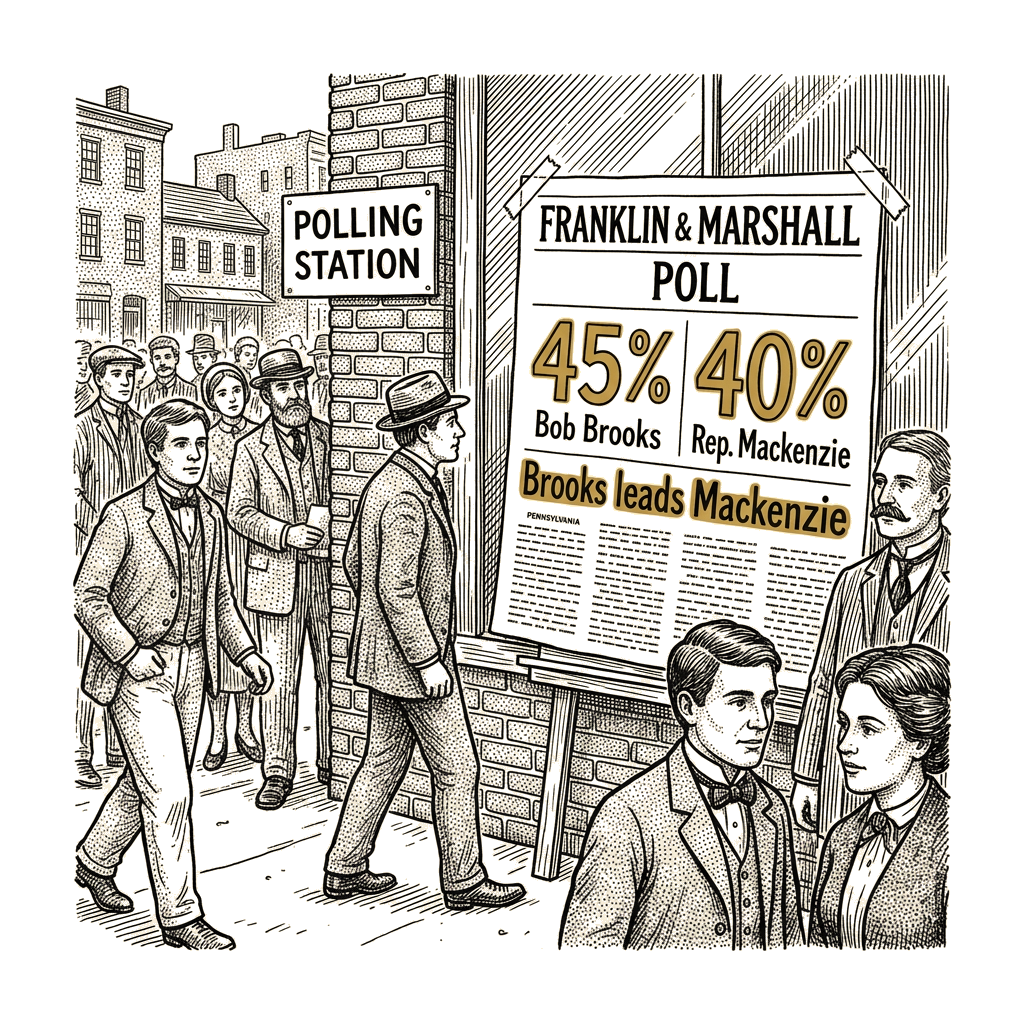
The Franklin & Marshall College poll giving Democrat Bob Brooks a 45%-to-40% lead over freshman Republican Rep. Ryan Mackenzie in Pennsylvania’s 7th Congressional District carries a 5.8-percentage-point margin of error — a band wide enough that a true tied result is not excluded by the survey itself. The Wall Street Journal frames the race as “Three House races test GOP’s white working-class coalition”; the reporting in the article supports that test framing while introducing variables that complicate any single-direction projection.
First-order, immediate horizon: a documented 5-point challenger lead against an incumbent who won in 2024 by roughly 1%; about 15% of respondents undecided; approximately $16 million in ad spending since the May 19 primary, roughly $10 million of it supporting Mackenzie according to AdImpact; both campaigns running door-knocking operations in the same reporting window, with Mackenzie speaking to volunteers before a day of door-knocking and Brooks rallying retirees at a United Steelworkers hall in Bethlehem alongside Jon “Bowzer” Bauman.
Second-order, short horizon: the ad-spending asymmetry concentrates attention on the final weeks before the Nov. 3 election. The article documents a Mackenzie ad attacking Brooks over a roughly $160,000 family loan; Brooks’s own response — that the ad is “not working” — functions as a market signal from inside the campaign. Concurrently, the documented rise in Saturday visits at the Central Moravian Church food pantry (from 40 a year earlier to “at least 65”) supplies external, demand-side evidence that SNAP cuts are reaching the district’s voters, and Borick’s statement that candidates are “carrying that weight upon their back” translates the article’s 62% “hurts rather than helped” response into a mechanism affecting every district Republican, including Mackenzie.
Third-order, medium horizon: the 7th is one of three heavily white, working-class Pennsylvania districts the Journal’s tracker flags; two are rated tossups. A Brooks win would become Democratic-cited evidence that affordability-salience attacks can flip white-working-class Trump districts in the same cycle; a narrow Mackenzie hold would become Republican-cited evidence that 2024 coalition gains persist under sustained cost-of-living pressure. Either outcome becomes part of the evidence base cited by both parties about the working-class coalition’s 2024 elasticity.
Reinforcing branches (amplification, drawn from the reporting): the 62% negative on Trump administration policies; cross-pressured defectors from prior Trump support, including Jim Koch (a Trump 2024 voter now registered Democrat) and the Republican Rob Manns (now considering Brooks); pantry demand data; and the affordability cues embedded in Brooks’s biography (“That’s what everyone’s worried about”). Dampening branches (counteracting): the “pockets of deep support” for Trump in the district, the approximately 5-to-3 ad-spending asymmetry, explicit Republican holdouts named in the article (Shafer, Lach, Solt), and single-issue voters such as the independent Tammy Lettich, whose stated opposition to abortion and transgender rights is given as the lens through which she considers Mackenzie.
Mackenzie’s stated positions rest on three documents in the article: touting $160 million in federal funding for healthcare, manufacturing, and affordable-housing projects; supporting legislation “that cut taxes on overtime, tips and Social Security”; and attacking Brooks on ethics (“Bob Brooks is not only a far-left individual, but he is ethically compromised”). The inferred interest behind the bundle is re-election, anchored by Mackenzie’s own statement that “literally everything you do could have been that difference” in a 1%-margin race — a calculation consistent with both the federal-funding emphasis (incumbent deliverables) and the in-cycle attack on the challenger’s record.
Brooks’s positions emphasize working-class biography (two-decade firefighter, state firefighters’ union leader, no college degree, lawn-care business) and an affordability platform (Medicare for All, raising the minimum wage, no-down-payment housing for teachers and first responders). The inferred interest is recognition of working-class identity as the route to office; the structural overlap with district demographics — the article states 45% of residents 25 and older lack a four-year college degree — makes the biography structurally matched to the constituency rather than merely stylistic.
The voter positions recorded in the article resolve into four inferred-interest clusters. Koch, weighing whether to back the Republican incumbent, signals recognition-dignity interest alongside material squeeze on diesel, fertilizer, and chemicals. Manns, considering Brooks, signals economic interest framed around bill management. Lettich signals identity/recognition interest on abortion and transgender rights, an interest that cuts across Mackenzie’s coalition. Shafer, Lach, and Solt signal administrative-quality and geopolitical-identity interests — the article quotes Solt as saying he doesn’t get “why we’re picking a fight with Canada” — that are not in direct opposition to Brooks’s affordability pitch but anchor a stable Republican floor.
Institutional interests named or implied in the reporting: the House Republican caucus has coalition-defending stakes across the three heavily white, working-class Pennsylvania districts the Journal’s tracker flags; AdImpact, named as the ad-tracking firm whose data the article cites, has revenue interest tied to the race’s roughly $16 million in ad spending; Franklin & Marshall College has institutional interest as the publisher of the district poll; Lehigh University has commentator interest through Chris Borick’s quoted analysis. The article does not detail these institutions’ internal calculations, but their positions in the reporting establish them as structural actors surrounding the race.
Shared-and-compatible interests on which an integrative move is structurally possible: both candidates claim delivery of localized economic relief (Mackenzie’s “historic tax reform that put more money back in people’s pockets”; Brooks’s working-class affordability framing). Genuinely-opposed interests that resist integrative resolution: tariff/trade posture (Koch’s framing against Lach’s); tax-cut extension versus Medicare for All and minimum-wage increases; and abortion/transgender rights positioning, which produces a Republican anchor independent of affordability data.
Reference class: incumbent House Republicans seeking a second term in white, working-class, college-degree-light districts while carrying roughly a 5-point poll deficit and roughly 15% undecideds in the final weeks before Election Day. The base rate for challenger carry-over of a 5-point lead under such conditions sits in the 50-55% range — an analyst-derived estimate assuming the typical undecided break toward the out-party under economic-salience dominance, not anchored to a named forecaster’s published historical table; this case diverges on several inside-view drivers.
Adjustments that widen Brooks’s win probability: the 62% negative on Trump administration policies (the article reports this as the most-said single answer); two documented cross-pressured defections (Koch and Manns); pantry data corroborating the materialization of SNAP-cut effects in the district; Brooks’s biographical fit with the non-college-degree constituency; and Borick’s mechanism statement that “the public’s pointing the finger at the president for these higher prices.” Adjustments that compress it: the approximately 5-to-3 ad-spending advantage per AdImpact’s $16 million total with $10 million of it backing Mackenzie, which historically moves generic-ballot numbers by 1-2 points toward the heavier-spending side; “pockets of deep support” for Trump in the district noted in the article; documented single-issue social voters (Lettich); and explicit Republican holdouts named in the article (Shafer, Lach, Solt).
Net of these adjustments, the resulting probability range is: Brooks winning by 1-3 points at roughly 45-55%; a tied or near-tied result (within 1 point either way) at roughly 25-30%; and Mackenzie winning within 1 point at roughly 20-25%. The 5.8-point margin of error on the survey, evaluated against an article published roughly two weeks before Nov. 3, means a true underlying race within one to two points of even cannot be ruled out by the polling alone; voters quoted by name in the article lean slightly toward Brooks, while the asymmetric late-cycle ad weighting tilts slightly toward Mackenzie. Which signal arrives first in the final fortnight — undecided breakage, ad-saturated persuasion, or a fresh economic data print — is the leading indicator of how the closing dynamic resolves.
Analytical techniques used in this piece
This analysis applies the methods below. Each links to a short, plain-English explainer you can read and reuse.
- Consequences & Sequels
- Plays a decision forward to its first- and second-order consequences.
- Interest Mapping
- Separates parties’ stated positions from their underlying interests (Fisher & Ury).
- Probabilistic Forecasting
- Puts calibrated probabilities on what happens next.