Summary
- The Wall Street Journal’s report of prior approval, a September withdrawal for clarity edits and a stated November intent makes another Zone 0 submission more likely than abandonment, without establishing the revised terms, Office of Administrative Law approval or operational consistency.
- Insurance Institute for Business & Home Safety research cited by the report identifies wind-driven embers as the cause of 60% to 90% of structural ignitions, but does not establish how many homes a statewide rule would protect or whether the rule would be effective, enforceable or affordable.
- The California Board of Forestry and Fire Protection has left unresolved the definitions, compliance triggers, inspection roles, insurer documentation and treatment of household costs that will determine whether a statewide standard operates consistently across local codes and private insurance practices.
- Yardzen’s more-than-threefold demand increase since 2024 and Ryan Elam’s insurer-driven landscaping changes show that private incentives are altering yards before any statewide requirement takes effect.
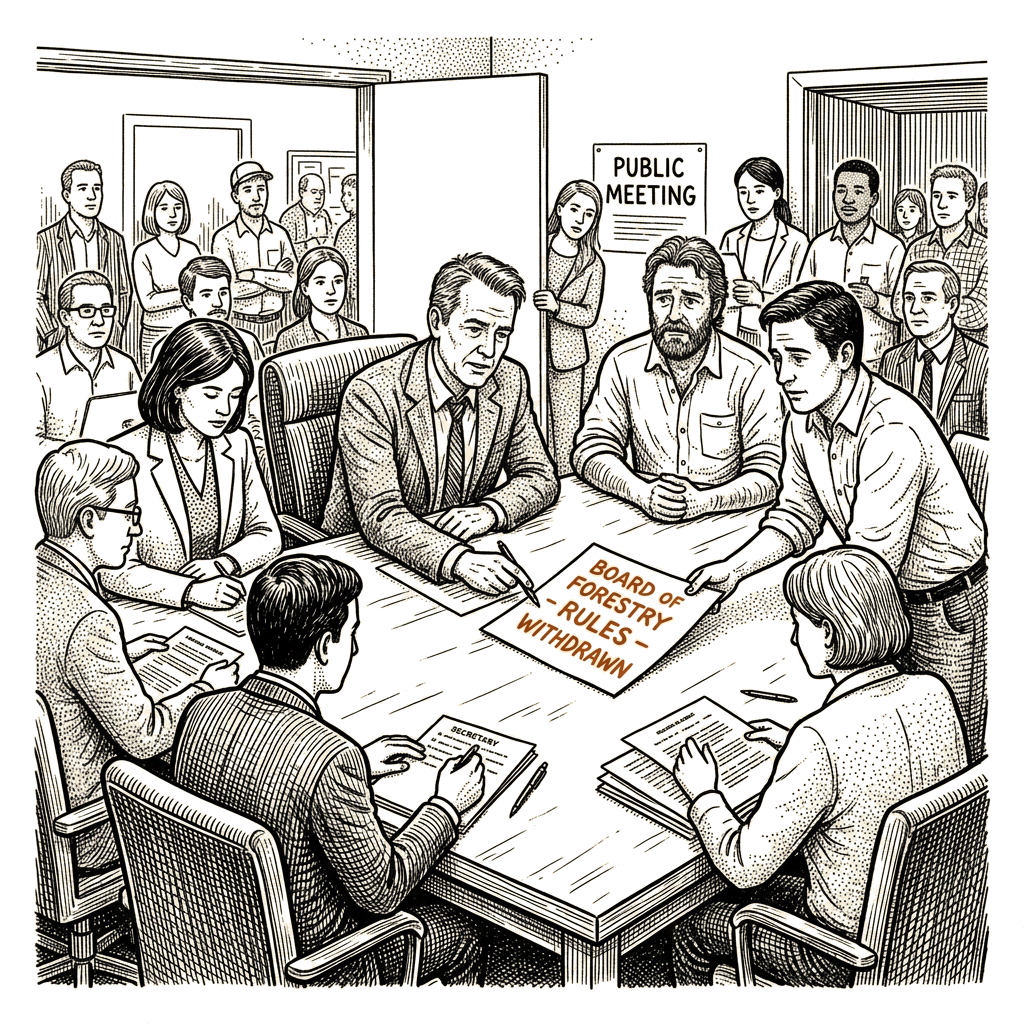
The California Board of Forestry and Fire Protection approved a statewide Zone 0 mandate for high-risk wildfire areas in August, withdrew the rules package in September for clarity edits and expects to resubmit it to the Office of Administrative Law in November, according to The Wall Street Journal; a board spokesperson supplied the expected November timetable. If approved, the mandate could reshape landscaping requirements for roughly two million structures, The Wall Street Journal reported. The available record therefore points more strongly toward another submission than toward abandonment, but it does not establish whether a revised package would retain its original terms, receive state administrative approval or produce consistency among local codes, insurance practices and household resources. The cited ember research establishes the hazard addressed by the five-foot perimeter without demonstrating the rule’s effectiveness or cost. Meanwhile, Yardzen’s rising demand and insurer-driven changes described in the report show that California’s landscaping transition is already occurring independently of the state timetable.
A procedural signal, not a settled rule
According to The Wall Street Journal, the California Board of Forestry and Fire Protection approved the statewide mandate in August and withdrew the package in September specifically to make clarity edits. The board’s stated intention to resubmit in November narrows the immediate procedural choice, but it does not resolve the policy choices embedded in the rules package. The chronology supports another filing more strongly than abandonment; it does not show whether the board favors unchanged terms, narrower terms, a phase-in or another form of implementation flexibility.
Independent official corroboration of the approval-withdrawal-resubmission chronology was unavailable in the available verification work, which identified no contradiction. The article does not identify which provisions the September edits affect or whether a resubmitted package would retain the zero-to-five-foot terms. If the edits concern the boundary between Zone 0 and wider defensible space, the revised definitions could determine how households, insurers and local officials distinguish the five-foot perimeter from broader landscape work. If the edits concern other provisions, the same implementation questions would remain relevant, although the record does not establish which provisions are most likely to change.
The reported reach also carries an evidentiary limit. If approved, the mandate could affect landscaping requirements for roughly two million structures, according to The Wall Street Journal. The article does not provide the calculation behind that estimate, and independent verification was unavailable. The figure therefore describes the mandate’s potential scope rather than demonstrated participation, compliance or avoided losses. The available record also does not establish the likelihood that the Office of Administrative Law would approve a resubmitted package.
The science supports one layer of wildfire defense
Research cited by the article from the Insurance Institute for Business & Home Safety found that wind-driven embers, rather than direct flame contact, cause 60% to 90% of structural ignitions. The underlying study was not independently located or reviewed in the available verification work, leaving the statistic supported by the article but externally unverified.
The research identifies an ignition mechanism relevant to the proposed perimeter. It does not estimate how many homes a statewide rule would protect or establish the rule’s effectiveness, enforceability or cost. The cited science supports the relevance of limiting ember exposure; it does not establish that a zero-to-five-foot mandate would, by itself, prevent a structure from burning.
The California Department of Forestry and Fire Protection diagram cited in the article treats Zone 0 as the innermost zero-to-five-foot perimeter. Gravel, hardscaping and other noncombustible materials can limit exposure to windblown embers. The diagram places that perimeter within a broader defense system: an inner buffer addresses direct flames and heat, while an outer buffer addresses dense vegetation and dead brush.
The article says broader defensible space can extend as far as 100 feet from a structure across distinct zones, a boundary that was not independently corroborated in the available verification work. Zone 0 therefore addresses one layer of the defense system rather than the full extent of defensible space. Much of the landscaping spending already observed is voluntary and can exceed the minimum perimeter work contemplated by the proposal, making private projects poor measures of the rule’s minimum compliance burden.
Compliance costs fall unevenly
Households face available compliance routes ranging from clearing shrubs and raking mulch to redesigning an entire landscape. The article reports that simple clearing and mulch raking can cost next to nothing, while an average full landscape redesign at Yardzen runs around $50,000. A rule that recognizes several attainable routes could therefore have a different practical effect from one that treats comprehensive redesign as the standard method.
Julianna and Mark Hayes are spending approximately $100,000 to replace nearly all of the foundation plants in their Japanese garden with rocks, turf and pavers in Marin County. The article reports that the couple was not legally required to clear the five-foot perimeter surrounding the house. The Hayes project and the Yardzen average are private-market observations rather than estimates of the cost of a statewide requirement; the record supplies neither a market maximum nor a complete distribution of project costs.
The available record contains no fiscal estimate for minimum perimeter work, no distribution analysis by household income and no analysis of renters or landlords whose landscaping obligations and access to compliance options may differ. Central Marin Fire battalion chief and wildfire hazard mitigation specialist Todd Lando said, “It changes what sits directly against the house, not the whole landscape.” Whether that limited change remains accessible to households would depend on the rule’s definitions, exemptions, phase-in, local implementation and assistance, none of which the article establishes.
Insurance and private decisions are moving before state approval
Home insurers and government fire agencies operate independently, but their Zone 0 guidance aligns closely because both draw on the same scientific research, Janet Ruiz of the Insurance Information Institute said. A statewide mandate could give home insurers a more consistent way to assess the safety of homes in high-risk areas. Such an assessment framework would not guarantee particular insurance terms. Approval could nevertheless convert some voluntary landscaping decisions into compliance decisions by standardizing both physical conditions and the information insurers use to evaluate homes.
Ryan Elam’s experience illustrates how insurance can change a property before any statewide requirement takes effect. The retired software developer’s longtime insurer refused to cover his new San Diego County home because of high wildfire risk, and Elam expected coverage for his current home to require landscaping changes, including removal of two birch trees and fresh mulch. The article describes insurance- and transaction-related changes; it does not prove that a statewide rule would itself impose a sale-compliance requirement.
Insurer requirements could continue changing yards if California delays, narrows or abandons the rule, leaving insurance availability rather than a uniform state mandate as the principal incentive. Voluntary adoption does not eliminate the existing patchwork. A common legal deadline could still produce uneven uptake because properties differ in resources, landscape design and the cost of available compliance options.
Approval would also be likely to accelerate demand for compliant materials, designers experienced in noncombustible landscapes and movable features such as planters that can be relocated during periods of elevated wildfire risk. The article reports that demand for fire-resilient design at Yardzen has more than tripled since 2024, although it does not define the measurement underlying the increase or provide independent company data. The Wall Street Journal linked the broader landscaping shift to mounting climate threats, shrinking insurance options and modern fire science.
The operative terms would determine operational consistency
Marin County’s local requirement applies to new construction and major home remodels. The statewide package could attach to new construction, major alterations, existing homes, property sales, insurance applications or some combination, but the operative rule text is unavailable. Effects associated with a property sale could therefore be mediated by a buyer, seller or insurer rather than imposed through a direct regulatory trigger.
The relationship between Zone 0 and wider defensible space would remain unsettled until the revised definitions are available. A common assessment framework could arise if approval includes clear triggers, definitions and a shared method for documenting compliance. If approval occurs without consistent enforcement or insurer practices, local inspection practices, private guidance and household uptake could continue to diverge.
If the package is delayed, narrowed or not approved, existing local codes and private insurance practices would remain the principal influences described in the article, while voluntary landscape changes could continue. The variables separating formal statewide uniformity from operational consistency are the scope of compliance, the relationship between Zone 0 and wider defensible space, enforcement and documentation, alignment between public and private standards, and the distribution of compliance costs.
Whether approval changes behavior across the roughly two million structures in the reported affected population or adds another layer to the existing patchwork depends on those variables. Formal state adoption would establish a common legal floor, but its practical reach would depend on how local agencies verify compliance, how insurers use the standard and how households bear the cost of meeting it.
Six decision paths remain analytically open
The available record does not show that the California Board of Forestry and Fire Protection formally considered the following paths, and the six paths do not constitute a confirmed exhaustive option set. The documentary evidence narrows only the procedural choice. Prior approval, a withdrawal specifically attributed to clarity edits and the stated intention to resubmit point more strongly toward another submission than toward abandonment, but the record does not show whether the board favors unchanged terms, narrower terms or a phase-in.
| Path | Meaning | Principal trade-off |
|---|---|---|
| Preserve the status quo | Leave statewide consistency to local codes, insurer guidance and voluntary adaptation operating since the 2017–2018 fire season. | Preserves local discretion while retaining differences in requirements, enforcement and cost. |
| Binary resubmission or termination | Resubmit the approved package after the clarity edits or allow the rulemaking to terminate. | Preserves momentum but may not resolve scope, affordability or implementation disputes. |
| Statewide standard with implementation flexibility | Establish a statewide noncombustible-perimeter standard while allowing phased compliance, local implementation methods, transition assistance and insurer disclosure. | Could reconcile statewide consistency with local variation, but the source supplies no funding or enforcement design. |
| Exit through inaction | Allow the rulemaking to lapse without adopting a statewide requirement. | Leaves the insurer- and voluntary-driven transition intact rather than resolving it. |
| Indirect levers instead of a direct obligation | Make insurer disclosure, mitigation finance and property-sale information the primary mechanisms rather than direct landscaping requirements. | Changes who carries the compliance burden, but a voluntary system may leave physical outcomes inconsistent. |
| Defer and monitor | Gather cost, equity and enforcement evidence before finalizing or revising the rule. | Improves the evidence base while risking delay in a policy area already seeing behavioral change. |
What happens next through year-end
The forecast horizon runs from October 21, 2026, the publication date of the supplied report, through December 31, 2026. The window covers the anticipated November resubmission and any Office of Administrative Law disposition completed by year-end. A package resubmitted but still awaiting final action on December 31 is classified as continued delay.
Yardzen’s reported increase in demand supports continued demand for noncombustible materials and redesigned planting, but it does not show that the statewide mandate caused the increase because the mandate has not taken effect. Insurer requirements could continue changing yards if the state rule is delayed or abandoned, leaving a mixed market in which insurance availability becomes the principal incentive.
A major wildfire or consequential insurer decision could rapidly change public sentiment, sales and the politics surrounding resubmission within the forecast window. Such an event is a stress case rather than a base forecast because the available evidence does not establish its likelihood. Another withdrawal, an Office of Administrative Law rejection or a materially narrowed package would interrupt movement toward uniform requirements. The record does not disclose how the California Board of Forestry and Fire Protection and the Office of Administrative Law would divide responsibility for revisions.
A consistent statewide assessment outcome would require a clear statewide rule, defined compliance dates, insurer disclosure and assistance for owners unable to meet the requirements immediately. The source contains no cost-benefit, enforcement or affordability study with which to score that path.
The source supplies no verified historical base rate for withdrawn rule packages and no evidential basis for ranking the scenario branches. The following bands are analyst-defined planning judgments, not probabilities reported by the article or historically calibrated estimates. The bands have low-to-moderate confidence because the revised rule text and review schedule are unavailable; their midpoints total 100%.
| Scenario | Planning band | Basis |
|---|---|---|
| Substantive approval: The board resubmits and the Office of Administrative Law approves the package by December 31, 2026, with the zero-to-five-foot core largely intact. | 45%–60% | The board already approved the mandate and says clarity edits are expected to produce another submission. |
| Approval with implementation changes: Approval occurs by December 31, 2026, with narrower scope, a phase-in or local implementation options. | 20%–30% | The withdrawal was attributed to clarity, while local requirements already vary. |
| Continued delay: The package is resubmitted or otherwise remains pending final review on December 31, 2026. | 10%–20% | The source does not establish the review schedule or whether the edits resolve substantive concerns. |
| No statewide requirement: The board abandons the package, does not resubmit it, or the Office of Administrative Law rejects it by December 31, 2026. | 5%–10% | A withdrawal after prior approval remains possible, though it would run against the board’s stated intention to resubmit. |
Approval by year-end would likely accelerate demand for compliant materials, experienced noncombustible-landscape designers and movable features, while raising questions about enforcement, resale and whether uniform rules produce uniformly affordable compliance. Delay would not necessarily stop the market shift; Ryan Elam’s insurance-driven changes and Yardzen’s rising demand show that private decisions are already operating independently of the state timetable.
The indicators most likely to alter the planning bands are the revised rule text, the Office of Administrative Law review schedule, local implementation guidance, insurer underwriting criteria, any published cost or equity analysis, direct evidence from groups opposing the mandate, and a major fire or insurance decision during the rulemaking window. The immediate milestone is therefore likely to be another submission rather than a final settlement. The durable issue is whether California’s five-foot perimeter becomes a clear, enforceable and financially accessible statewide rule, or remains a mixture of local requirements, private insurance decisions and voluntary household spending.
Evidence boundaries and unresolved policy questions
The Wall Street Journal frames the landscaping shift as voluntary adaptation already under way, not as evidence that the proposed mandate caused it. The California Board of Forestry and Fire Protection characterizes the withdrawal as a clarification exercise, but the available record does not establish whether the revisions are merely editorial or alter substantive policy terms.
The cited science supports the relevance of ember exposure but does not demonstrate statewide policy efficacy. Reported project costs illustrate private-market variation but do not measure the fiscal cost or distributional effects of compliance. Community pushback to Zone 0 mandates has surfaced, and Todd Lando described it as coming mostly from a vocal minority. The article contains no statement from an opposing resident or organization, so the reasons, reach and possible policy corrections behind that opposition cannot be assessed.
Material needed to confirm the formal option set includes the withdrawn and revised rule texts, board staff reports, fiscal analysis and Office of Administrative Law review criteria. Material needed to determine direct regulatory triggers includes the operative rule text establishing whether requirements attach to existing homes, sales, insurance applications, construction or alterations.
Material needed to assess enforcement includes Board or Office of Administrative Law guidance identifying the verifier, inspection role and documentation supplied to insurers. Material needed for cost and equity analysis includes representative compliance-cost estimates, household-income data, renter and landlord analysis and direct evidence from groups opposing the mandate.
The verification review found no independent corroboration for the article-supported chronology, two-million-structure estimate, embers statistic, Yardzen demand figure, cost figures or 100-foot defensible-space boundary. “Unsupported” in that review means not independently corroborated, not that the supplied article fails to support the claim; no contradictory evidence was identified.
Analytical techniques used in this piece
This analysis applies the methods below. Each links to a short, plain-English explainer you can read and reuse.
- Decision Architecture
- Designs the structure of a high-stakes decision — sequencing, gates, and what to settle first.
- Wicked Futures
- Explores a long-horizon, deeply entangled future with no clean resolution.