Summary
- Home Affairs counter-terrorism coordinator Brendan Dowling assessed that Australia was probably identifying radicalised people too late, a judgment that sits beside Australian Federal Police acting deputy commissioner Sandra Booth’s testimony that artificial intelligence can compress radicalisation from years or months into days.
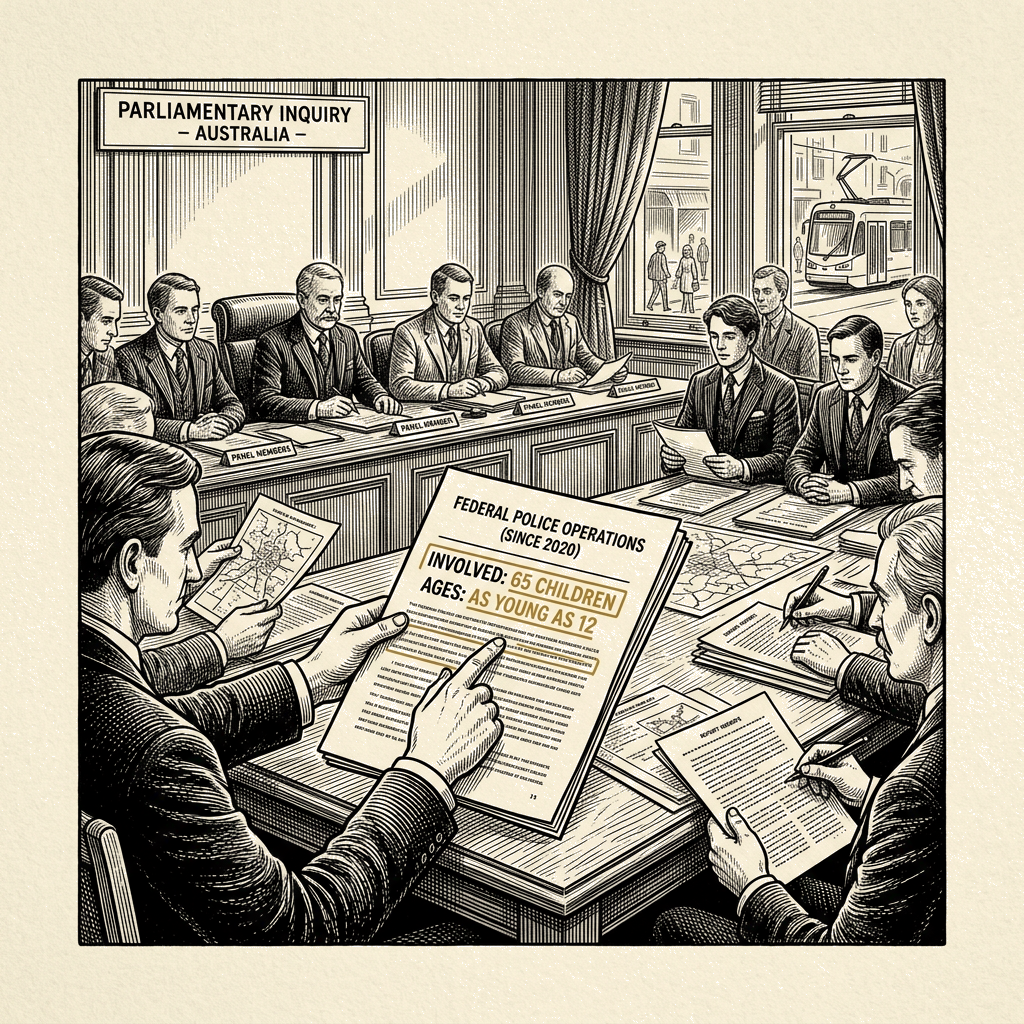
- Federal police operations since 2020 involved 65 children, including some aged 12.
- State or Commonwealth authorities charged 35 of the 65 children with terrorism-related offences.
- ASIO deputy director general for intelligence service delivery Claire McGuinness reported more children in ASIO’s caseload, including 12-year-olds, than in a caseload about 20 years earlier dominated by people in their early twenties.
- The Parliamentary Joint Committee on Intelligence and Security received testimony supporting a possible timing mismatch, but the published account does not quantify AI’s contribution, establish one referral sequence, or demonstrate that institutional capacity has already been exceeded.
Federal police operations since 2020 reportedly involved 65 children, including some aged 12, and state or Commonwealth authorities charged 35 of those children with terrorism-related offences. The inquiry’s central analytical significance comes from the timing of the evidence: Booth testified that artificial intelligence was accelerating and lowering the skills required to manipulate and radicalise young people online, while Dowling assessed that Australia was probably identifying radicalised people only after law-enforcement attention. Together, the accounts indicate a possible mismatch between radicalisation that can unfold within days and official identification that may lag behind that timetable, but the inquiry evidence does not measure how often the two timelines overlap or establish AI’s share of causation. McGuinness’s comparison with ASIO’s caseload about 20 years earlier establishes a reported shift toward younger subjects, while Booth’s warning about pressure on mental-health, education and judicial systems remains a prospective risk rather than a measured finding of present overload. The committee’s final report is due in March next year.
What the reported totals establish
The figures establish the reported scale of official involvement, not the sequence that produced that involvement. The 35 charges represent a subset of the 65 children associated with federal police operations. The account does not connect each operation to a later charge, identify how many operations were conducted by the Australian Federal Police rather than another federal police body, or explain whether evidence outside an operation contributed to any charge. The status and outcomes of the other 30 children are not reported.
The visible aggregate sequence begins with a federal police operation and continues to a charge by state or Commonwealth authorities. Exposure, recognition, referral, early support and the interval between operation and charge remain largely undocumented. The figures therefore cannot show whether operations followed timely intervention, whether charges arose directly from operations, or whether the remaining children entered and exited official systems through other pathways.
Booth’s appearance as an AFP witness does not establish that the AFP conducted every operation included in the federal total. Nor does the division of institutional roles establish a fixed progression from ASIO referral to AFP operation. The account leaves open which body acted first in any individual case and what threshold triggered official attention.
The inquiry account attributes the figures and testimony to named witnesses appearing before the Parliamentary Joint Committee on Intelligence and Security. The published material supplies no independent hearing transcript, committee exhibit or other approved primary record, so independent corroboration of the reported testimony and figures remains unresolved.
A partial pathway from exposure to intervention
Exposure and radicalisation. The initiating actors are not identified. Booth attributed the changing pace and scale of radicalisation among young people to artificial intelligence, growing grievance, searches for purpose and belonging, individual vulnerability and more sophisticated online networks. Her testimony supports AI as one influence within a broader process rather than as a demonstrated sole cause.
Booth testified that AI was lowering the skills required to manipulate and radicalise victims online. The account does not establish that every case began with online exposure, that AI materially altered every pathway, or that the children followed the same progression. The absence of case-level records also prevents comparison between children exposed to AI-mediated material and children whose radicalisation involved other mechanisms.
Detection and security attention. McGuinness reported that ASIO was encountering more children, including 12-year-olds, compared with a caseload about 20 years earlier that was predominantly composed of people in their early twenties. That comparison establishes a change in the age composition of ASIO’s observed caseload. It does not determine whether the change reflects different underlying pathways, earlier identification, broader referrals, altered monitoring or changes in recording practices.
The account does not identify what evidence causes a child to enter the caseload, what threshold distinguishes continued monitoring from referral, or whether referred children enter under comparable conditions. ASIO therefore cannot be placed at one fixed point in every pathway on the available evidence.
Police operations and charging. The source does not identify what triggers a federal police operation, whether ASIO referral is required, or whether ASIO and police agencies participated in a fixed sequence. Responsibility is distributed among ASIO, the AFP, Home Affairs, other federal police bodies and state or Commonwealth charging authorities. The source does not establish which institution could act at the earliest stage.
One illustrative account concerned a 13-year-old boy who allegedly possessed violent extremist material and used Discord. During a raid at the boy’s home, police alleged that a notebook contained plans for a school shooting. The account does not connect the notebook to the reported Discord use, identify who introduced the material, report AI use, or provide timestamps for exposure, discovery and alleged escalation. The example supports the existence of an online radicalisation pathway, but it cannot establish escalation tempo, AI involvement or a generalisable sequence.
Charging authority rested with state or Commonwealth authorities. The source does not show whether each of the 35 charges followed directly from a federal operation, whether other evidence or processes contributed, how the other 30 cases concluded, or how any individual case was ultimately resolved.
Intervention and institutional pressure. Booth warned that, without serious intervention, Australia’s mental-health, education and judicial systems could be overwhelmed by people committing serious offences, with possible consequences for democracy and institutions. She also reported an increase in threats against politicians. The published account treats institutional overload as a future risk; it provides no queue, staffing, waiting-time or outcome data showing that capacity has already been exceeded.
No early-intervention program, responsible authority, eligibility rule, referral pathway, support capacity or measured outcome is identified. The account also does not establish how many children received support before a police operation or charge.
Where the timing mismatch sits
The clearest functional mismatch is between radicalisation that Booth described as developing within days and Dowling’s assessment that people were probably identified too late, after radicalised individuals had attracted law-enforcement attention. The relevant measure would be the interval between the first identifiable concern and the first appropriate agency or service contact. The published account supplies no dated measure of either point.
At the online-to-authority boundary, no source identifies who first recognised concern, which referral route applied or what information was preserved. At the intelligence-to-police boundary, no source supplies a referral threshold, shared chronology or clear case ownership. At the police-operation-to-charging boundary, responsibility is not allocated between federal police activity and state or Commonwealth charging decisions. Information loss, role confusion and queue accumulation are therefore possible consequences to test, but none is measured in the account.
No prevention or support pathway is shown operating before conduct reaches the police-operation stage. Earlier support would require earlier identification and an authorised response, but the source establishes neither the timing nor the pathway. The functional mismatch also does not demonstrate that a published procedure was ignored or identify which institution bears responsibility for any delay.
The hearing evidence is asymmetric. AFP, ASIO and Home Affairs are represented through institutional witnesses, while children and families are represented mainly through aggregate counts and one alleged case account. Committee chair Senator Raff Ciccone invited people personally affected by radicalisation to come forward and acknowledged that doing so might not be easy, but the article reports no direct testimony from children or families. Operations and charges do not reveal affected children’s experiences, support needs or outcomes.
Explanations the available evidence cannot resolve
AI acceleration. Booth’s testimony is consistent with the explanation that AI materially shortens the interval between exposure and escalation and may be the dominant accelerator. The account contains no comparison of cases with and without AI, no case-level duration data and no independent test capable of isolating AI’s effect.
The youth environment. Booth’s account gives direct support to a broader explanation in which grievance, purpose, belonging, individual vulnerability and sophisticated online networks shape the pathways while AI acts as an accelerant. Her multi-factor testimony provides stronger direct support for this explanation than for a single-cause account, but the source still does not measure how the factors interact in individual cases.
Detection and referral. Growth in operations or caseloads may partly reflect changed monitoring thresholds, referral practices or identification timing rather than a corresponding increase in underlying incidence. The article supplies no denominator covering all concerns, referrals, intelligence assessments or early interventions.
Late response. Dowling’s assessment directly supports concern that official systems reach children primarily after police attention, limiting prevention and early support. The statement remains a hedged institutional judgment rather than a measurement of referral, operation or intervention times.
Different pathways. Children may enter official systems through routes shaped by age, evidence, jurisdiction and institutional thresholds. The difference between 65 operations and 35 charges is consistent with multiple pathways, but the source does not explain selection into those pathways, the sequence connecting operations to charges, or the disposition of the remaining 30 children.
The aggregate figures provide context for the scale of official involvement but contain no measure of AI use or radicalisation duration, so they cannot distinguish among the competing explanations. McGuinness’s comparison establishes a change in ASIO’s observed age profile but cannot separate changes in underlying pathways from changes in detection, referral or recording. Booth’s testimony supplies the strongest directional evidence for AI acceleration and the broader youth-environment explanation, but the absence of an independent comparative test prevents a conclusive causal finding.
The Discord example provides limited evidence that an online pathway existed in at least one case, but the absence of reported AI use and a dated sequence leaves AI acceleration unproved. Dowling’s statement supplies the clearest evidence for the late-response concern without measuring delay. Booth’s institutional warning supports a capacity risk without demonstrating that overload has occurred. No evidence described in the account is independently decisive, and no item supplies a test capable of separating the explanations by itself. The absence of formal decision rules, comparative cases and complete case chronologies leaves the evidentiary weighting comparative rather than conclusive.
Records that could distinguish the pathways
A matched, independently timestamped case series would provide more diagnostic evidence. The series would need to record first meaningful exposure, first report, first agency or service contact, whether AI materially altered the pathway, escalation, police operation, charging, support commencement and final outcome.
Repeated AI exposure preceding substantially shorter escalation intervals would strengthen the AI-acceleration explanation relative to the broader youth-environment explanation. Comparable AI-exposed and unexposed cases following similar timelines would weaken that distinction. Complete records could also reveal whether caseload growth reflects changed detection practices, different referral thresholds or different underlying pathways rather than a comparable rise across every stage.
Conditions shaping the next stage
The reported shift toward children and 12-year-olds, Booth’s cited factors of grievance, purpose and belonging, mental-health pressures and the reported increase in threats against politicians form the social context. AI, Booth’s reported reduction in the skills needed for online manipulation and radicalisation, sophisticated online networks and the Discord example form the technological context.
The article does not address household resources, service funding or other economic conditions. Those factors cannot be ranked on the available evidence and should not be treated as irrelevant. No environmental driver is identified.
The parliamentary inquiry, the distribution of federal, state and Commonwealth responsibilities, concern about institutional pressure and the final report due in March next year form the political and institutional context.
Four possible operating conditions
Two uncertainties organise the future range: whether escalation is gradual or accumulating or compressed into days, and whether identification and intervention are early and timely or late and under strain. These are planning conditions rather than probabilistic forecasts. The source provides no joint observations across the two axes and no basis for calibrated probabilities.
The axes can operate independently. A compressed pathway can be identified quickly if institutional capacity keeps pace, while a gradual pathway can be missed when information remains between agencies. A timely response can also be overwhelmed by a sufficiently rapid cascade. McGuinness’s historical age-profile comparison provides context about caseload composition, not a direct measure of current response delay or performance in any of these conditions.
| Escalation tempo | Identification and intervention capacity | Process implication and direct indicators |
|---|---|---|
| Gradual or accumulating | Early and timely | First-concern-to-contact intervals remain bounded; age-specific referral and support queues remain stable; support begins before a police operation. Broader-pathway case reviews may show AI absent or secondary, varied timelines, pre-enforcement support, and outcomes in which intervention preceded de-escalation or closure without charge. |
| Compressed or days-long | Early and timely | Exposure-to-escalation and first-concern-to-contact intervals both shorten; support begins within the compressed window; documented support before an operation becomes more common; age-specific queues do not accumulate; and new cases can be distinguished through information unavailable to conventional monitoring. |
| Gradual or accumulating | Late or under strain | First-concern-to-contact intervals lengthen; age-specific referral and support queues accumulate; support begins after concern and sometimes after an operation; and handoffs lack clear ownership. A broader-pathway reading would be indicated by many files lacking evidence of AI use, police or courts appearing as the first institutions contacted, repeated reliance on charges after alleged threats or plans, and caseload pressure without corresponding early-support records. |
| Compressed or days-long | Late or under strain | Documented escalation occurs within days while first-concern-to-contact intervals remain long or lengthen; operations and charges outpace support commencement; age-specific queues lengthen; more very young children appear in operational caseloads; pre-charge intervention remains limited; and authorities explicitly report capacity constraints. |
Aggregate caseload figures cannot distinguish among more underlying cases, earlier identification, broader referral practices or a combination of those changes. Distinguishing the four conditions would require referral thresholds, dated case timelines, the role of AI in individual cases, the identity of the first agency or service contacted, pre-charge interventions, support commencement, operational triggers, jurisdiction and outcomes for the 65 children. The 35 charges and the status of the other 30 children cannot establish a common sequence because the source does not disclose selection, chronology or disposition.
Indicators and response choices
Useful measures across all four conditions include a common case chronology, clear ownership at each handoff, separation of intelligence concerns from police operations and charging decisions, and preservation of age-specific mental-health, education and judicial support capacity. Without those records, the operating conditions remain difficult to distinguish.
AI-specific detection and digital-evidence capacity depends on AI materially driving a large share of pathways and remaining identifiable in the available material. Broad prevention directed toward grievance, belonging and youth support depends on the youth-environment explanation being dominant. A major enforcement surge is most closely associated with compressed and late conditions and could compete with support capacity needed for children who have not been charged.
Lengthening first-concern-to-contact intervals or accumulating age-specific queues would point to an interagency case review and additional youth-support capacity. Matched records showing AI-associated compression would strengthen the case for specialist digital-evidence and youth-safeguarding capacity. Threats or operations rising across jurisdictions before support systems keep pace would require coordination before separate institutional queues form.
A tail-risk case would involve a newly observed dissemination route synchronising attention across many young people and jurisdictions at once. Such a route could compress escalation while overwhelming identification and support capacity, linking the two uncertainties. The source provides no calibrated probability estimate and does not indicate that such a route is currently emerging.
The inquiry’s next evidentiary task
The defensible conclusion is that the supplied inquiry account documents reported official involvement with a younger caseload, presents AI acceleration as Booth’s attributed assessment, and records Dowling’s institutional judgment that identification is probably occurring too late. The account does not quantify AI’s contribution, establish a single causal pathway, show that a coordinated pre-enforcement support pathway exists, or demonstrate that Booth’s projected institutional pressure has already occurred.
The central issue is the timing and continuity of identification across institutional boundaries. The final report will need to distinguish changes in underlying pathways from changes in monitoring, referral and recording while examining when affected children first become visible to an appropriate agency or service. The Parliamentary Joint Committee on Intelligence and Security is due to hand down that report in March next year.
Analytical techniques used in this piece
This analysis applies the methods below. Each links to a short, plain-English explainer you can read and reuse.
- Process Mapping
- Lays out a process end to end — steps, hand-offs, and bottlenecks.
- Process Tracing
- Reconstructs the step-by-step causal pathway of a specific historical event.
- Scenario Planning
- Builds a small set of distinct, plausible futures to plan against.