Summary
- Peggy Flanagan and Michele Tafoya are converting the same accountability questions — federal enforcement, state leadership, and fraud allegations — into electoral energy, with each campaign casting different institutions as the problem.
- The Trump administration anchors the race’s hub-and-spoke structure, with the enforcement operation, the killings of two Americans by federal agents, the federal investigation into allegations of immigration fraud regarding Representative Ilhan Omar, and a new program to report suspected fraud all radiating from Washington into Minnesota politics.
- NPR reported that voters have been flooded with ads tying hundreds of millions of dollars in alleged fraud to Minnesota’s Democratic leaders, including Tim Walz, the party’s former vice presidential candidate; the article does not name who produced the ads.
- Michele Tafoya attributes blame to both the federal ICE rollout under Kristi Noem and to Governor Tim Walz and Flanagan, a dual attribution that permits a self-described moderate with Donald Trump’s endorsement to fault federal and state officials in a single answer.
- The people most directly affected — Somali American community members, the families of Renee Good and Alex Pretti, and state program administrators — are largely absent from the reported record.
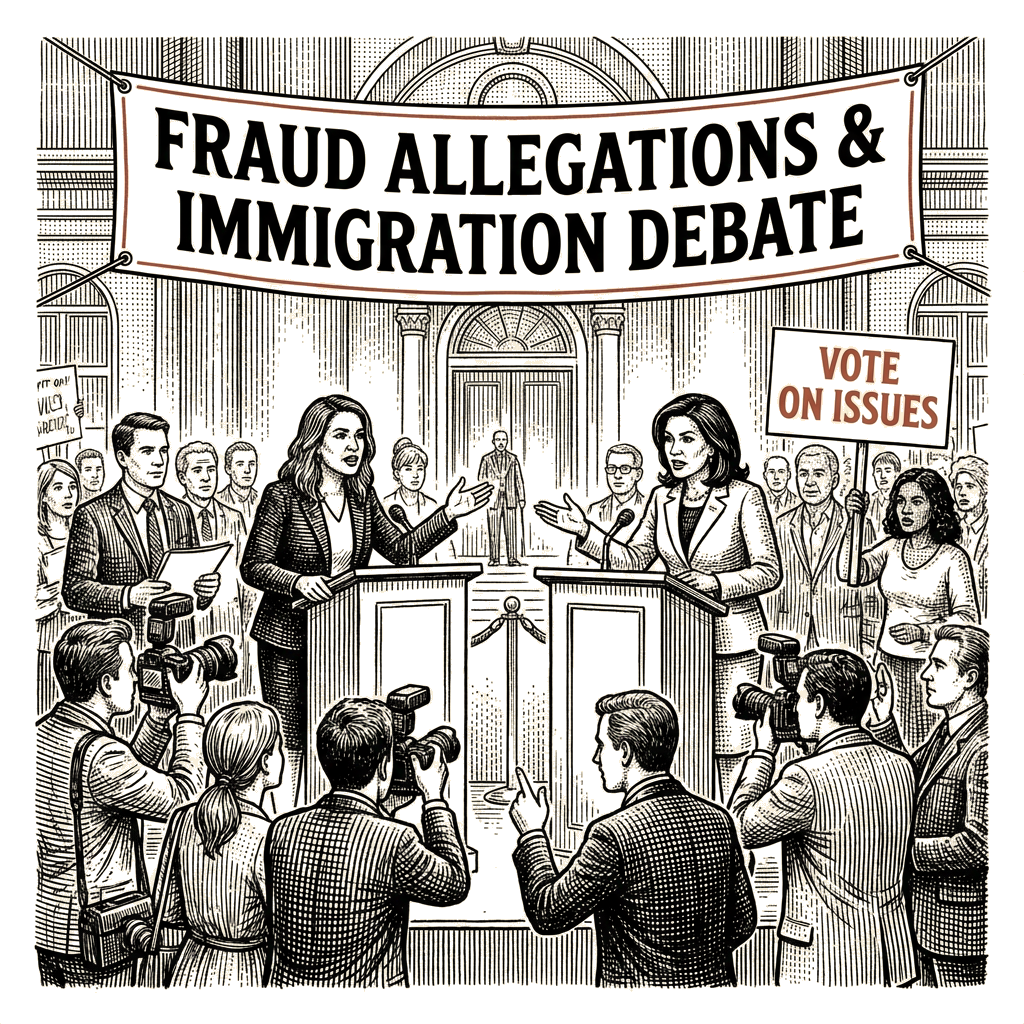
Minnesota’s open U.S. Senate race is closer than expected, NPR’s Clay Masters reported from Minneapolis. The seat is open because a Democrat is retiring; the candidates are Lieutenant Governor Peggy Flanagan on the Democratic ticket and Michele Tafoya on the Republican ticket, running as a moderate with President Donald Trump’s endorsement. NPR host Steve Inskeep said Democrats expect to gain Senate seats elsewhere while Republicans hope to gain a seat in Minnesota, so a Republican pickup would partially offset the national trend; the vacancy is what places the seat in play. The campaign’s final weeks have resolved into a contest over federal enforcement, state leadership, and fraud allegations — three tracks that point voters at different institutions as the source of the problem. Fraud figures prominently among them: NPR reported that the Trump administration used both alleged and proven fraud in state social-service programs as part of its reason for targeting Minnesota, and that voters have been flooded with ads tying hundreds of millions of dollars in alleged fraud to Minnesota’s Democratic leaders, including Tim Walz, the party’s former vice presidential candidate.
The race’s structure
The final-weeks argument has resolved into three tracks — federal enforcement, state leadership, and fraud allegations — and each track assigns responsibility to a different institutional address. The relationship structure of the race is hub-and-spoke: nearly every major development originates with the administration in Washington and radiates into the state’s politics — the enforcement operation; the killings of two Americans by federal agents, Renee Good and Alex Pretti, whose deaths sparked nationwide protests; the federal investigation into allegations of immigration fraud regarding Representative Ilhan Omar; and a new program to report suspected fraud, discussed in an Oval Office appearance. The wave of ads tying alleged fraud to the state’s Democratic leaders is the major current without an attributed origin in the report, and the article does not name who produced the ads. NPR’s description of the race as closer than expected co-occurs with these dispute lines but is not attributed in the report to any single one of them.
Who benefits
The fraud track distributes advantage through a definitional choice rather than a money transfer. NPR reported that the Trump administration used both alleged and proven fraud in state social-service programs as part of its reason for targeting Minnesota, and that voters have been flooded with ads tying hundreds of millions of dollars in alleged fraud to Minnesota’s Democratic leaders, including Tim Walz, the party’s former vice presidential candidate. The figure is labeled alleged and the article does not supply provenance for it. Bundling the two categories into a single sum is the load-bearing parameter: an ad that labels a sum “proven” moves liability from allegation to record, while one that labels it “alleged” leaves the sum untested in the same sentence. For the administration, the benefit is narrative control — a stated justification for targeting the state, paired with a fraud-reporting program discussed from the Oval Office. For Walz and Flanagan, it is a liability they did not originate and cannot audit from the article’s account.
Ian Lopez, a UC Berkeley law professor who studies the exploitation of race as a basis for mobilizing political support, disputed the use of the fraud allegations: “These allegations of fraud against people of color in Minnesota as a way to whip up racial resentment and to try and transmute that into political energy - those are classic techniques of dogmas of politics.” That reading is consistent with the article’s account of who is named in the ads and who is named in the Oval Office remarks; it is not, on this report, evidence about the underlying fraud figures themselves, whose provenance the article does not supply.
Among Republican-leaning voters, the benefit runs through a definitional shortcut a union exchange illustrates. Dale Johnson, a conservative voter and retired snowplow driver, said he raises the spending issue at his union meetings and is met with pushback; a colleague dismissed his concern by noting the money was mostly federal, and Johnson replied, “It’s federal money that they’re blowing. That shows you that people aren’t really using their head.” The exchange turns on whether federal dollars spent under state administration count against state leaders — a question the article poses through voters rather than resolves. The frame travels into organized labor, a constituency not usually associated with the conservative base, on grounds a union member can defend.
Trump’s endorsement sits on Tafoya’s candidacy, and the same Oval Office appearance in which he discussed the new program to report suspected fraud also served as the occasion for him to attack Minnesota and its Somali American community: “They’ve - they’re destroying it. Probably - maybe they’ve destroyed it.” The federal investigation into allegations of immigration fraud regarding Omar, raised in that appearance, is described by Omar as an intimidation attempt ahead of the midterms; the characterization is hers, the article reports no findings from the investigation, and there is no reported role by either Senate campaign. On Flanagan’s account of unchecked federal power, the investigation functions as further instance of her central claim — a cross-link tying the congressional contest to the Senate race.
Flanagan has made federal immigration enforcement central to her campaign; at a recent roundtable in an elementary school library she framed the race in those terms: “This is, I think, the model of what the most corrupt, cruel administration in our nation’s history - what they can get away with when, you know, this goes unchecked. So this is a choice in this race.” Whether the emphasis is aimed at motivating her base is an inference from her public remarks and schedule, not something the article reports; the documented base for the argument is NPR’s report that Democratic voters this year have been motivated by immigration following the Trump administration’s enforcement that led to protests and deaths in Minnesota.
Tafoya’s documented response to the same controversy was to split the blame. At a debate earlier this month hosted by Minnesota Public Radio, asked how the Trump administration had handled Operation Metro Surge, she raised the two Americans killed by federal agents and said, “The loss of Renee Good and Alex Pretti is devastating.” Her criticism of the federal side attaches to a specific official rather than to the administration as a whole: “I did not like the way that ICE rollout was handled by Kristi Noem, and she was appropriately fired” — the dismissal claim carried in her voice, with no independent sourcing in the record. She also accused Governor Tim Walz and Flanagan of “a massive failure in leadership.” Criticizing both federal and state officials in the same answer is the documented conduct that permits a self-described moderate with Trump’s endorsement to hold both positions; no inference about intent is required to observe it.
Applied symmetrically: Flanagan’s frame draws on an established constitutional concern about limits on federal power while also serving her coalition’s mobilization, per NPR’s report that immigration enforcement has motivated Democratic voters this year, and the fraud frame draws on a public concern about stewardship of public money separable from its distributional overlay — which people the allegations render suspect. Both campaigns are converting the same accountability questions into electoral energy, with different targets cast as the problem.
What happens next
The chain by which a national enforcement fight becomes a state ballot question runs in steps the article documents. Trump’s enforcement and Operation Metro Surge produced protests and the deaths of Renee Good and Alex Pretti. Both parties then nationalized the race: Trump attacked Minnesota and its Somali American community from the Oval Office, while Flanagan attacked the administration from a school-library roundtable. Tafoya must answer for both federal and state conduct in a single answer. Local Democratic leaders absorb fraud advertising aimed at the state, whether or not the ad’s authors can be identified from the article. The immediate result is that voters receive ads pairing fraud sums with named Democratic officials while the administration pairs its enforcement rationale with alleged and proven fraud.
The consequences run across four horizons. In the immediate term, the final weeks before election day are saturated: Trump has remained focused on Minnesota, and the investigation into allegations of immigration fraud regarding Omar is a live campaign event in the stretch. In the short term — months — responsibility bifurcates: Flanagan answers for federal conduct she opposes, Tafoya answers for state conduct she also criticizes, and both must answer for events neither administered; the seat itself matters as a partial offset to the national trend. In the medium term — one to five years — the precedents set by the race affect state-federal relations: the template of enforcement plus fraud allegations as a federal approach to a state, and the response of an electorate in a state that historically tilts blue to being cast as a target; a further medium-term risk named by neither campaign is the chilling effect of high-visibility fraud scrutiny on eligible participation in benefit programs — families who cannot distinguish scrutiny of a program from suspicion of themselves. If the fraud figures remain unprovenanced in the argument, the incentive to keep them unprovenanced persists on one side and the incentive to demand a source persists on the other, which predicts continued ad volume and continued state-leadership blame as the earliest visible signals of that pattern holding. In the long term, the deaths of Good and Pretti stand to become a policy case for how federal operations are reviewed, and Minnesota’s shifting electorate will determine whether either party’s investment in the state was structural or situational.
The horizons conflict: the immediate mobilization both parties derive from the allegations and the deaths trades against the long-term cost to institutional trust, and the short-term advantage of nationalizing the race trades against the medium-term risk, to both parties, of a state that has seen itself as a target. Feedback loops run on several tracks. NPR’s report of Democratic motivation suggests the administration’s focus has energized the opposition it is attacking. The race’s closeness draws national attention and advertising — NPR reported voters being flooded with ads — which further nationalizes the contest, which tends to keep it close. The new program to report suspected fraud institutionalizes a channel for allegations whose findings could later serve as the reason for further targeting, as NPR reported the administration already used alleged and proven fraud in its targeting rationale; the program’s first operating year will test whether its design produces substantiated findings or unmanageable volume, an outcome the reporting does not yet establish. Trump’s continued focus, including his remarks about the Somali American community, supplies material both coalitions can use.
Two unintended consequences bracket the record. The operation’s own history contains the clearest one: the deaths of two Americans at the hands of federal agents produced nationwide protests, and that protest movement now structures both campaigns’ messages. The fraud-reporting channel presents a prospective one: reporting mechanisms without evidentiary thresholds can overwhelm investigative capacity and discourage participation, and neither candidate has addressed that risk in the reported record. The counteracting branch is Tafoya’s dual attribution, which blurs a clean nationalization of the race and is consistent with NPR’s closer-than-expected framing.
How this is being framed, and whose account is missing
The people most directly affected by the underlying events are largely absent from the reported record, which carries the voices of the two candidates, the president, a conservative union voter, and a law professor. It does not include a Somali American community member’s account of the enforcement or the investigation, though the community is repeatedly referenced as the object of the president’s attacks and the target of the allegations. It does not include the families of Renee Good and Alex Pretti, whose deaths sit at the center of the events both campaigns are addressing. It does not include the state officials who administer the social-service programs at the center of the fraud allegations, or the local officials in the communities where Operation Metro Surge ran. On the record’s silences, one inference is available without designing policy: the frame those absent interests would construct addresses the same three issues — fraud, enforcement, accountability — while casting a different set of people as the problem. Its specific design is beyond what the report supplies.
Both campaigns have converted the same facts — two deaths, one enforcement operation, a series of allegations — into opposing verdicts on federal power, and told voters the election is the choice between them; the precedents the race is setting, in enforcement, in program oversight, and in national campaigns built on allegations, will outlast the count.
Analytical techniques used in this piece
This analysis applies the methods below. Each links to a short, plain-English explainer you can read and reuse.
- Consequences & Sequels
- Plays a decision forward to its first- and second-order consequences.
- Cui Bono — Who Benefits
- Asks who gains and who pays from a state of affairs, decision, or claim.
- Relationship Mapping
- Extracts the network of ties among people, institutions, and entities.