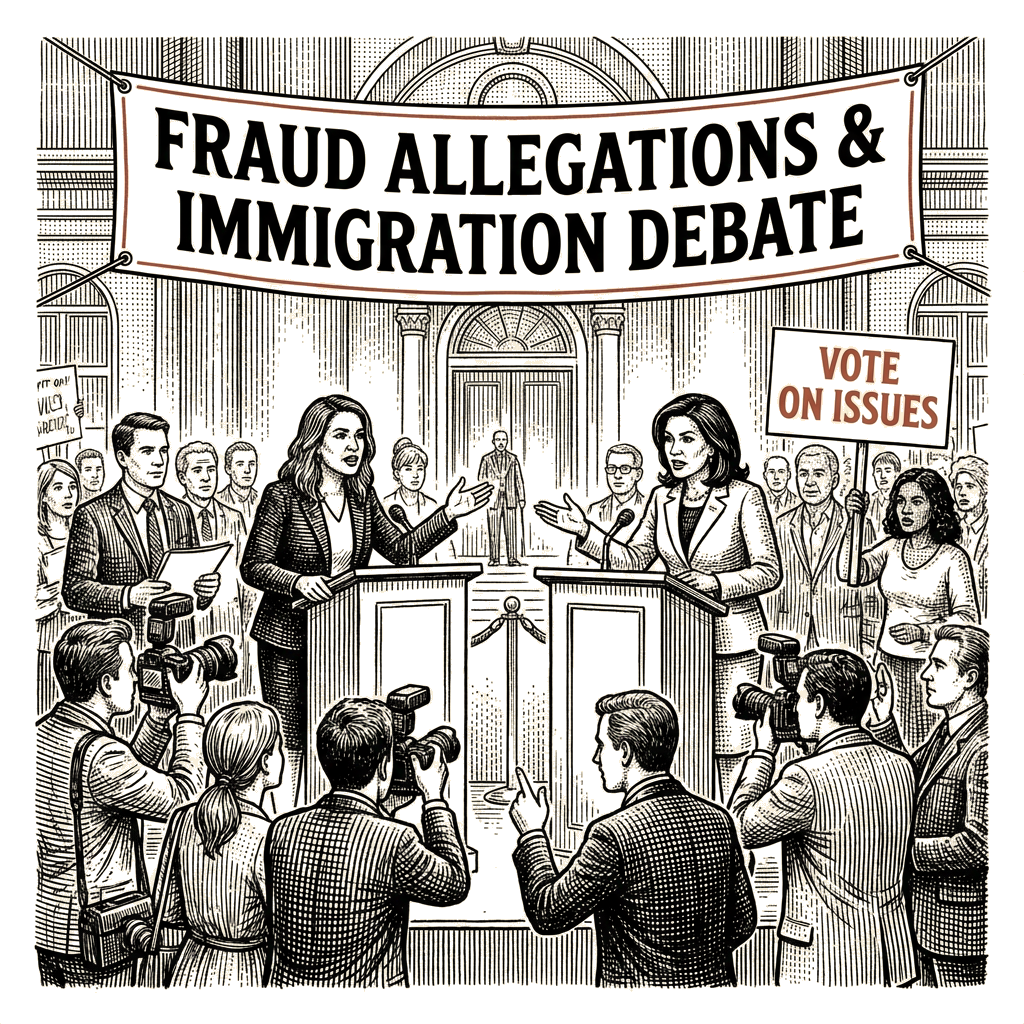
Flanagan and Tafoya divide over federal enforcement and state leadership
NPR’s Clay Masters reported from Minneapolis that Minnesota’s open U.S. Senate race is closer than expected. The seat is open because a Democrat is retiring, and the candidates are Lieutenant Governor Peggy Flanagan on the Democratic ticket and Michele Tafoya on the Republican ticket. Tafoya is running as a moderate and has President Donald Trump’s endorsement. NPR host Steve Inskeep said Democrats expect to gain Senate seats elsewhere while Republicans hope to gain a seat in Minnesota.
Flanagan has made federal immigration enforcement central to her argument. At a recent roundtable in an elementary school library, she discussed the local effects of the Trump administration’s enforcement. She said the events showed how the administration could act and described the election as a choice: “This is, I think, the model of what the most corrupt, cruel administration in our nation’s history - what they can get away with when, you know, this goes unchecked. So this is a choice in this race.”
NPR reported that Democratic voters this year have been motivated by immigration following the Trump administration’s immigration enforcement that led to protests and deaths in Minnesota. Trump and the Republican Party have also focused on immigrants, including Somali Americans and Representative Ilhan Omar. NPR said immigration and fraud had been among the issues the administration and Democrats fought over throughout the year.
Operation Metro Surge has become a central point of contention. At a debate earlier this month hosted by Minnesota Public Radio, Tafoya was asked how she thought the Trump administration had handled the operation. She brought up the two Americans killed by federal agents, Renee Good and Alex Pretti, whose deaths sparked nationwide protests. Tafoya said, “The loss of Renee Good and Alex Pretti is devastating.”
Tafoya’s comments placed responsibility for the controversy with both federal and state officials. She said, “I did not like the way that ICE rollout was handled by Kristi Noem, and she was appropriately fired.” She also accused Governor Tim Walz and Flanagan of “a massive failure in leadership.” Flanagan has directed her criticism at the Trump administration, arguing that the events showed how unchecked federal power operates.
Fraud allegations form another central campaign issue. NPR reported that the Trump administration used both alleged and proven fraud in state social-service programs as part of its reason for targeting Minnesota. Separately, the report said voters were being flooded with ads tying hundreds of millions of dollars in alleged fraud to Minnesota’s Democratic leaders, including Walz, the party’s former vice presidential candidate.
Dale Johnson, a conservative voter and retired snowplow driver, says he raises the spending issue at his union meetings and is met with pushback. He said another union member dismissed the concern by telling colleagues that the money was mostly federal. Johnson replied, “It’s federal money that they’re blowing. That shows you that people aren’t really using their head.” His exchange focused on whether the money should count against Minnesota’s Democratic leaders.
Trump has remained focused on Minnesota in the final weeks before election day. In an Oval Office appearance last week, he discussed a new program to report suspected fraud and used the occasion to attack Minnesota and its Somali American community. Trump said the state had once been beautiful but was being ruined: “They’ve - they’re destroying it. Probably - maybe they’ve destroyed it.”
During the same appearance, Trump brought up a federal investigation into allegations of immigration fraud regarding Omar. The Minnesota congresswoman said the investigation was an intimidation attempt ahead of the midterms.
Ian Lopez, a UC Berkeley law professor who studies the exploitation of race as a basis for mobilizing political support, disputed the use of the fraud allegations. Lopez said: “These allegations of fraud against people of color in Minnesota as a way to whip up racial resentment and to try and transmute that into political energy - those are classic techniques of dogmas of politics.”
Flanagan has built her case around what she calls unchecked federal power, while Tafoya has faulted both the federal rollout and Minnesota’s leadership. Those competing accounts have become central to the final weeks of a race NPR described as closer than expected. Republicans hope to gain the seat in a state that historically tilts blue, while Democrats expect to gain Senate seats elsewhere.