Summary
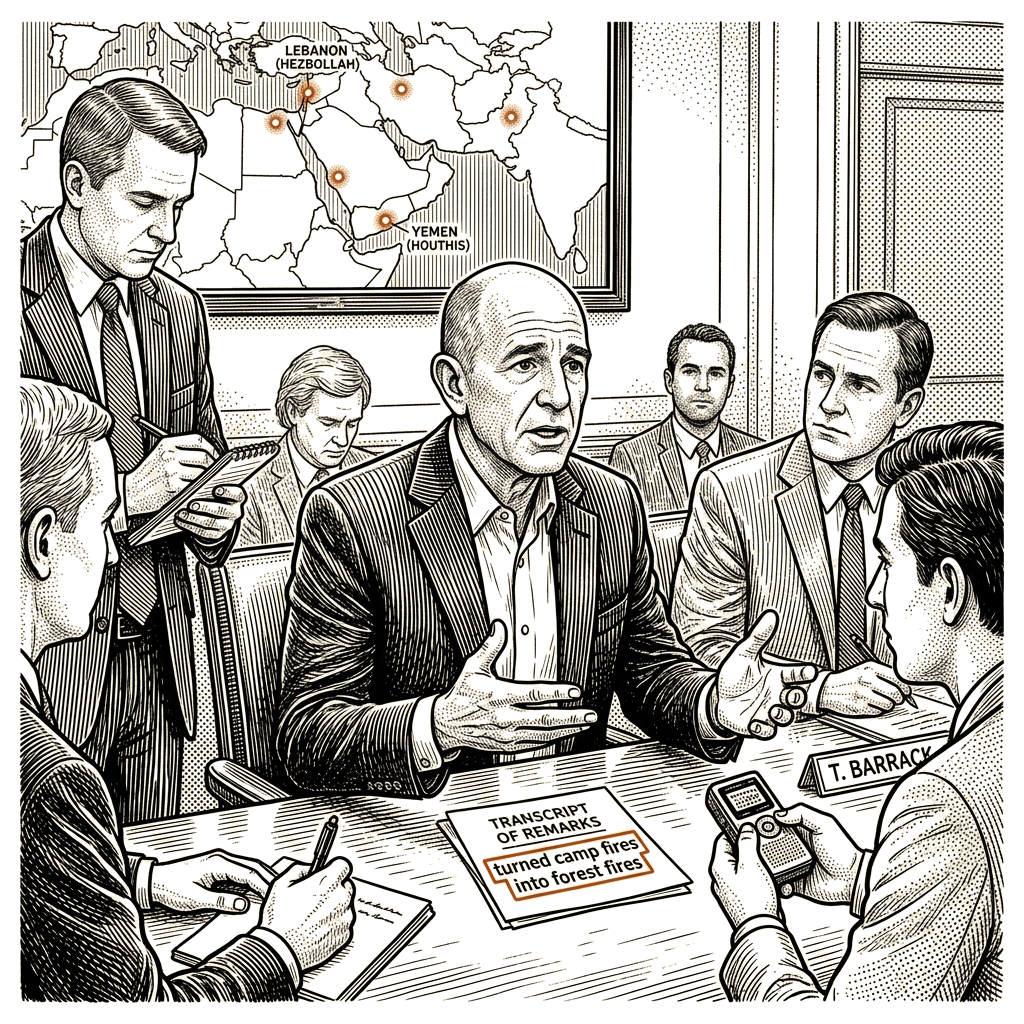
- Tom Barrack, Donald Trump’s envoy to Turkey and counselor to the president on the Middle East, said the February US-Israeli war on Iran turned “camp fires into forest fires” — an admission that maps the conflict propagating along Iran-aligned networks, the Strait of Hormuz and allied dependency structures that existed before the strike.
- Brent crude reached $117 a barrel, 50% above prewar levels, worldwide inflation was pushed to 4%, and the International Monetary Fund cut its Saudi Arabia forecast from July’s 1.7% growth to a 3.3% contraction — per the Guardian’s account, with Riyadh raising its 2026 budget deficit projection to $65.3bn, 48% above the original.
- Donald Trump coupled the Iran and Ukraine theaters by announcing a 60-day “energy truce” that neither Volodymyr Zelenskyy nor Vladimir Putin had agreed to — which the Guardian described as entirely fictional — while a Starlink contract dispute placed a private satellite service at the junction of both wars.
- Vladimir Putin proposed a three-way US-China-Russia summit in Shenzhen and sent Sergei Lavrov to Tehran on 19 October, a linkage the Russia affairs analyst Amir Chahaki characterized as Putin extracting Ukrainian concessions from Trump in exchange for persuading Tehran toward Trump’s demands.
- The root cause the record supports is interactive: force used against a live negotiation — Oman’s mediator, Badr Albusaidi, said agreement “had been within reach before the bombing started” — striking a single-provider architecture that amplified the shock, with Barrack’s own count of 23 American-instigated regime changes that have not worked ruling out any single-leader fix.
- What happens next turns on two independent uncertainties — whether the nuclear-file negotiation is recovered and whether US partners accelerate decoupling from US security and technology underwriting — with Iran’s nuclear-fatwa debate serving as the tracked indicator in every scenario.
In Doha remarks last week reported by the Guardian’s diplomatic editor, Patrick Wintour, Barrack said the war on Iran that Trump and Israel launched in late February had turned “camp fires into forest fires,” spreading through Hamas, Hezbollah, six Iranian militias, the Houthis and into north Africa. The admission carries the analytical claim the reporting substantiates: the propagation followed identifiable structure rather than chance, because the Iran-aligned network, the Strait of Hormuz chokepoint and the dependency architecture beneath Gulf exports and allied militaries all existed before the first strike. Its measurable traces, per the Guardian’s account, include Brent crude at $117 a barrel — 50% above prewar levels — less than a fortnight before the US midterm elections, worldwide inflation pushed to 4%, an IMF forecast of a 3.3% Saudi contraction in place of the 1.7% growth it projected only in July, and a Saudi deficit projection raised on 30 September to $65.3bn, 48% above the original figure. From there the wiring runs onward: a 60-day “energy truce” the Guardian described as entirely fictional, a Starlink contract sitting at the junction of two wars, Moscow’s offer to arbitrate between them, European spectrum and procurement pushes, and a Gulf security pact the Guardian framed as a potential “Berlin Wall moment.”
How the war propagated
The organizing structure is a hub with cross-linked spokes. Washington sits at the center of nearly every thread — the Iran war, the Ukraine “energy truce,” the Putin invitation to the winter G20 the US is hosting at a golf club just outside Miami, the Starlink dispute, the European spectrum protest, the midterm calendar — while the spokes connect to one another rather than running only to the hub. Barrack likened the Middle East to a Rubik’s Cube, in which a single move can inadvertently affect the whole picture: “When you adjust one thing in the region what we have seen is everything then changes,” he said. “Those unintended consequences, and the sequential pace of what is happening, is unexpected.” He both mapped the interdependence and professed surprise at its pace: “We started trying to do something with our allies in Iran that spread through Hamas, Hezbollah, to six Iranian militias, the Houthis and is now going to north Africa. So where does it stop? How much does this US intervention help or hurt?”
Causal: the strike to Iran’s doctrine. Per the Guardian’s account, the Islamic Revolutionary Guards Corps, having been attacked twice mid-negotiation, has adjusted its defense doctrine to allow preemptive strikes not only against US bases but across the globe; hardliners around the new supreme leader, Mojtaba Khamenei, are more entrenched than ever, and public debate inside Iran now leans toward ending the fatwa on possessing nuclear weapons. Ali Larijani — the figure the Guardian described as the Iranian with the most strategic nous — was killed on the war’s first day, the day on which, per Badr Albusaidi, Oman’s foreign minister and a mediator in the February Iran-US talks, an agreement on the core issue “had been within reach before the bombing started.” The reading that the strike destroyed the channel through which restraint was being purchased is an inference from that juxtaposition, not a stated mechanism; it would fail if postwar Iranian doctrinal statements had preserved a negotiation-first posture, and the reported doctrine change points the other way. Tony Radakin, the UK chief of the defence staff, described what such a doctrine means: “People can hurt us from a distance, and it doesn’t cost a fortune to be able to do so.”
Causal: the chokepoint to the price. The Strait of Hormuz, open to commercial traffic for centuries, has become an Iranian bargaining chip, the Guardian reported; Brent crude reached $117 a barrel, 50% above prewar levels, and worldwide inflation was pushed to 4%, the price print landing less than a fortnight before the US midterm elections. The mechanism is a risk premium applied to the corridor through which Gulf exports move. The link would fail if prices had decoupled from shipping risk; per the Guardian’s account they tracked the war.
Dependency: Vision 2030’s three assumptions. An analysis cited by the Guardian argued that the kingdom’s Vision 2030 plan was built as a hedge against oil-price volatility, assuming open sea lanes, functioning airports and a US security umbrella to deter attacks on its export infrastructure — and that every one of those assumptions has failed since February. The IMF now forecasts a 3.3% Saudi contraction, a five-percentage-point downgrade from the 1.7% growth forecast it issued only in July, and on 30 September Riyadh raised its 2026 budget deficit projection to $65.3bn, 48% above the original forecast. The dependency link would fail if Saudi growth had held despite the failed assumptions; the revisions show the opposite.
Structural: the Iran–Ukraine coupling. Energy channel: Trump deflected responsibility for high fuel prices to Ukraine’s attacks on Russian oil refineries, the Guardian reported; he demanded that Volodymyr Zelenskyy stand down, describing him as “the real impediment to peace,” and announced a 60-day “energy truce” that neither Zelenskyy nor Putin had agreed to — which the Guardian described as entirely fictional. The accompanying deal to release Russian diesel was, per the Guardian, so small that no serious commentator expected it to have a serious impact on US prices. Technology channel: Musk said the Ukrainians had breached the terms of the Starlink contract by using it to attack Iran, placing a private satellite contract at the junction of two wars. The administration then gave conflicting accounts about why Ukrainian forces lost their previous levels of access to the military-grade version of Starlink — some blaming Musk for acting on his own, others, including Vice President JD Vance, saying Musk would contractually have required the permission of the White House or the military to act — and even after the decision was supposedly reversed, what actually happened remained unresolved, per the Guardian.
Influential: Moscow’s arbitrage channel. Putin proposed a three-way US-China-Russia great-power summit at an already scheduled 18 November meeting in Shenzhen, China and, on 19 October, sent his veteran foreign minister, Sergei Lavrov, to Tehran for the first time since the war began, to test whether the conflict could be ended on terms Trump could tolerate. The stated mechanism of the linkage belongs to Amir Chahaki, a Russia affairs analyst cited by the Guardian: “The more Putin can persuade Tehran to move closer to Trump’s demands, the more concessions he can extract from Trump on Ukraine.” The coupling is described in the material as strategic rather than accidental — Chahaki’s cited analysis alongside Moscow’s documented diplomacy: the Shenzhen proposal, the Lavrov trip, and the invitation Trump extended, overruling objections from some in his own party, to Putin for this winter’s G20 summit at the Miami-area golf club.
Influential: Starlink to European digital sovereignty. In May the European Commission proposed reserving 70% of the 2GHz frequency spectrum, which allows smartphones to connect directly to satellites, for European enterprises, restricting access for players such as Starlink; Deutsche Telekom, Orange, Vodafone and Telefónica are already lining up to bid, prompting US diplomatic protests. Poland’s foreign minister, Radosław Sikorski, accused Musk of digging his own grave in Europe, asking why “a Ketamine-addicted trillionaire in bed with foreign powers should think he deserves regulatory privileges and frequency permissions.” The former Canadian foreign minister Chrystia Freeland predicted countries would “think really hard before they buy another F-35 controlled by the Pentagon,” asking, “Why would you want a jet that Americans control?” One thread, four domains: warfighting, technology regulation, weapons procurement, alliance politics.
Causal: prices to European politics. French President Emmanuel Macron told demonstrators their anger was legitimate: “Demonstrators expressed concern about the cost of living and the price of fuel. Both are driven by the conflict launched in the Persian Gulf, a conflict in which France has taken no part but whose consequences we are suffering.” Polish Prime Minister Donald Tusk told his parliament that fuel prices were “devilishly expensive” and that the Donald responsible was Trump, not him. German Chancellor Friedrich Merz said: “My biggest concern at the moment is not our economy, not the USA or China, but Russia’s influence on our society.”
Correlational: messaging to domestic standing. The Guardian reported Trump’s domestic popularity in ruins; the Republican pollster Karl Rove said Trump “came across more as a heckler at a UFC match than as a reassuring wartime commander-in-chief,” warning: “The more undisciplined the White House messages on war and the economy, the more at risk GOP candidates will be.” As stated, the link between messaging and standing is correlation; the causal claim is Rove’s, not the Guardian’s.
The cross-linking node: credibility of the US umbrella. The same variable recurs across the map — in Vision 2030’s failed assumptions, in Albusaidi’s call this week for a Gulf security pact that includes Iran, a proposal the Guardian called a potential “Berlin Wall moment” because it implies the US should no longer be the region’s security provider, in Freeland’s F-35 question, and in the Guardian’s Saudi example: a country that offered Trump gifts and was in return left to fend off Houthi attacks that senior UN diplomats insisted were driven entirely by a timetable meeting Iran’s needs. Gulf finance, Gulf security architecture and transatlantic procurement are, on this reporting, the same phenomenon read from three capitals.
The sources name the structure themselves. India’s external affairs minister, Subrahmanyam Jaishankar, said: “The indivisibility of our existence permeates every aspect of human activity and it has deepened as globalisation has advanced. The fact now is that war anywhere threatens peace everywhere.” The American international relations scholar Charles Kupchan, in a new book cited by the Guardian, argued that power is rapidly diffusing across the international system, with the Guardian summarizing his view of Trump as “a symptom of a trend that is systemic and widespread.” And the hub’s own envoy supplied the retrospective pattern: “We have had 23 regime changes take place across the greater Middle East and Levant instituted one way or another by some American hand or influence, and none of them have worked.” The Guardian noted Barrack pointed to Iraq, Libya and Afghanistan — but not Iran — and quoted his conclusion: “Every time we try to intervene and change the person or the regime, it seems to have been a mistake.”
Root cause
The failure under analysis is of statecraft rather than of production; the symptom is the spread Barrack named plus its economic transmission.
The dominant causal chain runs through the timing of the strike — force used against a live negotiation. The mediator’s account, quoted above, and the Guardian’s report of two mid-negotiation attacks on the IRGC anchor that timing. Why the war spread: the strike left Iran’s leverage intact and activated it — the aligned network, the chokepoint and Iranian doctrine. Why doctrine hardened rather than softened: the Guardian’s account places the doctrinal shift against the circumstances of its onset, the juxtaposition carried in the propagation map above; the channel-destruction reading remains an inference, not a stated mechanism. Why force was used against a live negotiation: the operation carried two unresolved theories of purpose — the Guardian reported Benjamin Netanyahu wanted to order “the IDF, Mossad, and the security services” to “overthrow the regime in Iran,” while the American focus was nuclear weapons — against the mediator’s account that agreement was within reach when the bombing started.
At root, the material locates the failure in the interaction: a strike launched mid-negotiation, hitting a single-provider architecture, under undisciplined signaling — and, at the structural level the material itself supplies, in an intervention method that authorizes force before a settlement design exists. Barrack’s tally states the pattern across decades and administrations. The removal test distinguishing root from contributing factors: sequence force behind a completed agreement and the mid-negotiation strike does not occur; the doctrine shift, the network activation and the chokepoint bargaining are never triggered. A fix targeting any single decision-maker’s judgment fails that test, because the cited pattern spans decades and administrations.
Alternative chains documented in the same material, preserved because they change what a remedy targets: (1) single-provider dependency — even without the February strike, a system with one security underwriter, one dominant satellite constellation and one chokepoint strait was built to propagate shocks; the Vision 2030 failures, the Starlink single point and the F-35 question sit on this chain, and the war revealed fragility rather than created it. (2) Deliberate linkage — the coupling of the two theaters as strategic rather than accidental, per Chahaki’s cited analysis and Moscow’s documented diplomacy. (3) Signaling — the fictional truce and the undersized diesel release, with Rove’s warning stating the mechanism.
Contributing factors amplify probability without being the root: the horizontal topology of Iran-aligned forces, which moved conflict node to node, with documented coordination in at least one channel — the senior UN diplomats’ insistence that the Houthi attacks Saudi Arabia was left to fend off were driven entirely by a timetable meeting Iran’s needs; single-corridor energy dependence, which converted a regional war into 4% global inflation per the Guardian’s account; cross-theater technology dependency, which let a Starlink contract dispute couple two wars; the diffusion of power Kupchan describes and Jaishankar compresses; Hormuz geography itself; the midterm calendar; the hardened-Tehran record — the killing of Ali Larijani, the entrenchment around Mojtaba Khamenei, the doctrine change, the fatwa debate; the pressure vector of Netanyahu’s reported appetite for a third strike in two years, on which Abdul El-Sayed, the Democratic Senate candidate in Michigan, offered the characterization that Netanyahu had “a 40-year project to get us to fight this war” — recorded as his claim; and Iran’s own documented conduct, from the Hormuz bargaining chip to the preemptive doctrine and the fatwa debate.
The domestic incentive structure shows the same gap at the level of process. With Brent at $117 and the midterms days away at the time of the Guardian’s report, the timing created the conditions in which announcing a settlement was politically cheaper than negotiating one — an inference about conditions, anchored to the observable conduct: an announcement without signatories. The conflicting Starlink accounts indicate the same gap one level down: no single decision record connecting statements to authority. David Frum, a former speechwriter for George W. Bush, offered an individual-level interpretation — Trump was “much more of a self-aware conman when he entered politics a decade ago than he is now. He now may be kind of lost: truly in a world of illusions, where he no longer himself knows what is true and what is a lie” — which stands alongside the structural account; the observable conduct remains the unsigned announcement and the Putin invitation.
What happens next
Several elements hold regardless of how either uncertainty resolves: Iranian doctrine now permits preemptive global strikes per the Guardian’s account, and hardliners around Mojtaba Khamenei are entrenched; the diplomatic calendar is fixed — the proposed 18 November Shenzhen summit, the winter G20 in Miami; the US midterm elections fall inside the window’s opening days, the $117 Brent print having landed less than a fortnight before them; the European spectrum process launched in May is in motion with four major operators lined up; Vision 2030’s three assumptions have already failed per the analysis cited by the Guardian; and the price level — $117 Brent, 4% inflation — is embedded in economies heading into elections. The reporting is quiet on the environmental dimension; the nearest entry is Hormuz geography itself.
One tracked variable cuts across every scenario: whether Iran’s nuclear-fatwa debate — per the Guardian’s account now leaning toward ending the fatwa on possessing nuclear weapons — crosses from debate into policy. It is treated as moving, not predetermined; its direction appears as an indicator in every cell.
Two critical uncertainties are genuinely independent: (1) whether the nuclear-file negotiation is recovered — via the Lavrov–Tehran channel or Gulf mediation — or collapses further; (2) whether US partners’ decoupling from US-provided security and technology underwriting accelerates — a Gulf pact that includes Iran, the spectrum reservation, the F-35 question — or stalls and the dependencies hold. The independence evidence: a settlement could land while decoupling proceeds on reliability grounds, as Freeland’s framing suggests; decoupling could stall even amid collapse, since Albusaidi acknowledged his proposal runs counter to deep suspicion of Iran across the Gulf, as the Guardian reported. The drivers: the theater axis turns on war decisions in Tehran, Jerusalem and Washington — Netanyahu’s reported third-strike appetite, the IRGC doctrine, the fatwa debate, whether mediators can revive the February track; the underwriting axis turns on US domestic politics and budgets — the midterm calendar Rove flagged, the G20 signal, the spectrum dispute.
- Settlement recovered / underwriting reasserted — managed de-escalation inside the old architecture. Tehran moves toward terms Trump can tolerate through the Russian channel; the Hormuz premium unwinds; the US remains security provider. Indicators: a revived Iran-US nuclear track on the February precedent; movement in the Lavrov track; the truce acquiring actual signatories; Hormuz traffic normalization; Saudi deficit projections revised back down; G20 composition signaling reintegration rather than realignment; the fatwa debate receding as negotiation recovers; the midterm outcome read against Rove’s warning.
- Settlement recovered / decoupling accelerates — peace inside a reordered region. An agreement lands, but the Gulf pact proceeds anyway and Europe banks its sovereignty wins; US leverage contracts even in victory. Indicators: pact talks convening with an Iranian seat; the 70% reservation surviving US protests; procurement diversification moving from Freeland-style questions to policy; the fatwa debate’s direction as settlement lands; the midterm outcome read against the same warning.
- Settlement collapses / dependencies hold — escalation inside the old architecture. A third strike on Iran in two years, which the Guardian reported Netanyahu has sought, meets an adversary whose doctrine now permits preemption and whose internal debate leans toward ending the nuclear fatwa; the spread Barrack described continues toward north Africa; Saudi fiscal revisions deepen. Indicators: Netanyahu’s reported third-strike request moving from advocacy toward execution; doctrinal statements or texts on the fatwa; renewed Hormuz disruption; expanded US force deployments to the Gulf; Houthi attack tempo, read against the timetable the UN diplomats described rather than as local initiative; further IMF downgrades; the midterm outcome read against the same warning.
- Settlement collapses / decoupling accelerates — fragmentation. Regional security reorganizes without the US while the war continues; Russia arbitrates between the two theaters at maximum advantage, per Chahaki’s mechanism; the Guardian’s “Berlin Wall moment” framing attaches to architecture built without Washington. Indicators: pact talks proceeding despite active conflict; the Shenzhen summit convening; further exclusions of US-supplied systems; Barrack’s list extending beyond north Africa; Brent sustaining above $117 with inflation above 4%; renewed Houthi campaigns on the timetable the senior UN diplomats described; further single-provider disputes of the Starlink type; the fatwa debate hardening into policy; the midterm outcome read against the same warning.
Two wild cards sit outside the matrix. First, if Iranian public debate resolves toward ending the fatwa on possessing nuclear weapons — the direction the Guardian reported it leaning — both axes collapse at once: escalation ceases to be a choice and becomes a track, and the underwriting question is superseded by direct-confrontation logic. Second, the proposed 18 November Shenzhen summit hardening into a three-power directorate absorbing both theaters — a future in which Gulf and European preferences become marginal and the matrix no longer describes the board.
On strategy: robust across all four futures is dependency diversification across security providers, satellite capacity and energy routes — vindicated by the Vision 2030 failure — plus keeping mediator channels open, the Omani precedent, and continued European investment in technological and procurement autonomy, where pace varies but direction does not. Strategy-dependent bets: re-upping on US underwriting pays in the first two futures and is mispriced in the last two; betting on Russian mediation pays in the third and entangles in the fourth; conciliatory gifting toward Washington is the strategy the Guardian’s Saudi example records as attempted, with the outcome reported above. Contingent actions key to leading indicators: energy-contract hedging on third-strike signals; Hormuz insurance on closure signals; pact engagement on failure of umbrella-reassertion signals.
Albusaidi’s team offered the counter-principle to the whole record: “war sometimes just happens; peace is always caused.” Whether any path closes on a caused peace will be visible in indicators rather than announcements; the truce announced without signatories already set that standard. Barrack’s two questions — where it stops, whether the intervention helps or hurts — are, in substance, the scenario question, and the observables above are what will answer it. The sources converge, from different positions, on the same unit of analysis: not any single actor’s conduct but the wiring all of them now share.
Where the record is unsettled
The analysis above rests on a single originating report — Patrick Wintour’s 31 October account in the Guardian — and the corroboration behind its load-bearing facts is uneven; the gaps and tensions are recorded here rather than smoothed over.
Resting solely on the Guardian’s account, externally unverified and preserved as reported: Ali Larijani’s death on the war’s first day; the IRGC doctrine account; the IMF’s 3.3% contraction forecast, July’s 1.7% forecast and the $65.3bn / 48% / 30 September deficit figures; Mojtaba Khamenei’s succession and the entrenchment around him; the 4% worldwide-inflation figure; the 50%-above-prewar ratio; the truce characterization — 60 days, neither party agreed, described by the Guardian as entirely fictional; the European Commission’s 2GHz proposal; the Shenzhen and Lavrov dates; and Barrack’s 23-regime-changes quotation. Where external checks were inconclusive, the Guardian’s figures stand as reported rather than adjusted.
Partially corroborated: Brent crude at $117 — companion Guardian business reports corroborate Brent passing $117, its highest level since April and consistent with the less-than-a-fortnight-before-the-midterms timing, and an above-$100 trajectory tied to the Iran conflict. The surroundings of the Trump–Putin diesel arrangement are partially corroborated — a deal announced on 9–10 October that drew Zelenskyy’s fury, with Trump publicly questioning Zelenskyy’s leadership — while the specific truce terms are not corroborated.
Flagged for source review: excerpts of BBC reporting, unverified within this analysis, corroborate that Larijani was killed in an Israeli strike and that strikes began on 28 February, but place the supreme leader’s death on the war’s first day and Larijani’s assassination after it — in tension with the Guardian’s first-day placement for Larijani; those excerpts are compatible with, but do not confirm, Mojtaba Khamenei as the new supreme leader. A wording variance is also open: excerpted accounts elsewhere describe an agreement to buy Russian diesel where the article says the deal was to release it.
Analytical techniques used in this piece
This analysis applies the methods below. Each links to a short, plain-English explainer you can read and reuse.
- Relationship Mapping
- Extracts the network of ties among people, institutions, and entities.
- Root-Cause Analysis
- Traces a symptom back along its causal chain to the conditions that actually generated it.
- Scenario Planning
- Builds a small set of distinct, plausible futures to plan against.