Brent crude hits $117 as the IMF forecasts a 3.3% Saudi contraction
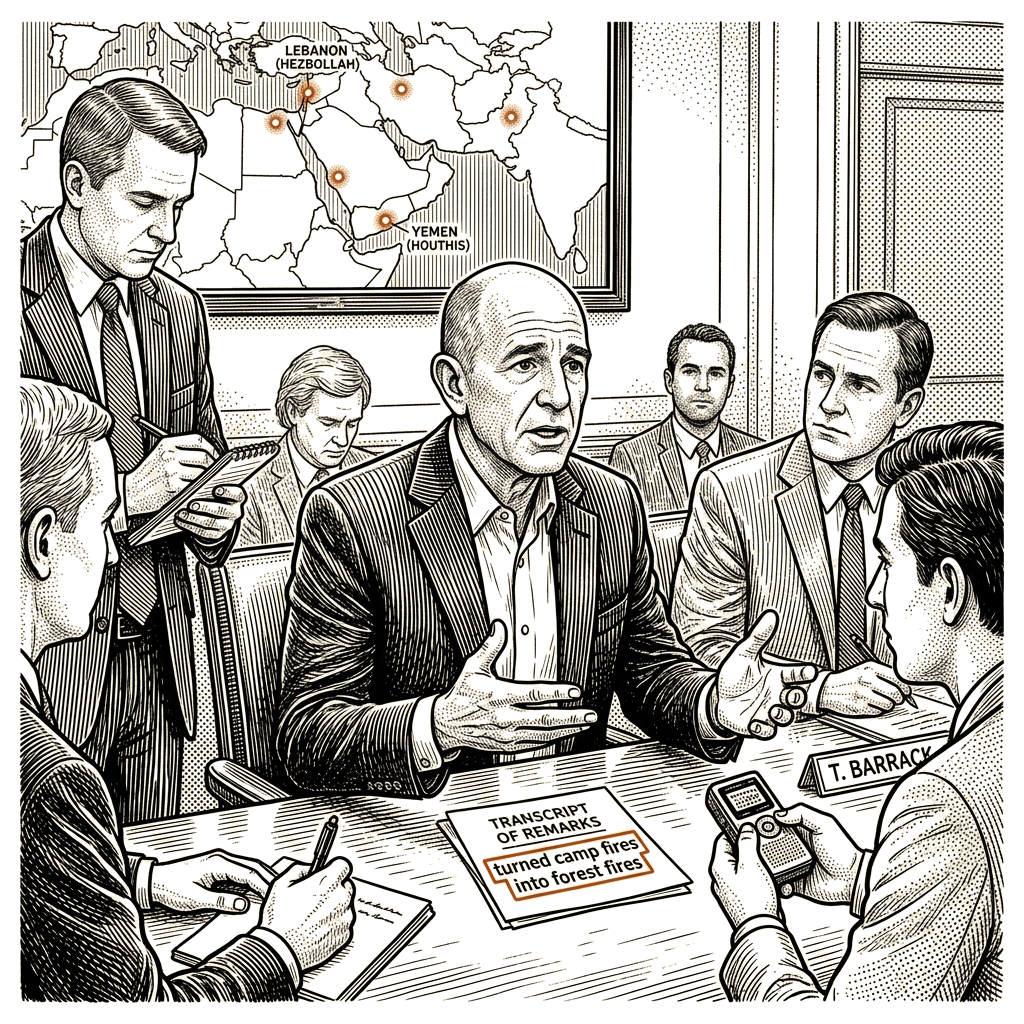
Tom Barrack, President Donald Trump’s envoy to Turkey and counselor to the president on the Middle East, said the war on Iran that Trump and Israel launched in late February had turned “camp fires into forest fires,” with consequences now reaching north Africa. Barrack made the admission in remarks in Doha last week reported by the Guardian’s diplomatic editor, Patrick Wintour.
Barrack likened the Middle East to a Rubik’s Cube, in which a single move can inadvertently affect the whole picture. “When you adjust one thing in the region what we have seen is everything then changes,” he said. “Those unintended consequences, and the sequential pace of what is happening, is unexpected.” He went on: “We started trying to do something with our allies in Iran that spread through Hamas, Hezbollah, to six Iranian militias, the Houthis and is now going to north Africa. So where does it stop? How much does this US intervention help or hurt?”
The Guardian reported that Barrack, without breaking from Trump, answered his own question: “We have had 23 regime changes take place across the greater Middle East and Levant instituted one way or another by some American hand or influence, and none of them have worked.” Pointing to Iraq, Libya and Afghanistan — but, the Guardian noted, not Iran — Barrack said: “Every time we try to intervene and change the person or the regime, it seems to have been a mistake.”
Other officials framed the same interdependence. Speaking this week, India’s external affairs minister, Subrahmanyam Jaishankar, said: “The indivisibility of our existence permeates every aspect of human activity and it has deepened as globalisation has advanced. The fact now is that war anywhere threatens peace everywhere.” The American international relations scholar Charles Kupchan, in a new book cited by the Guardian, argued that power is rapidly diffusing across the international system, and the Guardian summarized his view of Trump as “a symptom of a trend that is systemic and widespread.”
By the Guardian’s account, the war’s economic consequences have been severe. Worldwide inflation has been pushed to 4%, and less than a fortnight before the US midterm elections the price of Brent crude reached $117 a barrel — 50% above prewar levels. The strait of Hormuz, open to commercial traffic for centuries, has become an Iranian bargaining chip, the Guardian reported.
The International Monetary Fund now forecasts Saudi Arabia’s economy to contract 3.3%, a five-percentage-point downgrade from the 1.7% growth forecast it issued only in July. On 30 September the Saudi government raised its 2026 budget deficit projection to $65.3bn, 48% above the original forecast. An analysis cited by the Guardian argued that the kingdom’s Vision 2030 plan was built as a hedge against oil-price volatility, assuming open sea lanes, functioning airports and a US security umbrella to deter attacks on its export infrastructure — and that every one of those assumptions has failed since February.
Inside Iran, the Guardian reported, the war has not produced greater stability. Ali Larijani, whom the Guardian described as the Iranian with the most strategic nous, was killed on the war’s first day. Hardliners around the new supreme leader, Mojtaba Khamenei, are more entrenched than ever, and public debate inside Iran now leans toward ending the fatwa on possessing nuclear weapons. The Islamic Revolutionary Guards Corps, having been attacked twice mid-negotiation, has adjusted its defense doctrine to allow preemptive strikes not only against US bases but across the globe. “People can hurt us from a distance, and it doesn’t cost a fortune to be able to do so,” said Tony Radakin, the UK chief of the defence staff.
The Guardian reported that Benjamin Netanyahu, spoiling to attack Iran for a third time in two years, wanted to order “the IDF, Mossad, and the security services” to “overthrow the regime in Iran,” while the Americans’ focus was on nuclear weapons. The Democratic Senate candidate in Michigan, Abdul El-Sayed, was blunter: “Everybody could have told you this is a dumb idea. There was really only one person in the whole world who had a 40-year project to get us to fight this war. He’s a prime minister of another government [Netanyahu]. And he finally found the dumbass who was willing to do it.” Badr Albusaidi, Oman’s foreign minister and a mediator in the February Iran-US talks, told an audience in Cambridge this week that an agreement on the core issue — Iran’s nuclear program — “had been within reach before the bombing started.”
The Guardian reported that the chaos has left Trump’s domestic popularity in ruins. The Republican pollster Karl Rove said Trump “came across more as a heckler at a UFC match than as a reassuring wartime commander-in-chief,” warning: “The more undisciplined the White House messages on war and the economy, the more at risk GOP candidates will be.”
Faced with the plunging numbers, Trump tried to deflect responsibility for high energy prices to a second theater — Ukraine’s attacks on Russian oil refineries, the Guardian reported. He demanded that Zelenskyy stand down, describing him as “the real impediment to peace,” and announced a 60-day “energy truce” that neither Zelenskyy nor Putin had agreed to, which the Guardian described as entirely fictional. The accompanying deal to release Russian diesel, the Guardian said, was so small that no serious commentator expected it to have a serious impact on US prices.
The administration also gave conflicting accounts about why Ukrainian forces lost their previous levels of access to the military-grade version of Elon Musk’s Starlink, the Guardian reported. Some blamed Musk for acting on his own; others, including Vice President JD Vance, said Musk would contractually have required the permission of the White House or the military to act. Musk said the Ukrainians had breached the terms of the Starlink contract by using it to attack Iran. Even after the decision was supposedly reversed, what actually happened remained unresolved.
Trump’s intertwining of the two wars gave Russia its opening, the Guardian reported. Putin proposed a three-way US-China-Russia great-power summit at an already scheduled meeting in Shenzhen, China, on 18 November, and on 19 October sent his veteran foreign minister, Sergei Lavrov, to Tehran for the first time since the war began, to test whether the conflict could be ended on terms Trump could tolerate. “The more Putin can persuade Tehran to move closer to Trump’s demands, the more concessions he can extract from Trump on Ukraine,” said Amir Chahaki, a Russia affairs analyst cited by the Guardian. Trump has taken steps the Guardian described as helping Putin, overruling objections from some in his own party to invite him to this winter’s G20 summit, which the US is hosting at a golf club just outside Miami. David Frum, a former speechwriter for George W. Bush, attributed Trump’s confidence in Putin to decline: Trump was “much more of a self-aware conman when he entered politics a decade ago than he is now. He now may be kind of lost: truly in a world of illusions, where he no longer himself knows what is true and what is a lie.”
In Europe, the Guardian reported, Trump’s pro-Russia posture has fed a populist narrative about the draining cost of supporting Ukraine, and leaders have responded by publicly blaming the Iran war for the squeeze on living standards. French President Emmanuel Macron told demonstrators their anger was legitimate: “Demonstrators expressed concern about the cost of living and the price of fuel. Both are driven by the conflict launched in the Persian Gulf, a conflict in which France has taken no part but whose consequences we are suffering.” Polish Prime Minister Donald Tusk told his parliament that fuel prices were “devilishly expensive,” and that the Donald responsible was Trump, not him. German Chancellor Friedrich Merz said: “My biggest concern at the moment is not our economy, not the USA or China, but Russia’s influence on our society.”
The Guardian linked Musk’s Starlink intervention to a European push for digital sovereignty. In May the European Commission proposed reserving 70% of the 2GHz frequency spectrum, which allows smartphones to connect directly to satellites, for European enterprises, restricting access for players such as Starlink. Deutsche Telekom, Orange, Vodafone and Telefónica are already lining up to bid, prompting US diplomatic protests. Poland’s foreign minister, Radosław Sikorski, accused Musk of digging his own grave in Europe, asking why “a Ketamine-addicted trillionaire in bed with foreign powers should think he deserves regulatory privileges and frequency permissions.” The former Canadian foreign minister Chrystia Freeland predicted countries would “think really hard before they buy another F-35 controlled by the Pentagon,” asking, “Why would you want a jet that Americans control?”
In the Gulf, Albusaidi called this week for a Gulf security pact that includes Iran — a proposal the Guardian called a potential “Berlin Wall moment” because it implies the US should no longer be the region’s security provider. Albusaidi acknowledged the idea is counterintuitive given deep suspicion of Iran across the Gulf, the Guardian reported; his team put it this way: “war sometimes just happens; peace is always caused.”
The Guardian concluded that more and more countries are waking up to the dangers of being excluded and abused by the US, and Freeland said the realization has taken a long time. She described leaders who believed they could win Trump over: “I can win this guy over. I can give him the shiniest prize. I can give him a gold watch that’s encrusted with diamonds. I can flatter him in the most outrageous way.” The Guardian cited Saudi Arabia as an example — a country that offered Trump gifts and was in return left to fend off Houthi attacks that senior UN diplomats insisted were driven entirely by a timetable meeting Iran’s needs.