Summary
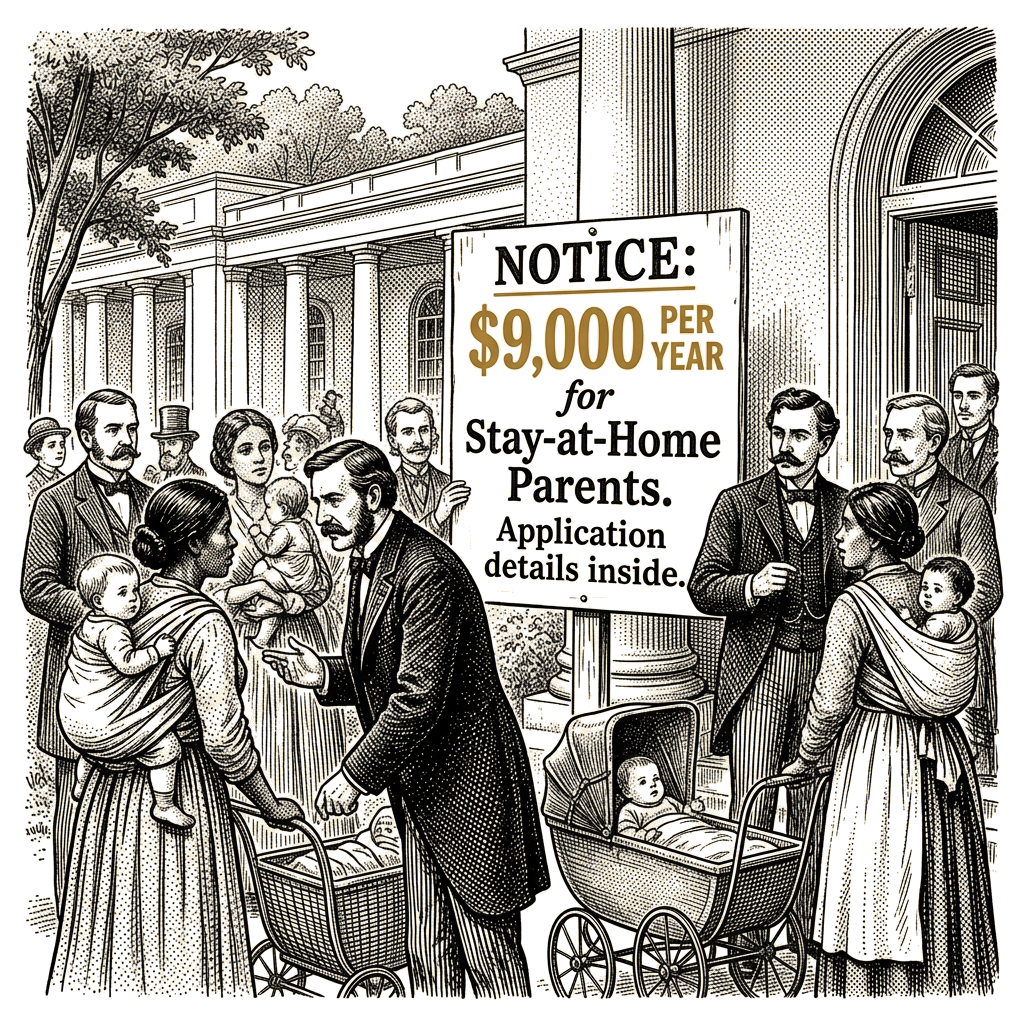
- The White House is considering a plan, reported by the New York Times and carried by the Guardian on October 31, 2026, to pay parents $9,000 a year to stay home with money drawn from Department of Health and Human Services programs that have typically gone to low-income, single-parent families.
- The proposal’s beneficiary description and its funding source point at different family types: the Guardian’s headline names married parents as the beneficiaries, its subheading states that “Funds would shift from programs that typically support single mothers, low-income families,” and eligibility rules do not appear in the available reporting.
- Economic Policy Institute analyst Chandra Childers told the Guardian the reallocation “could actually make child care even more expensive or less available,” because “rates have to rise on other families, some of whom may already be stretching to make it as it is.”
- The Georgetown Law Center on Poverty and Inequality reports forty per cent of households, including those with one parent working less than full-time, spend an outsized percentage of their income on child care.
- Parent testimony from inside the proposal’s apparent beneficiary class runs against assumed support: Natalia Goodnow says “It should be up to me and my family to make that decision, and not the government pushing me to stay at home,” and Jillian Whitlow, whose family’s daycare bill exceeded its monthly mortgage, says “I would love it if there was a lot less government in all of our lives.”
The White House is weighing a program that would pay parents $9,000 a year to stay home with their children, drawing the money from federal programs that typically support single mothers and low-income families, according to the New York Times in reporting carried by the Guardian. The proposal — reportedly proposed by Vice President JD Vance, and characterized by the Guardian as part of a Trump administration agenda that emphasizes a “traditional” family structure — pairs its headline beneficiary description, married parents, with a funding source drawn from programs serving single-mother and low-income households, and the eligibility rules that would reconcile the two do not appear in the available reporting. Critics told the Guardian the reallocation could make child care more expensive or less available for families that keep using paid care, while parents inside the proposal’s apparent beneficiary class questioned both its adequacy and its premise.
The design as reported
Reduced to its design, the proposal turns on four parameters: who is eligible; what condition attaches — at least one parent at home; how large the payment is, at $9,000 a year; and what funds it — Department of Health and Human Services programs that, per the reporting, have typically gone to low-income, single-parent families. The programs named as the funding source serve households for whom leaving paid work typically means forfeiting most of their income.
Those two ends of the design do not point at the same population. The Guardian’s headline — “The Trump administration wants to give married parents money to stay at home. Will it be enough?” — describes the beneficiaries as married parents, while the report’s subheading states the funding shift flatly: “Funds would shift from programs that typically support single mothers, low-income families.” The report’s body describes payments to “parents” without qualification. Eligibility rules for the program under consideration do not appear in the available reporting.
Who benefits
The reported design creates at least four claimant groups: stay-at-home or would-be stay-at-home parents, the recipients; single mothers and low-income families, the populations the reallocated programs “typically support,” in the Times’ characterization as carried by the Guardian; families that remain in paid child care, facing whatever price effects follow the funding shift; and parents who move between home and paid work rather than occupying either role permanently, who appear among the parents the Guardian interviewed but are largely unaddressed in the proposal as reported.
The parameter pairing produces a two-sided exposure for a single class of households: a single or low-income parent faces a take-it-or-keep-working structure — the same family is eligible for the payment under one arrangement and excluded under the other, while the programs backing the payment are drawn down either way.
Eligibility does not guarantee support: the reporting shows households inside the proposal’s apparent beneficiary class on both sides of the question. Natalia Goodnow of Pittsburgh, a married stay-at-home mother of two, left work temporarily, was delayed in returning by a post-pandemic daycare waitlist, and is building a consulting business for flexibility; she says the $9,000 would not approach her foregone earnings: “It should be up to me and my family to make that decision, and not the government pushing me to stay at home.” Her family already feels single-income strain on her husband’s earnings: “I have to have a second income stream created to give him flexibility to scale down, because it’s just not sustainable.”
Jillian Whitlow’s Texas family adopted a caregiving-parent arrangement when the cost of daycare for her children was greater than the family’s monthly mortgage payment — and the caregiver was her husband, a configuration the reported “stay-at-home parent” framing does not distinguish. She sees the proposal as interference: “I would love it if there was a lot less government in all of our lives,” and “I would love it if each individual family had more freedom to make the decisions that they want to make about the best way to raise their families.”
Erica Hall of Seattle spaced her children five years apart because two daycare enrollments were unaffordable and self-funded her maternity leave; now recently laid off, she is deciding whether to re-enter the workforce — “Do we move to a lower-cost daycare? What kind of job should I look for? Can I dial back now?” “Do we need to completely 100% replace my income?” For parents already near the margin of staying home, the payment lowers the effective cost of that choice.
Adequacy has two calibration points in the reporting: Goodnow’s foregone earnings exceed $9,000, and Whitlow’s family found daycare cost more than their monthly mortgage; whether $9,000 closes any family’s gap is testable only family by family.
Absent from the record are the parties the drained pool currently funds: the available reporting does not address how child care providers and workers would respond, how the Department of Health and Human Services programs the funds are drawn from would adapt, or whether eligibility terms would extend to the families above. That absence is itself informative: the White House is described as “considering” the program, and the legislative mechanics are not yet specified.
Objection incidence maps onto the design’s structure: the funding source lands hardest with single-mother and low-income households; the rate-rise risk with families who keep using paid care, who would absorb higher prices without receiving the payment; the adequacy gap with secondary earners such as Goodnow; the consistency question with policy analysts such as Hipple; the political optics with the proposal’s opponents generally.
What happens next
Chandra Childers, a senior policy and economic analyst at the Economic Policy Institute, told the Guardian the reallocation “could actually make child care even more expensive or less available,” explaining: “The minute you start draining resources that go into funding this childcare pool, then rates have to rise on other families, some of whom may already be stretching to make it as it is.” Her framing of the alternative: “Families of all compositions need help right now. All families do. We should not pit families against each other.”
Childers’ statement that rates “have to rise” is asserted as necessity without the drawdown magnitude that would make it testable; no elasticity, drawdown size, or program budget appears in the available material, so no aggregate cost estimate can be run. The reallocation transmits cost, per Childers’ asserted mechanism, onto the 52-per-cent dual-income majority the design does not pay.
A second risk the payment does not touch is supply: a parent paid to stay home does not, by itself, create a daycare slot for a parent waiting to return to work — the constraint Goodnow’s waitlist experience documents.
If the payment moves marginal second earners — parents in the positions described for Hall or Goodnow — out of paid work, the fiscal arithmetic changes on both sides; the reporting permits flagging that channel but supplies no data to size it.
On reversibility, a reallocation is legislatively reversible; how readily any contraction of the funded care pool Childers describes would reverse is not addressed in the reporting.
Liz Hipple, a policy expert at the Georgetown Law Center on Poverty and Inequality, said recent pushes to increase work requirements for Medicaid and Snap benefits will probably make it harder for some families to support themselves, and that policies supporting higher wages or paid parental leave would go much further: “If the Trump administration was serious about supporting traditional families with one breadwinner, there are plenty of labor policies that they could support. Those aren’t the policies that they’re pursuing.”
How the options compare
The criteria in play — outcome quality, cost, risk, fit, reversibility — are neither redundant nor aligned: the payment serves the administration’s stated aim directly, and the reported mechanism is zero-sum, reallocation rather than new spending.
Across the four options the reporting supports — adopt the design as reported; fund the same payment with new money rather than reallocation; convert it to an unconditional child payment; or pursue the labor-side policies Hipple cites — an outranking screen in the ELECTRE family fits the decision’s shape better than a weighted sum, because methods in that family veto options that violate a minimum threshold on any criterion rather than netting scores against each other. The screen is bounded to the four options the reporting itself supports; other designs in the family-policy space are unassessable from this material.
At least one criterion functions as a threshold rather than a tradeable: continued access to affordable child care for the population the Georgetown Law Center on Poverty and Inequality measures at 40 per cent of households, including those with one parent working less than full-time, already spending an outsized share of income on care. A compensatory weighted sum would permit gains on at-home support to be netted against that access criterion; an outranking screen with a discordance threshold treats a severe access regression for that population as not offsettable.
Two results follow. First, conditional dominance: for evaluators who weigh the access criterion and attach no independent value to avoiding new spending, funding the identical payment with new money weakly dominates the reported design, since it delivers the same benefit without the identified cost channel. Under a non-compensatory threshold on access, the reported design is eliminated outright whenever the price response is severe, whatever the fiscal weights; it survives only where the choice set excludes new-money funding — a constraint the reporting never mentions — and the threshold is treated as overrideable when no alternative is available to carry the benefit. Second, a single-weight flip: any positive weight on distributional incidence, combined with Childers’ asserted mechanism and the Georgetown exposure figure, ranks the reported design below alternatives that preserve the funding pool.
The screen is directional rather than numeric because the reporting supplies no magnitude for the child-care price response.
How this is being framed
The Guardian characterizes the proposal as part of a Trump administration agenda that emphasizes a “traditional” family structure, in which one parent stays home to care for children.
The plan was reportedly proposed by Vice President JD Vance, whom the Guardian describes as a potential 2028 presidential candidate and who has proclaimed himself a defender of “pro-family” policies. His documented record on the underlying question sits in the article’s own sourcing: his 2021 Wall Street Journal op-ed criticized federal spending on daycare, arguing that “young children from average, healthy homes can be harmed by spending long hours in childcare.” In a social media post at the time he wrote: “It turns out that normal Americans care more about their families than their jobs, and want a family policy that doesn’t shunt their kids into crap daycare so they can enjoy more ‘freedom’ in the paid labor force.”
The overlap between the payment’s proposed beneficiaries and the constituency Vance’s documented positions address stands in the record; the burden of arguing the payment’s merits independently of that record falls on the proposal’s defenders.
A symmetric sourcing note cuts both ways: the principal criticism comes from institutions whose remits align with the programs at issue — the Economic Policy Institute on child-care funding, the Georgetown Law Center on Poverty and Inequality on poverty policy — a correlation readers may weigh as they would any sourced claim. The same alignment logic applies to the sponsoring side, whose champion’s documented record is quoted above.
Two criteria often merged under a single “pro-family” label — child care affordability and support for a preferred family structure — are distinct and in tension here: the Georgetown report documents the affordability burden across households, including those with a parent who works less than full-time; Goodnow documents the preference criterion. A payment can serve the first while burdening the second.
The baseline evidence runs the other way from the proposal’s premise: dual-income households now make up 52 per cent of American families, compared with 31 per cent in 1975, according to the Pew Research Center, and eight out of 10 of those families say the arrangement has been beneficial to their finances — a statistic that evidences the incumbent arrangement’s self-reported financial viability, not preferences over alternatives.
The three parent testimonials are individually vivid but constitute three households, not a measure of support among parents who prefer home care.
The strongest counter sits inside the critics’ own evidence base: the same institution that houses Hipple produced the report documenting that forty per cent of households already spend outsized income shares on child care. A critique portraying the payment as an answer to a nonexistent problem will not hold — Whitlow, who favors less government involvement, is herself the parent of a family whose daycare bill exceeded its mortgage. The documented burden is real; the dispute is whether this payment answers it, and for whom.
The artifact under criticism is only partially specified: because eligibility, mechanics, and budget are not specified in the available reporting, the documented criticisms attach to the reported funding mechanism, while a defense of the design’s details cannot yet be mounted by anyone — supporters and critics are arguing over parameters the available reporting does not yet specify.
What is not known, and what would resolve it
Unspecified in the available reporting: eligibility rules; beneficiary counts on both sides of the shift — how many families the reallocated programs currently reach and how many would claim the payment; legislative language establishing whether the reallocation is zero-sum program by program; whether supply-side measures accompany the payment; whether the payment would interact with existing tax credits; the aggregate program cost, since no eligibility count and no program budget appear; and the magnitude of the child-care price response.
Publication of the eligibility rules, the funding mechanics, and an estimate of the child-care price effect — ideally from the administration rather than its critics — would resolve the question.
The closing status: the proposal is under consideration; its beneficiary description and its funding source point in different directions; its decisive parameters are not specified in the available reporting. It stands on a documented problem and a contested answer — a payment sized below the earnings of at least some parents it would bid to keep home, funded by the support that currently reaches others.
Where the evidence stands
Several load-bearing facts rest on the article’s own sourcing, with external verification unresolved: the proposal’s existence and status, attributed to the New York Times; the Department of Health and Human Services reallocation mechanism; the Georgetown forty-per-cent figure, which anchors the threshold analysis above; Childers’ title and affiliation; and the Pew Research Center’s eight-out-of-10 statistic, on which the viability framing leans.
The Pew figures, 52 per cent and 31 per cent, match Pew’s own published series, with a definitional nuance: Pew’s series uses a narrower population — different-sex couples with children under 18, with two full-time working parents — than the article’s “American families” summary; the figures match.
The 2021 Vance op-ed matches the Wall Street Journal’s own listing — “Biden’s Daycare Plan Is Bad for Families,” May 3, 2021 — which carries a co-byline, Jenet Erickson; the article’s “penned” attribution stands, with co-authorship noted as a precision nuance. The specific quoted sentences from the op-ed and the social media post are unconfirmed verbatim outside the article and are retained as reported.
Three quantities the comparison above turns on are absent from the available material: the magnitude of the child-care price response, the eligibility count, and the program budget.
Analytical techniques used in this piece
This analysis applies the methods below. Each links to a short, plain-English explainer you can read and reuse.
- Decision Clarity
- Articulates the real stakes, stakeholders, and interests behind a decision facing a third party.
- Multi-Criteria Decision Analysis
- Scores competing options against several weighted criteria at once.
- Red-Team Advocate
- Argues the adversary’s case in full to expose what a plan underrates.