Summary
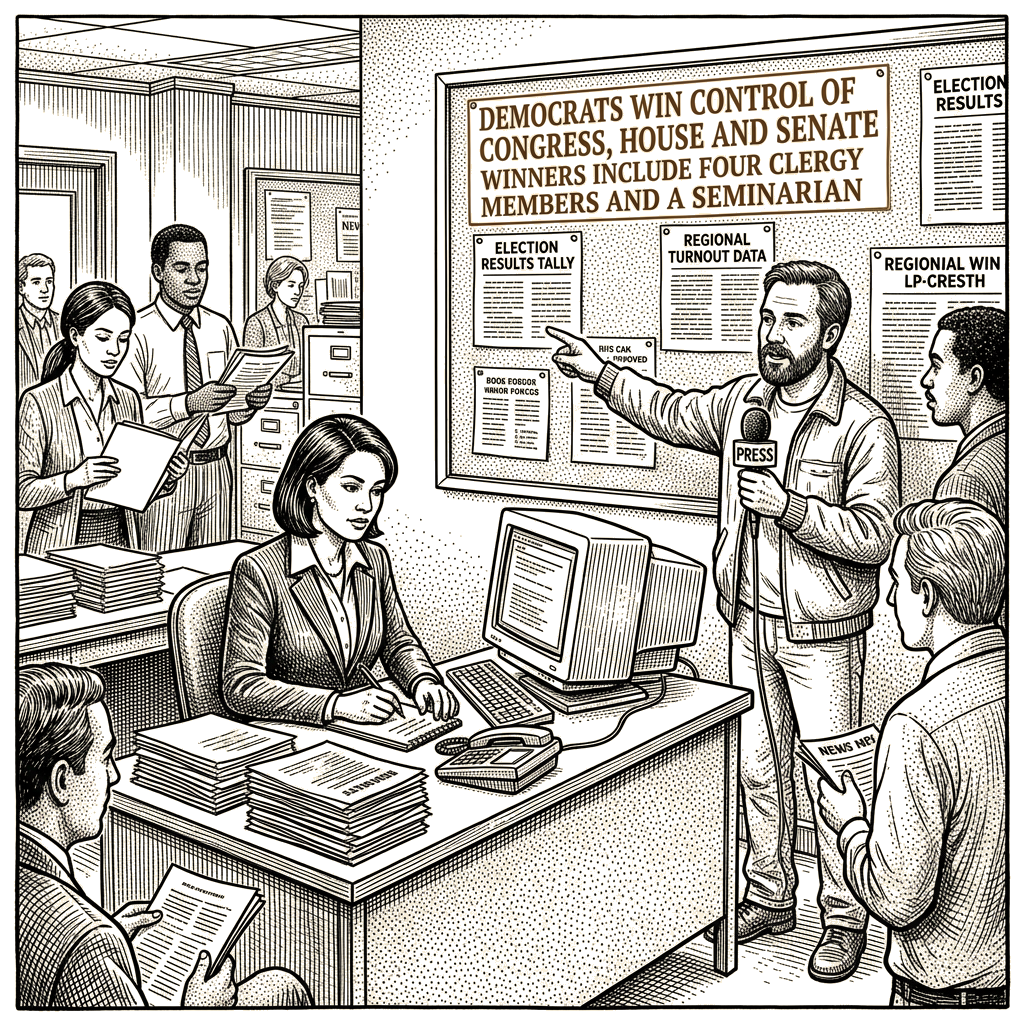
- NPR’s November 4 report documents four members of the clergy and a seminarian — Adam Hamilton, James Talarico, Frederick Haynes, Sarah Trone Garriott, and Lindsay James — among the winners as Democrats won control of Congress, and the report’s evidence points to ministry-honed practice rather than explicit scripture as the documented electoral asset.
- Per Jason DeRose’s account, James Talarico’s Texas campaign used explicit religious language: Sunday-morning church visits, preaching on the parable of the good Samaritan, and the repeated line “Blessed are those who weep.”
- Jason DeRose reported that Iowa winners Sarah Trone Garriott and Lindsay James spent campaign events listening more than talking, focused on grocery and ambulance costs, and carried no explicit religious message DeRose reported hearing.
- Garriott’s and James’s wins supply the highest-diagnosticity evidence against explicit religious content as a necessary ingredient — two documented winners whose campaign events, per DeRose’s account, ran without campaign scripture.
- Congregational selection, prior officeholding, and cycle-wide cost strain remain either observationally equivalent or untested, because the material supplies no district baselines, no clergy-candidate base rates, and no comparable account of Republican campaigns.
NPR’s November 4 report, credited to religion correspondent Jason DeRose, identified four members of the clergy and a seminarian — Adam Hamilton, James Talarico, Frederick Haynes, Sarah Trone Garriott, and Lindsay James — among the Democratic winners as Democrats won control of Congress on Tuesday; The Associated Press had not called clergyperson Chris Jones’s Arkansas House race when NPR reported. The evidence supports a more specific conclusion than the report’s title: the transferable electoral asset appears to have been ministry-honed practice — listening, presence, attention to circumstances voters themselves described — while explicit religious language operated in only part of the winning set, and whether clergy candidates as a class outperformed any baseline cannot be determined from the material supplied.
The candidate-level record
NPR’s account places the winners in both chambers. On the Senate side, DeRose identified Adam Hamilton, pastor of a very large United Methodist congregation in Kansas, described by DeRose as “one of only a few megachurch pastors in Congress,” and James Talarico, a Presbyterian seminarian and Texas statehouse representative. On the House side, DeRose listed Frederick Haynes, pastor of a 13,000-member Baptist church in the Dallas area; Sarah Trone Garriott, a Lutheran pastor and state senator from the Des Moines area; and Lindsay James, a Presbyterian chaplain and statehouse representative in Iowa. Chris Jones, a clergyperson running for House in Arkansas, remained part of the discussion with his race uncalled by The Associated Press at the time of the report.
Talarico’s campaign used explicit religious language, DeRose reported: Sunday-morning visits to multiple churches, preaching on the parable of the good Samaritan — which DeRose described as a story about caring for the most vulnerable — and an allusion to the beatitudes in the line Talarico repeated, “Blessed are those who weep,” followed by the observation that people sometimes see more clearly through their tears. DeRose said that language connected with people who were hurting — some feeling the pain of gas and grocery costs, others feeling disenfranchised after Texas redistricting eliminated one of the state’s majority Black congressional districts.
Iowa offered, in DeRose’s account, a different expression of the skills clergy need to be good pastors. Sarah Trone Garriott and Lindsay James spent more time listening than talking — hearing what voters cared about at coffee hours after worship and while shaking hands at a county fair — and DeRose did not hear explicit religious messages from either candidate. Both focused on what voters said they cared about: the cost of groceries and the cost of an ambulance ride. DeRose described the method as “genuine listening,” something sometimes called “ministry of presence,” and said the skill is needed by both clergy and politicians.
Across the campaigns, DeRose’s account divides the documented conduct into two distinct practices the evidence weights differently: Talarico’s scripture-centered messaging about suffering, and Garriott’s and James’s presence-centered attention to daily concerns. The common element across both is attention to the circumstances voters described and the concerns they voiced.
Which explanations the evidence separates
The material accommodates a ranked board of explanations, ordered by how well the evidence distinguishes them. Confidence in the leading account is medium.
Combined skills-plus-resonance mechanism (leads). Ministry-formed delivery operates as the channel; grievance over daily costs and representation operates as the content. The Iowa winners’ campaign events carrying no explicit religious message, per DeRose’s account, and the cost-and-representation content of the resonance are high-diagnosticity observations — they fit this account and strain the alternatives. The qualification stands: the report supplies accounts of winners rather than counterfactuals, so the mechanism is a constrained inference, not a demonstrated cause.
Explicit religious content as necessary ingredient (evidence against). Garriott’s and James’s wins supply the highest-diagnosticity evidence against this explanation as a necessary condition: two documented winners whom DeRose did not hear use explicit religious language. If campaign scripture were the operative variable, the Iowa results would be anomalies; under a skills account, they are a second expression of the same capability. Had Garriott and James preached as Talarico did, the content and skills explanations would be indistinguishable; because they did not, the report’s own evidence separates religious content from ministry conduct.
Congregational selection. The wins may reflect who was drawn into candidacy — the public-communication and community-organizing aptitudes that lead people into ministry may be the same aptitudes that make strong candidates — rather than anything ministry taught. Transfer and selection are observationally equivalent in this material: the same Iowa evidence is consistent with skills learned in ministry and with aptitudes that predate it, and no reported observation separates them. The venue-detailed listening account corroborates the skills hypothesis without separating it from selection.
Community-embeddedness (adjacent domain). Candidacies built on dense local networks — congregations being one such network — fit the same evidence, and the material cannot separate this contributor from the ministry-skills account, so it stays on the board. One in-record detail partially discriminates: the voter contact DeRose described ran through mixed settings — coffee hours after worship and handshakes at a county fair, the fair being a general civic venue a purely congregation-bound embeddedness account would not reach.
Tradition-level framing advantage (Jones’s account). A general claim about traditions, not about these districts; it carries medium diagnostic weight for these particular results.
Prior officeholding and structural viability. Talarico, Garriott, and James carried state-office records, and prior office is a standard asset in congressional campaigns generally; it explains viability without distinguishing these winners — consistent but low-diagnosticity, and it persists untested, the material containing no district baselines against which over-performance could be measured. Hamilton’s description as one of only a few megachurch pastors in Congress bears on visibility.
Cycle-wide conditions. Cost-of-living strain and disenfranchisement among voters affected by Texas redistricting — which eliminated one of the state’s majority Black congressional districts — moved voters toward candidates who acknowledged hurt; the grievance conditions fold into the leading account as the content its delivery channel carried, while the cycle-wide hypothesis persists untested in the confidence statement.
Coverage selection. A religion correspondent surveying a wave election encounters clergy winners as a matter of the desk’s remit; NPR chose religion as an angle, and five identifiable clergy-adjacent winners among an unspecified total is a composition observation, not a causal one. This candidate cannot be excluded.
Inversion test. Had DeRose reported explicit religious language from the Iowa winners, the ranking of explanations would shift materially — the current ranking rests on a single discriminating observation, the reported absence of explicit religious language.
Base rates. The material does not supply how many clergy ran, in both parties, and how many lost. Those counts would convert composition into cause only partway: they could test whether clergy ran or won disproportionately relative to comparable candidates, but because who chooses to run is endogenous to the same aptitudes, even favorable base rates could not separate transfer from selection.
Anomalies attached to the leading account: missing baselines, missing base rates (the principal anomaly), the unresolved transfer-versus-selection equivalence, the uncalled Arkansas race, and the untested incumbency and cycle-wide hypotheses. The material does not warrant escalation to a fuller competing-hypotheses matrix.
How the report frames religion’s role
Robert Jones of the Public Religion Research Institute supplied the report’s interpretive frame: “This idea of compassion, loving your neighbor, making room for everyone, hospitality is actually quite a prominent theological virtue in the mainline tradition. I think it’s actually much better suited for broad, pluralistic democracy.” DeRose said Jones viewed that approach as better suited to broad, pluralistic democracy than the “us versus them” terms in which, per DeRose’s account of Jones’s view, many evangelical Christians have framed both religion and politics.
Jones’s claim is general rather than district-specific. It predicts where ministry-style approaches should perform best — pluralistic electorates — but the material does not include the districts’ compositions, so the prediction is recorded, not tested. The attribution boundary holds throughout: Jones is credited only with the hospitality and pluralism claim the report carries; framework mappings applied to his contrast sit in this analysis’s own voice, with no extension to campaigns of any party that his sourced statements do not contain.
The feedback structure: loops, delays, and archetypes
Presence-trust loop (reinforcing, short-cycle). Candidates spend event time in constituent venues; voters experience being heard; trust accumulates; support follows at the polls; office brings visibility and continued constituent access; access creates more occasions for presence. Every edge is positive — even parity — confirming a reinforcing loop. DeRose’s remark that this listening skill “is needed by both clergy and politicians” is the report’s own statement of the transfer the loop formalizes.
Delays. Trust builds over a campaign season of repeated encounters — a delay the venue detail supports (coffee hours after worship, handshakes at a county fair). The office-to-access edge is assumed to run in years — a structural assumption of the model, not a report finding. A further delay is visible in Talarico’s, Garriott’s, and James’s state-office tenures before their federal runs: local presence compounding into national results over years. Grievance accumulates slowly across election cycles.
Gain condition. DeRose’s account ties the resonance of the tears language to voters “who were hurting” — over gas and grocery costs, or over redistricting. Strain is an exogenous condition that raises the gain on the trust edge: voters reporting strain are more receptive to being-heard messages.
Base-reliance spiral (reinforcing, faster). Built from Jones’s attributed contrast: exclusive framing raises in-group mobilization; mobilization raises reliance on base-centric campaigning; reliance narrows cross-partisan persuasion; narrowed persuasion lowers general-electorate support; falling support pushes candidates back toward the base. Two negative edges, even parity — reinforcing, and faster than the presence loop, because base mobilization pays within a primary calendar measured in months while presence pays across seasons. This spiral appears only as the contrast case Jones describes, not as an observed Democratic instance.
“Shifting the Burden” mapping (hedged). The topology resembles what the systems-archetype vocabulary associated with Peter Senge names “Shifting the Burden” — an analytical lens imported from systems literature, not a finding of the material; the attribution of the name rests on general systems-literature knowledge and was not externally verified. On this archetype, a fast symptomatic loop relieves immediate pressure while the fundamental capability it displaces atrophies. Communication craft is the symptomatic solution; the drivers DeRose cited — grocery and ambulance costs and the eliminated district — are the fundamental load. A party investing in messaging while those persist would, on this archetype, keep building a grievance stock that each cycle demands better delivery to address. The archetype’s characteristic dependency dynamic has a campaign-level analogue — parties and campaign staff losing in-house listening capacity as base-messaging practice comes to dominate — though that dynamic is archetype inference, not material evidence.
Three further archetypes from the same vocabulary bear on the circuit. “Success to the Successful”: wins would likely steer recruitment attention toward clergy-adjacent candidates, deepening that bench — though the record says nothing of recruitment. A balancing “Escalation” loop: opponents adapting counter-framing would erode any edge; the material contains no evidence on such adaptation, so its strength is unknowable here. “Fixes That Fail”: candidates adopting the surface of religious language without the underlying practice risk credibility erosion that suppresses the approach — and the Iowa pair shows the practice can run without the language, not the reverse.
Imitation loop (balancing). Success breeds imitation: as presence-style campaigns proliferate, differentiation decays, and the strategy that marked these candidates in 2026 becomes baseline practice. One negative edge, odd parity — balancing; a market-level balancing mechanism, distinct from the archetype’s capability-erosion dynamic.
Documentation status. The loop the material documents operating — in both stylistic registers — is the presence-trust loop; its dominance over the untested incumbency, selection, and cycle-wide hypotheses remains conditional.
The model’s boundary. Three variables sit outside the analysis — campaign finance flows, national party recruitment deliberations, and any institutional response from evangelical organizations — because the material supplies no evidence on any of them. Including a well-funded counter-messaging effort, for instance, would strengthen the balancing loop and could change the dominant-loop story; speculation there would outrun the record.
Leverage points
In the leverage-points framework associated with Donella Meadows — an ordering retained here as framework-internal analytical vocabulary, externally unconfirmed — the candidate levers span the depths. At the parameter level: party recruiters choosing candidates from institutions that confer community trust — fast, but a tweak. At the structure-and-rules level: the districting process implicated in the Texas grievance, where changing who draws the lines addresses a driver rather than a symptom. At the paradigm level, in Meadows’s terms the deepest lever: the conception of the voter relationship Jones described — hospitality versus the “us versus them” framing.
What happens next
First: amplifying religious content without the presence conduct should produce little marginal gain in pluralistic electorates — the Iowa cell already suggests content is not the necessary ingredient. Observable: district composition data paired with campaign-conduct records.
Second: campaigns reallocating event time from message delivery to documented listening should see gains concentrated where material strain is high, and smaller where electorates are sorted by identity rather than strain. Observable: district-level cost-of-living indicators tracked against margin shifts.
Third: if imitation proceeds, the listening style’s electoral advantage should visibly decay within one or two cycles. Observable: clergy-candidate counts in both parties, and comparative margins, in the next cycle.
What the record cannot resolve
Symmetry limit. The report is scoped to Democratic winners and contains no comparable account of Republican campaign messaging in these races; an equivalent accounting of clergy candidates in both parties would be required before any comparative claim about religion’s electoral value.
Title versus body. The report’s title — “How religion helped Democrats win control of Congress” — states a causal claim its body only partially supports. The narrower claim the evidence supports is that ministry-derived conduct, in two documented expressions, accompanied a set of Democratic wins whose counterfactuals — the uncalled Chris Jones race, the total winner counts, the clergy-candidate base rates (which would test composition but not separate transfer from selection), and the districts’ baselines — remain unresolved in the available material. What the body documents, per the report’s own account, is narrower than the title: ministry-shaped attention applied to material grievances in a handful of contests, the common element across campaigns being attention to the circumstances voters described.
Sourcing qualifications. The Senge archetype names rest on general systems-literature knowledge and were not externally verified; the Meadows depth ordering is externally unconfirmed and retained as framework-internal vocabulary. The Texas redistricting fact — the elimination of one majority-Black congressional district — is article-supplied and stands as reported; available external corroboration covers 2025 redistricting with redrawn maps in use at the 2026 House elections, which leaves the specific claim unresolved and surfaced for source review.
Analytical techniques used in this piece
This analysis applies the methods below. Each links to a short, plain-English explainer you can read and reuse.
- Differential Diagnosis
- Lists the candidate explanations for a symptom and rules them out one by one.
- Systems Dynamics (Causal)
- Models the feedback loops and delays that drive a behavior over time.