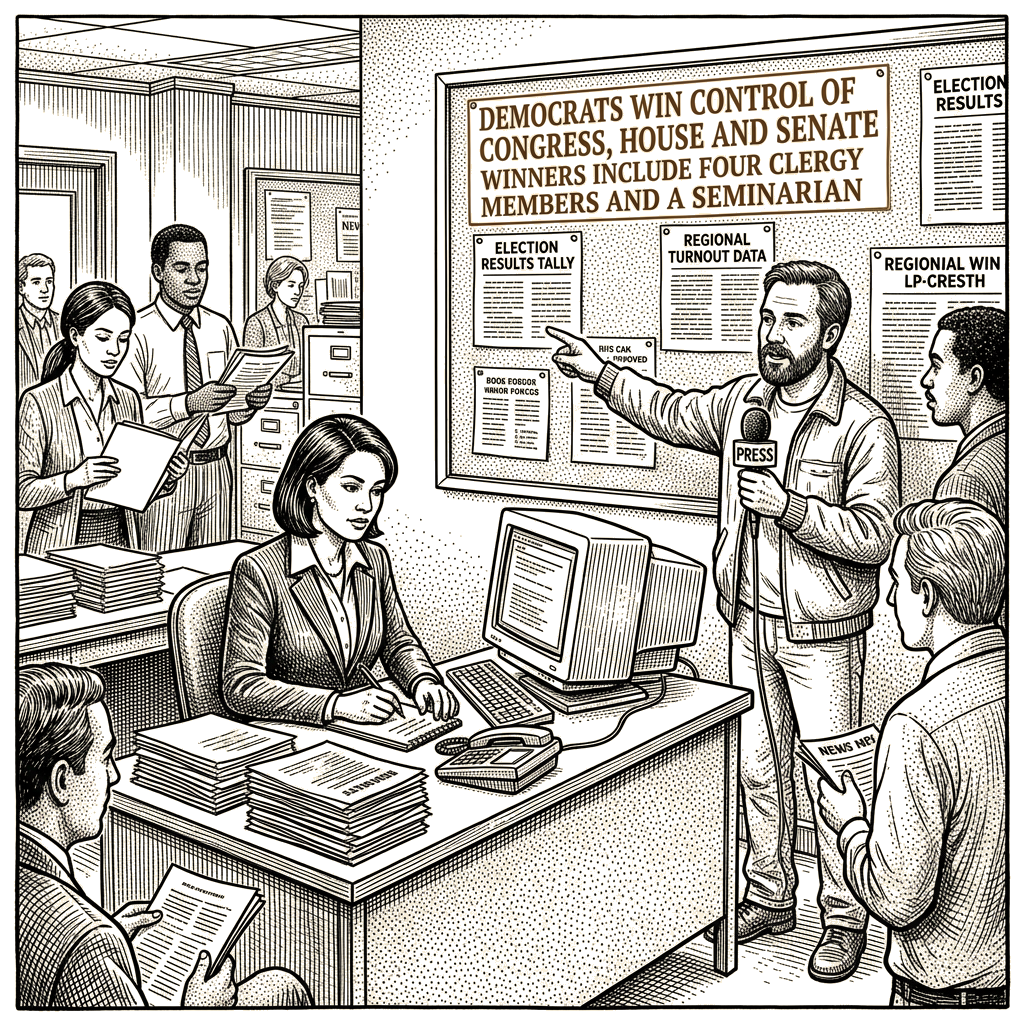
Four clergy members and a seminarian won House and Senate seats
NPR reported that Democrats won control of Congress on Tuesday, with House and Senate winners among them including four members of the clergy and a seminarian. NPR religion correspondent Jason DeRose said he saw the candidates combine religious messages with skills developed in ministry. The report also noted that Arkansas House candidate Chris Jones’s race had not been called by The Associated Press.
On the Senate side, DeRose identified Adam Hamilton and James Talarico. Hamilton is the pastor of a very large United Methodist congregation in Kansas, and DeRose described him as one of only a few megachurch pastors in Congress. Talarico is a Presbyterian seminarian and Texas statehouse representative.
On the House side, DeRose listed Frederick Haynes, the pastor of a 13,000-member Baptist church in the Dallas area, as another megachurch pastor on the Democratic side. He also listed Sarah Trone Garriott, a state senator from the Des Moines area and a Lutheran pastor, and Lindsay James, a Presbyterian chaplain and statehouse representative in Iowa.
Chris Jones, a clergyperson running for House in Arkansas, was also part of the discussion. The Associated Press had not called that race when NPR reported.
DeRose asked Robert Jones at the Public Religion Research Institute how clergy from mainline Protestant denominations might have affected how they encountered voters and appealed to them. Jones said, “This idea of compassion, loving your neighbor, making room for everyone, hospitality is actually quite a prominent theological virtue in the mainline tradition. I think it’s actually much better suited for broad, pluralistic democracy.”
DeRose said Jones viewed that approach as better suited to broad, pluralistic democracy than the way many evangelical Christians have framed both religion and politics in “us versus them” terms.
Talarico’s campaign used explicit religious language, DeRose said. On Sunday mornings, Talarico visited multiple churches and preached on things like the parable of the good Samaritan, which DeRose described as a story about caring for the most vulnerable. Talarico also alluded to the beatitudes with the line he repeated, “Blessed are those who weep,” and said people sometimes see more clearly through their tears.
DeRose said that language connected with people who were hurting. Some felt the pain of the cost of gas or groceries, while others felt disenfranchised after Texas redistricting eliminated one of the state’s majority Black congressional districts.
DeRose said Iowa offered a different expression of the skills clergy need to be good pastors. Sarah Trone Garriott and Lindsay James spent more time listening than talking, hearing what voters cared about at coffee hours after worship and while shaking hands at a county fair. DeRose did not hear explicit religious messages from either candidate.
Instead, Garriott and James focused on what voters said they cared about: the cost of groceries and the cost of an ambulance ride. DeRose described this as “genuine listening,” something sometimes called “ministry of presence.” He said the skill is needed by both clergy and politicians.
In DeRose’s account, Talarico’s approach centered on scripture and messages about suffering, while Garriott’s and James’s centered on presence and attention to daily concerns. Across the campaigns, the common element was attention to the circumstances voters described and the concerns they voiced.