GOP rivals label Democratic clergy ‘Pastors in Name Only’
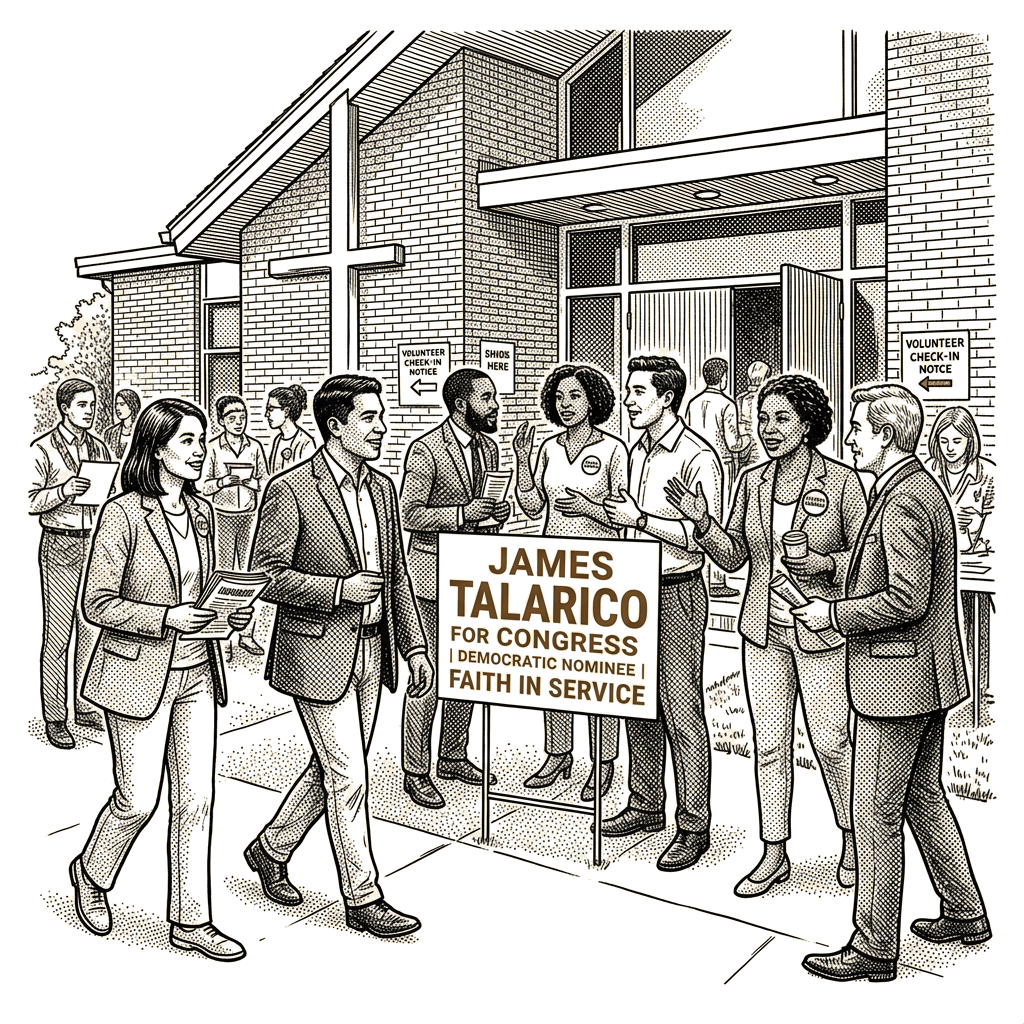
James Talarico, the Democratic nominee for U.S. Senate in Texas, addressed congregants at Brentwood Baptist Church in Houston on a recent Sunday and told the gathering he wanted to speak “not as a candidate, but as a fellow Christian.” A Texas state representative and former middle school teacher studying at Austin Presbyterian Theological Seminary, Talarico is among at least half a dozen Democratic candidates for Congress this midterm cycle who are ordained clergy or studying for ministry. They include a megachurch pastor in Dallas, a Methodist minister in Kansas and two members of the clergy in Iowa, all of whom are in competitive races.
The faith-forward strategy runs against the religious profile of the Democratic base. Pew Research Center’s 2023-24 Religious Landscape Study found that 28% of Democrats and Democratic-leaning adults said religion was very important in their lives. On the campaign trail, the candidates have been invoking biblical teachings as they make the case for policies involving health care, veterans, immigrants and economic opportunity, while trying to persuade voters in states and districts where religion remains an important part of public life. At a Democratic town hall later that afternoon in Houston — where nearly 700 people filled a room and many wore T-shirts or carried signs that read “Talarico for Texas” on the front and “Love Thy Neighbor” on the back — Talarico said his faith does not mean he wants religion to control government. “My faith is central in my life,” he said. “But I also know that the most dangerous form of government is theocracy. Because the only thing worse than a tyrant is a tyrant who thinks they’re on a mission from God.” Talarico, a vocal opponent of Christian nationalism, has also criticized what he described as ideological influence at the Defense Department. “We have seen Christian Nationalism infiltrate our Defense Department from Secretary Hegseth,” he said.
The pitch has drawn sharp attacks from Republicans. Texas Lt. Gov. Dan Patrick went after Talarico at the state Republican convention earlier this year. “I’ve never seen so much blasphemy from anyone running for office,” Patrick said. “And let me tell you what, I’m going to pray for that guy, because when he loses the Senate race, if he campaigns against God, as he’s been doing, he’s going to hell for sure.” Talarico’s Republican opponent, Texas Attorney General Ken Paxton, has also questioned his religious identity. “We cannot let Texas turn based on a deceiver like James Talarico, who does not want the world to know who he really is,” Paxton said at a campaign rally this summer. Talarico has folded the attacks into his own message. “The real blasphemy is kicking the sick off their healthcare to fund tax cuts for billionaires,” he told congregants at Brentwood Baptist. “Sometimes we see the world most clearly through our tears. If your heart is breaking as you watch what’s happening to our beloved country, it means you still have a heart. So blessed are you who weep.”
Houston voters in the pews and on the doorsteps gave mixed reactions. Candice Stroud, a member of Brentwood Baptist for more than 40 years, said she appreciates Talarico’s willingness to talk openly about Christianity. “I think Democrats have been talking about religion for years. It’s just nobody wants to listen to us if you don’t say what they want to hear,” Stroud said. Asked whom she meant by “they,” Stroud said: “The Republicans, basically. They don’t want to hear that we are Christians. We go to church. We believe in the Bible.” Brandon Sterling, a 40-year-old nurse practitioner, said he considers himself “more spiritual than religious” but understands why Talarico is talking about faith. “We’re here in the South,” he said. “A lot of people lead their political views with their religious views. So if this is the voice or if this is how you have to reach the greatest amount of people, then so be it. It doesn’t offend me at all.” Madison Vega, a Democratic volunteer canvassing in Houston’s Montrose neighborhood, said her grandfather, like Talarico’s, was a Baptist preacher and that Talarico’s approach to Christianity resonates with her. “Part of the reason that I’ve kind of lost my closeness to the church is just that I kind of heard a lot of divisive messaging from church when I was growing up,” Vega said. “And I like the way he doesn’t use Christianity as a weapon.” Kristin Kott, one of the voters Vega encountered, said her main concerns are improving schools and recovering from recent flooding. “Talking about religion as it relates to policy and things like that, I would be turned off by,” Kott said. “I don’t think religion should play into government and politics at all. I thought the country was founded on that.”
In Dallas, Frederick Haynes, the Democratic nominee for U.S. House in Texas’s 30th District, has led the 13,000-member Friendship-West Baptist Church for more than four decades. Haynes said he was inspired to run after the Texas Legislature redistricted the state, eliminating one of its two predominantly Black U.S. House districts. He frames his politics through the Gospel of Luke. “I’m a Luke 4 Christian because Jesus says the spirit of the Lord is upon me because he’s anointed me to preach good news to the poor,” Haynes said. “He prioritizes those who’ve been made poor by systems. Set the captives free. Heal those who are broken.” Haynes’ Republican opponent, Everett Jackson, a local businessman and community leader, has attacked the pastor’s religious sincerity on the conservative YouTube show Disturbing the Peace. “I cannot categorize him as a shepherd or a pastor,” Jackson said. “A shepherd — the good shepherd, as we’re told by the Lord — they would see to the safeguarding of the sheep and lead them in the righteous path. This is not what Freddie Haynes is doing. Freddie Haynes has politicized the gospel and therefore misled his parishioners.”
Haynes recently hosted an interfaith forum in Dallas focused on housing, affordability and voting rights. About 50 people attended, most of them Christian church leaders from Baptist, Methodist and Pentecostal congregations, along with a large group of Muslims. Ali Asgar Alibhai, a professor at the University of Texas at Dallas, said anti-Muslim rhetoric in Texas politics has affected his work. “Living in Texas right now and seeing what’s going on with Islamophobia right in my backyard has certainly made my job a little more challenging,” Alibhai said. “The people that I found solidarity with were often the faith groups here.” Haynes said part of his run for Congress is about translating his religious calling into public life. “I’ve spent my ministry on the outside, fighting what is happening on the inside,” he told the forum. “But now,” he said, “it’s as if God is saying, okay, you’ve been called to bring the outside voices and outside vision into the House.”
In Iowa, state senator Sarah Trone Garriott, the Democratic nominee for the 3rd Congressional District, combines politics with ordained Lutheran ministry. She served as an interim pastor at Grace Lutheran Church while its regular minister was away and preached on a recent summer Sunday on a passage in the Gospel of Matthew. “The Kingdom of Heaven challenges what we have come to expect or learned to accept,” she told the congregation. After the service, Rich Snyder, a longtime church member and retired chemist, said he is not naturally inclined to support clergy in politics. “I’m skeptical until I get a chance to listen to their expressions of faith and how they view their calling,” Snyder said. “When it becomes a calling, rather than a prescription or a bully pulpit, then I’ll start to listen.” Trone Garriott frames her political calling through the parable of the Good Samaritan. “Everyone is your neighbor,” she said. “Anyone who is overlooked and left behind and forgotten. That’s who you were called to help. And that is the calling of government.”
Her Republican opponent, Rep. Zach Nunn, has questioned her judgment by raising an incident from Trone Garriott’s seminary internship, when her supervisor asked her to assist at a wedding for two people who said they were Satanists. Nunn said on WHO NewsRadio 1040 in Iowa: “She talks about the situation like it was some kind of a charming story. She even joked about picking Bible verses so the Satanists could feel more at home.” Trone Garriott defends the recounting as “a story about the power of scripture. I believe it spoke to that couple in that moment, who seemed like the wrong people in the wrong place. And it was speaking to me.”
In northeast Iowa, Lindsay James, a Presbyterian chaplain and four-term state representative, is the Democratic nominee for the 2nd Congressional District. At the Bremer County Fair in the small town of Waverly, James talked with voters about health care. Lindley Sharp, who works in public health, said she is concerned about the effect of federal budget cuts. “It’s going to mean less money for local public health down the line after some of their federal funds are gone,” Sharp told the candidate. Kip Ladage, who works in emergency medical services, raised concerns about Medicare and Medicaid reimbursement. “Look at the Medicare and Medicaid reimbursement that we get because we’re getting hosed here,” Ladage said. “If we have a $600 call, we’re lucky to get $100.” James said she was inspired to run for Congress after lawmakers cut federal healthcare spending by nearly a trillion dollars. “About 27,000 Iowans were at risk of losing their health care in just Iowa’s second congressional district,” she said. James said her work as a chaplain taught her what people need from leaders. “It’s about showing up for people,” she said. “It’s about listening without judgment. It’s about offering hope. And it’s about telling the truth.”
James’ Republican opponent, Joe Mitchell, has criticized James and Trone Garriott over their positions on transgender rights and their interpretation of Christianity. Both Iowa Democrats voted against bills in the Iowa legislature intended to limit transgender people’s access to public bathrooms and participation in youth sports. At the conservative evangelical Family Leadership Summit this summer, Mitchell said: “I call them PINOs — Pastors in Name Only — because they’re not real pastors. They don’t profess the true gospel of Jesus Christ.” Mitchell, like the Republican opponents of Talarico, Haynes and Trone Garriott, frames himself as following more traditional Christian teachings about gender and family.
In explaining her call to elected office, James points to the parable of the Good Samaritan and to an interpretation offered by the Rev. Martin Luther King Jr. “He talked about the road being notorious for people getting harmed and hurt,” James said. “And that we had a moral obligation not just to pick up the person who’s hurting, but to actually fix the road.” For these Democratic candidates, that is not just an individual calling but the collective work of government.