Summary
- NPR’s account of the Democrats’ planned probes documents a two-layer boundary contest — over who holds decision authority on federal money and military force, and over whom the probes’ own machinery serves — read here through Werner Ulrich’s critical systems heuristics, per the methodology literature.
- President Trump and OMB Director Russ Vought twice ignored how Congress directed federal spending, per Eric McDaniel, and Congress never authorized the war in Iran or the Pentagon’s strikes on vessels it describes as drug boats — conduct the account records as one institution substituting its operational judgment for another’s claimed authority.
- The record Democrats plan to build rests on official documents and sworn testimony; applied through Donna Haraway’s situated-knowledges critique, that design institutionalizes official standpoints while affected parties — the children said to have died in the alleged school bombing, the unnamed beneficiaries of the spending directives — enter as anonymous attribution.
- Ailsa Chang’s cost-of-living challenge and Eric McDaniel’s concession (“Totally. I think that’s a huge risk.”) mark two live measures of success — institutional boundary-restoration and pocketbook outcomes — that the account leaves unadjudicated.
- The account identifies three judgments — the measure of success, the knowledge base and the witness function — whose revision, on the framework’s terms, would change whom the oversight system serves.
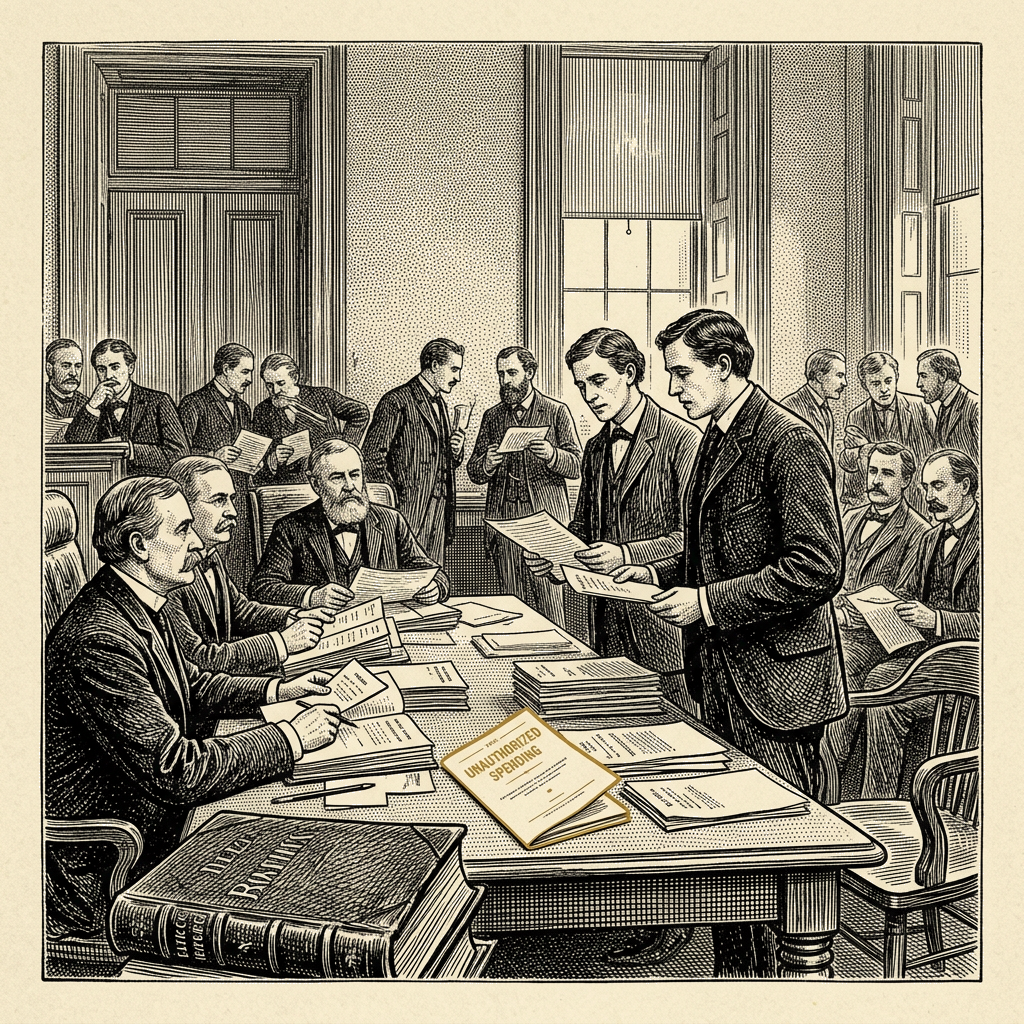
Congressional Democrats enter the new session — NPR’s report, dated November 5, 2026, describes the majorities as “sworn in this January,” a referent the account leaves unresolved — with the full investigatory toolkit: the authority “to force documents to be turned over, to make people testify under oath and to hold people accountable in the courts if they refuse.” NPR’s Eric McDaniel says the probes will center on federal spending President Trump and Office of Management and Budget Director Russ Vought have twice directed away from Congress’s instructions, and on military campaigns Congress never authorized — the war in Iran and the Pentagon’s strikes on vessels it describes as drug boats in the Caribbean and the Pacific. Read for structure, per Werner Ulrich’s critical systems heuristics — per the methodology literature, with external verification of that attribution unresolved — the account documents a boundary contest on two layers: the executive conduct under investigation consists of boundary judgments about who decides on money and force, and the investigatory machinery Congress is preparing carries a set of its own. McDaniel frames the program as a defense of two constitutional boundaries, fiscal and force: “So expect to see deep looks at both of those things.”
The crossings under audit
The account organizes the coming agenda around three congressional functions McDaniel names — passing laws, directing tax dollars through the power of the purse, and oversight of the executive branch — and around two crossings of constitutional boundary.
The first is fiscal. President Trump and OMB Director Russ Vought have twice ignored how Congress directed federal spending, per McDaniel — “either declining to spend it on the things Congress said they should or doing other things with it.” He called the practice “a very big deal,” because the purse is “the constitutional power that underpins all other congressional powers,” and he posed the question the agenda exists to press: “So if the presidency manages to subsume that, what is Congress really there for?”
The second is force. Congress “is supposed to authorize all military conflicts,” per McDaniel, and has never done so for the war in Iran or for the Pentagon’s strikes on “vessels it describes as drug boats” in the Caribbean and the Pacific; the president and his secretary of defense, he said, have “never made the case to the American public about the war in Iran.”
One example looms large in the account: allegations that the U.S. military bombed a school in Iran in the early days of the offensive, where “more than a hundred children are said to have died.” The claim enters the account hedged and attributed — not established — and external verification of the strike and the reported toll remains unresolved. McDaniel’s proposed remedy is a probe establishing “a factual record about what happened and what might need to change about how we conduct strikes going forward,” and he says the matter “is not a topic with a clear partisan lean.”
Other targets are, per McDaniel, more predictable: per NPR, the president and his family “have gotten much richer during the second term,” and the Justice Department’s handling of documents tied to Jeffrey Epstein will be a focus. McDaniel argues the less obvious subjects — the ignored spending directives and the never-authorized campaigns — may prove “even more important for the health of democracy.”
Reading the account as boundary judgments
The framework applied here is Werner Ulrich’s critical systems heuristics, per the methodology literature; external verification of the framework’s attribution returned no results, so the hedged attribution is load-bearing rather than decorative. On the framework’s own scheme, every governing arrangement — including an oversight program — embodies boundary judgments across four clusters: motivation (whose purposes), control (whose decisions), expertise and knowledge (whose knowing counts), and legitimacy (who is heard for the affected). Twelve judgments in all, each with an “is” — what actually supplies the purpose, the decision authority, the knowledge, the representation — and an “ought”: what would prevail if those affected but not involved counted.
The account supports the audit on both layers. The executive conduct under investigation consists of boundary judgments — decisions about whose directions on spending govern and whether authorization is required. The investigatory machinery Congress is preparing carries a set of its own, and the account supplies enough of it — stated purposes, tools, targets, conceded risks — to read both.
Who holds the decision authority
In the account’s present tense, committee hands hold the instruments McDaniel lists: subpoena authority, document compulsion, sworn testimony and court enforcement. What those hands face is an evidence base largely in the subjects’ custody — the records of redirected spending and the operational facts of the strikes sit in executive control, with compliance routed through courts on timelines the account leaves unexamined; enforcement attaches “if they refuse,” which makes compliance a contested proceeding whose timing sits outside Congress’s control.
Outside the investigators’ decision environment sit three forces the account names: the presidential signature — Chang notes Democrats “cannot make President Trump sign those bills into law” — the impeachment calculus, and the electoral clock. What remains unilateral, in her words, is to “investigate, investigate, investigate.”
On the material’s own showing, the largest documented gap between what is and what would count as right sits in this cluster. Appropriations and authorization operate, in practice, as executive decisions: impoundment functions as the boundary judgment that Congress’s spending directions are advisory — exercised twice, per McDaniel — and the campaigns proceed on the judgment that authorization is not required. Both substitute one institution’s operational judgment for another’s claimed authority without reopening the boundary itself. On the framework’s terms, the “ought” would give affected parties standing in agenda-setting — a standing the current arrangement does not grant.
Whose knowledge becomes the record
The proposed record is built from official documents and sworn testimony — standpoints the subpoena system is designed to capture, modeled on inquiries that reached executive conduct through official records. Donna Haraway’s situated-knowledges critique bears directly: a record composed of executive paper and under-oath testimony institutionalizes official standpoints, while the experiential knowledge of affected parties enters, if at all, as press-reported allegation. Applied to the account: a subpoena-built record can compel the officials who ordered and executed strikes; it has no evident channel for the testimony of survivors or the families of the dead, who hold the experiential knowledge at issue.
The guarantee judgment — who or what vouches for the record’s accuracy and for the adequacy of those supplying it — goes unnamed in the account but is load-bearing. Sworn testimony is compelled, not validated; nothing in the described toolkit guarantees its accuracy or completeness. That is why a hedge like “are said to have died” could persist even after a subpoena-backed inquiry. On the material’s showing the guarantor is partial by construction: courts supply enforcement, public attention supplies pressure, history supplies precedent — and the strongest sanction is subtracted, since McDaniel sees no impeachment ahead. The guarantee reduces to record, publicity and judicial process.
The claim that a record converts into outcome rests, on the material’s own showing, on McDaniel’s precedent list alone. Jürgen Habermas’s discourse framework locates a further condition in the account’s noted silence — no public case made for the war in Iran. On this account, authorization presupposes public justification, and hearings function as repair of public discourse only if their findings survive scrutiny beyond partisan motive — the condition Chang tested and McDaniel conceded.
Who counts as affected
In the account the affected appear almost entirely as anonymous attribution. The children are said to have died; communities near the vessel strikes do not appear; no program, recipient or beneficiary of the twice-ignored spending directives is named — the people the money was directed toward are the unnamed clients of the purse-side inquiry. No witness for those populations is quoted.
The paradigmatic witness is involuntary: the families of the children said to have died in the alleged school bombing. For them, per the material, a factual record is the only institutional voice available, and they appear solely as allegation. McDaniel’s observation that the school matter has no clear partisan lean argues for its investigability; it does not answer investigability by whom, on whose testimony.
The affected also include the American public, to whom, per McDaniel, the president and his secretary of defense have never made the case for the war in Iran.
The worldview premise beneath the account’s system is institutional constitutionalism — democracy’s health measured by interbranch balance. On the framework’s own terms, the emancipation gap is widest for those outside the franchise: Iranians affected by the strikes have no evident channel into the record, while domestic beneficiaries’ channel is the election — the same mechanism that produced the current majorities. Emancipation runs unevenly: voters hold the electoral lever; affected parties abroad hold no exit except the record itself.
Gerald Midgley’s systemic-intervention terms identify the scoping choice visible in the material — spending, force, the family’s finances, the Epstein documents — as itself a boundary decision: it defines the oversight system while excluding the economic frame voters prioritized, an exclusion with political consequences rather than a neutral given.
What the probes are for
McDaniel’s declared purpose is institutional and informational, and the measure of success he invokes is precedential: probes used “to great effect” through U.S. history, benchmarked against the post-Watergate transparency ideal Jimmy Carter “would say” the public deserved — “a government as good as its people,” a second-hand quotation the account relays without direct sourcing.
The account records a competing purpose claim. Chang pressed that cost of living was the election’s huge concern, “a matter much more concrete than public corruption,” and asked whether the probes risk coming off as retribution and only that; McDaniel conceded: “Totally. I think that’s a huge risk.” Two live measures of success — institutional boundary-restoration and pocketbook outcomes — sit in the material without adjudication.
A third purpose, electoral positioning, appears in McDaniel’s own hedges. He sees no impeachment — “As best I can tell, there’s no momentum” — because Trump is “less popular now than ever before” and “on his way out of office,” the political upside of barring a future term gone, and because Democrats have taken on board the lesson that impeachment failed as a political strategy during Trump’s first term. Their agenda spans healthcare, housing, tariffs, education and climate — “It’s a big world out there,” he said — with possible “table setting” for 2028 carried as possibility, not plan. None of these purposes was set by the affected.
The is-map clients are visible: the majority party, whose standing and institutional position the program serves, and the corruption-concerned electorate McDaniel cites — government corruption “at the top of the list of voter concerns” is his warrant for prioritizing investigation. Chang’s retribution question marks the risk that the second client serves the first, kept here as a conceded risk marker rather than a hardened finding. The ought-map clients are the intended recipients of the withheld or redirected funds and the populations affected by the un-authorized campaigns. Target selection is itself a boundary judgment inside this cluster: which crossings get audited first is decided by the investigators, not by those crossed.
Three worldviews, one open question
Three worldviews coexist in the material without resolution. The reporting’s own constitutional-institutionalism treats powers as real when exercised and records as curative, process before outcomes. Chang’s materialism is anchored to her words “a matter much more concrete than public corruption.” A third is implied by the conduct described: purse and sword decisions effectively residing in the presidency.
The rivalry of measures is documented, not inferred. McDaniel cites government corruption “at the top of the list of voter concerns” as the warrant for prioritizing investigation; Chang’s cost-of-living framing sets pocketbook outcomes against it. The article leaves the worldviews contested. McDaniel’s purse question — what Congress is for if the presidency subsumes the spending power — is where the three collide, and it is the question the account cannot close: it is the one the investigations are designed to press.
The symmetric standard
The symmetric audit applies to conduct and remedy alike. If the investigatory program’s operative client is 2028 positioning, the program substitutes party purpose for affected interest — the mirror image of the substitutions it investigates, and the substitution Chang named and McDaniel conceded. The symmetric standard is not who stands accused but whose purposes, knowledge and representation the system admits.
Three judgments that would change whom the probes serve
On the framework’s terms, three judgments, revised, would change whom the system serves.
The measure of success. Define it as documented conduct change — spending executed as directed or authorization sought, strike practice revised per the factual record — rather than hearing volume. Tested against the account’s own precedents, the standard is demanding. As NPR describes them, the Watergate-era probes “exposed cover-up schemes by the Nixon administration”; the Reagan-era case appears as “the sale of weapons to Iran to fund Nicaraguan rebels”; and the 9/11 Commission and the CIA black-site torture report appear as inquiries convened and reports issued, with what conduct changed afterward left unstated. On the account’s own rendering, the historical standard was built on exposure and documentation; a conduct-change measure would hold the coming probes to more than its precedents are shown to have produced.
The knowledge base. Admit non-official and affected evidence as primary sources. The school allegation cannot be established or closed by official testimony alone, and the hedge “are said to have died” marks precisely the gap such evidence would fill or would leave confirmed as unestablished. Treat guaranteeing the record as a judgment in its own right — one that serves McDaniel’s stated aim of establishing what may need to change in how strikes are conducted going forward.
The witness function. Seat named witnesses or advocates for affected populations, with standing, in the record — converting anonymous attribution into testified fact or closing it as unestablished — and treat affected-person harm as an independent measure rather than only as evidence for the institutional question.
The question the account leaves open
Between the account’s stated ideal — the transparency standard McDaniel relays from Carter — and its conceded risk of retribution sits the boundary question the account raises but leaves to the investigators: whether the coming probes treat the affected as the reason for the record or as material in an institutional contest.
The markers are in the account itself: which targets come first, whose testimony fills the record, and whether what needs to change is measured in changed conduct or in positional advantage.
Analytical techniques used in this piece
This analysis applies the methods below. Each links to a short, plain-English explainer you can read and reuse.
- Boundary Critique
- Examines whose interests and voices the framing of a problem includes — and whom it leaves out.