Summary
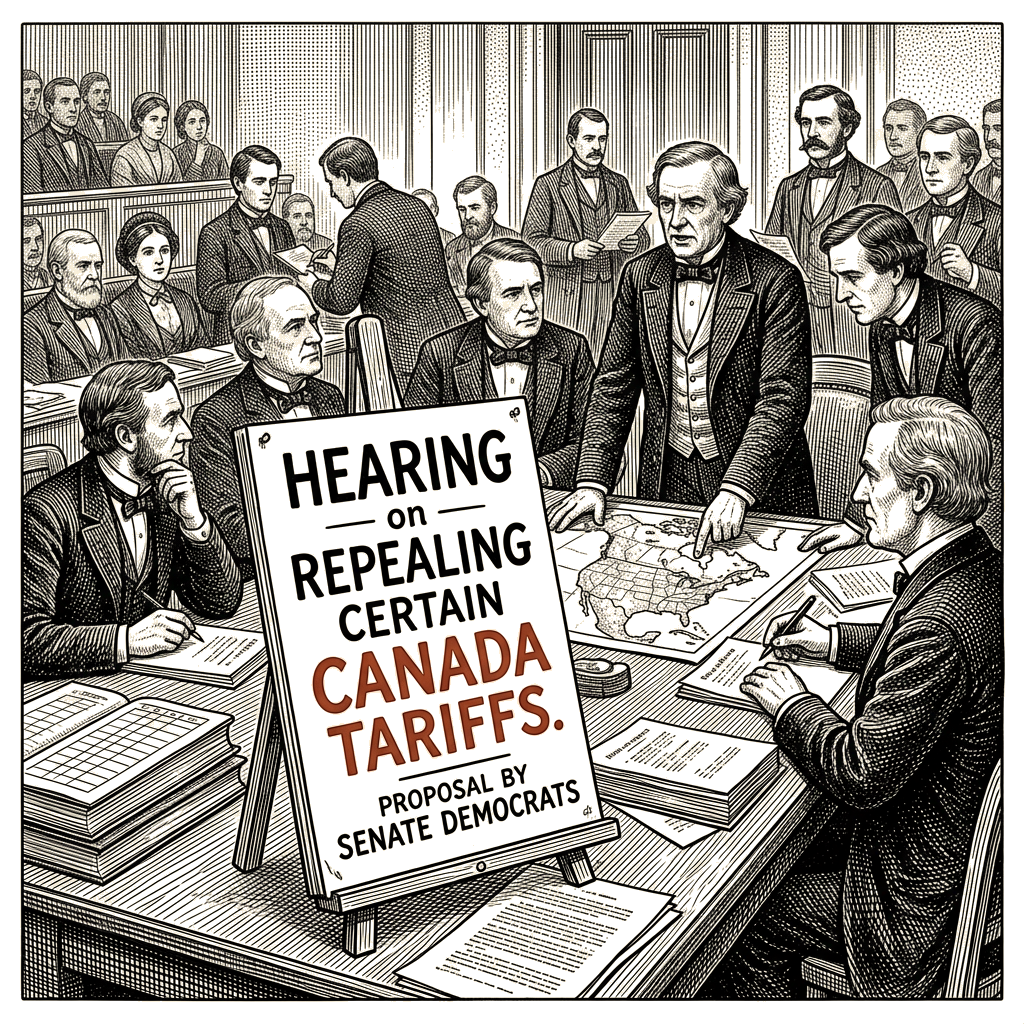
- Senate Democrats under Sen. Ron Wyden are sequencing repeal of President Trump’s Canada tariffs as a first recorded vote designed to locate Republican defectors and build momentum toward the 2028 election, not as legislation on a path to enactment.
- Democrats’ 253 House seats and 54 Senate seats leave repeal six votes short of Senate cloture and 37 House seats and 13 Senate seats short of a veto override.
- The campaign’s most consequential failure mode is narrow success: repeal of the Canada tariffs while the executive expands tariffs through Section 232 and Section 301 statutes that, per the reporting, are unlikely to see fundamental rewrites in the next two years.
- A credible veto and both parties’ dual-use interest in the Section 232 and Section 301 authorities hold the equilibrium at the status quo: Democrats bank recorded votes, Republicans withhold cloture support, the tariffs stand.
- Leading observable markers are the Republican co-sponsor list when the Senate Finance Committee bill appears after January, U.S.–Canada negotiation status through December, and Section 301 and Section 232 tariff unveilings at the U.S. Trade Representative’s office and the Commerce Department.
Senate Democrats will make President Trump’s tariffs on Canadian goods the first target in a campaign to roll back his broader tariff agenda, Sen. Ron Wyden of Oregon said, with repeal legislation in discussion ahead of Democrats taking control of the Senate Finance Committee in January. On the documented arithmetic — 253 House seats and 54 Senate seats against a 60-vote cloture threshold and 290-vote House and 67-vote Senate override requirements — the sequencing operates less as a probable repeal vehicle than as a first vote intended to locate Republican defectors and build a recorded-vote record for the run-up to the 2028 election. The plan’s most consequential failure mode is not outright defeat but narrow success: repeal of the Canada tariffs while the executive expands tariffs through the statutory authorities the campaign is unlikely, on the article’s reporting, to constrain. The sourced trajectory is a first-vote campaign that may not repeal the Canada tariffs, is unlikely to constrain the broader statutes, and leaves the executive’s agenda advancing regardless of congressional makeup.
The plan as documented
Sen. Ron Wyden of Oregon, the ranking Democrat on the Senate Finance Committee, said Senate Democrats will make repeal of President Trump’s tariffs on Canadian goods the first target in a campaign to roll back the broader tariff agenda, and that he is already talking with colleagues about repeal legislation ahead of Democrats taking control of the committee in January. “There is overwhelming support for repealing the tariffs on products from Canada,” Wyden said, adding, “Ultimately, Congress must take away the president’s ability to unilaterally and arbitrarily impose tariffs.”
According to people on Capitol Hill, the Canada bill would be the first in a series of actions; later measures could target Section 338 of the Tariff Act of 1930, which underpins the Canada levies but had never before been used by a president, and Section 122 of the Trade Act of 1974, which Trump invoked for the first time earlier this year to impose temporary tariffs.
In the House, Rep. Debbie Dingell of Michigan said she has been speaking for months with Rep. Gregory Meeks, the ranking member on the House Foreign Affairs Committee, about potential legislation to push back on the Canada tariffs. Rep. Richard Neal of Massachusetts, the ranking member on the Ways and Means Committee, which oversees trade, said Democrats would be ready to address Trump’s “price-hiking tariffs,” though he offered no specifics.
The push follows an election season in which many victorious Democratic candidates called for an end to Trump’s trade conflict with Canada. The tariffs were central campaign issues in border states such as Michigan, Maine and Alaska, where even Republican candidates “pivoted to oppose the levies in the face of voter opposition.”
The arithmetic
Democrats captured 253 House seats and 54 Senate seats as of Thursday evening. A veto override requires a two-thirds majority — 290 House votes and 67 Senate votes with all members voting — a gap of 37 House seats and 13 Senate seats beyond the Democratic totals. Cloture on any repeal “would likely need 60 votes,” six more than the Democratic Senate count on these numbers. The three border states the reporting names as tariff battlegrounds — Michigan, Maine and Alaska — hold six Senate seats between them, roughly the size of the cloture gap and far short of the override gap. The article’s hedges stand: “it isn’t clear Democrats could muster the additional support needed to override a presidential veto,” and whether the effort forces any change in tariff policy “remains uncertain.”
Who wants what
Assessed through the stakeholder-salience framework associated with Mitchell, Agle and Wood — power, legitimacy and urgency evaluated separately rather than collapsed into influence — and with the documented positions specific enough that behavior under particular offers (messaging votes, oversight hearings, a negotiated agreement) can be projected from the record:
Senate and House Democrats want recorded votes, Republican defections, and momentum toward larger changes in the run-up to the 2028 election. What they can lose is the record itself: a failed cloture vote is a citable artifact the other side can use. Their salience profile: legitimacy claimed from the election, urgency arriving with January’s committee control, no override power. The caucus is not monolithic — Peter Harrell, former head of international economic policy on the Biden administration’s National Security Council: “Basically every Democrat is on record against the Canada tariffs,” but “Where it gets more complicated is proposals to meaningfully constrain Section 301 and Section 232.” Former Rep. Dan Kildee: “where we do see some disagreement is on specific, targeted tariffs and trade actions,” pointing to levies on steel, aluminum and national-security sectors. The documented fallback if repeal fails, per Harrell and Kildee: Democratic lawmakers and aligned think tanks plan to devise ways to use the same trade authorities for progressive trade goals — such as raising labor and environmental standards abroad — should a Democrat win the White House in 2028.
Congressional Republicans hold the pivotal power — the 60th vote and the override seats — but the reporting documents their urgency only in campaign contexts; their governing behavior is unrecorded. Border-state Republicans can lose either way: a recorded pro-repeal vote defies a sitting president of their party, while a recorded anti-repeal vote contradicts their documented campaign posture. The cheapest available posture is the campaign one — opposition rhetoric without floor commitment. The predictive claim: offered messaging votes, oversight hearings, or a negotiated agreement that lowers tariffs, that posture is sustainable; asked to supply cloture votes that cannot deliver enactment, the documented conduct to date is rhetoric, not votes.
The executive holds the veto plus delegated tariff authority and active urgency via the threatened January doubling. Documented assets: tariffs on $20 billion worth of Canadian goods, some Canadian products blocked from U.S. shelves, the threat to double tariffs on Canadian vehicles absent an agreement before January, and an expansion pipeline — the U.S. Trade Representative’s office “is likely to unveil in the coming months” Section 301 tariffs based on “alleged industrial overcapacity” in China and 15 other economies, likely bringing tariffs back toward pre-February levels, and the Commerce Department “could unveil” Section 232 national-security tariffs on industrial robots, medical devices and potentially other sectors. The executive’s best alternative is administrative continuation regardless of Congress: “The president has been moving forward on his trade agenda irrespective of the makeup of Congress,” said Kelly Ann Shaw, who served on the National Economic Council in Trump’s first term. “I think the president is just going to keep going.”
Canada carries the documented exposure — tariffed goods, blocked products, the vehicle-tariff doubling threat, the January deadline — yet holds no vote in the U.S. legislature, and the reporting supplies no account of Ottawa’s position or response; that gap is worth stating rather than filling, and Canada’s leverage runs through channels the reporting does not detail.
Future administrations of both parties are stakeholders the current action creates: whether Section 301 and Section 232 survive constraint determines their 2028 options. Silent parties in the reporting: U.S. importers and retailers, though the article notes some Canadian products have been blocked from U.S. shelves, and border-state consumers, whose views reached the record filtered through candidates’ campaigns.
The map’s structural feature is both parties’ institutional interest in the authorities themselves. Blake Harden, a former trade counsel for Republicans on the House Ways and Means Committee: “Both parties like the idea of having those authorities for their president to do what they want to do,” and “You don’t have consensus on trade in either party right now, so both sides have to contend with that, and it limits opportunity.” Harrell draws the same line from the Democratic side, per the quotes above.
Prospective failure modes
Run through research psychologist Gary Klein’s premortem technique — treating the campaign as having failed two years on, then tracing causes back to present decision points — the plausible failure modes cluster into five classes, each anchored in a documented feature of the situation:
Execution failure: the votes do not materialize; people familiar with the lawmakers’ thinking said Democrats are unlikely to muster enough Republican votes to override Trump vetoes beyond the Canada question.
Assumption failure (the conversion premise): Wyden’s “overwhelming support” is a claim about sentiment; the reporting documents campaign-season opposition, including Republican candidates’ pivots, but not governing roll-call votes. The conversion of campaign positions into defections is the plan’s load-bearing premise and remains untested. The leading indicator arrives early: the co-sponsor list when Wyden’s bill appears after the January committee takeover — co-sponsorship is the least costly commitment available, and if border-state Republicans decline even that, the conversion assumption has failed before any floor vote.
Context-shift failure (the January interaction): the plan schedules legislation after the committee takeover; the escalation threat is set before January. Two branches are live. A U.S.–Canada agreement before the new Congress is seated would remove the grievance while the tariffs persist, leaving repeal votes aimed at a settlement rather than a crisis. Failure to agree and a doubling of vehicle tariffs would, per lawmakers quoted, add momentum to repeal efforts — documented as lawmakers’ expectation, not a demonstrated outcome; escalation could as plausibly consolidate party lines as crack them. The field has already shifted once, when the Supreme Court struck down many of Trump’s earlier tariffs in February, and the forthcoming unveilings could shift it again. A second indicator: the state of bilateral negotiations through December.
Interaction failure (narrow success defeating the larger purpose): repeal of the Canada levies while the administration leans harder on Section 232 and Section 301, statutes the reporting says are unlikely to see fundamental rewrites in the next two years. The targeted levies are themselves first-use applications of delegated authority — Section 338 and Section 122 — which sharpens the dual-use problem below.
Motivational failure: the documented intra-Democratic disagreement on targeted tariffs (Kildee’s steel, aluminum and national-security distinctions), compounded by the dual-use incentive described in the game structure below.
The second step’s coalition boundary: momentum from a Canada win, even if obtained, meets the documented boundary at the next statute, and the reporting that fundamental rewrites of Section 232 and Section 301 are unlikely in the next two years is the ceiling on the broader campaign, whatever the Canada bill does. The indicator: whether any Democrat from a steel- or aluminum-producing state co-sponsors constraint language on Section 232. The House leg is the plan’s other chamber: the observable is whether the Dingell–Meeks text attracts cross-party original co-sponsors at introduction — testing the conversion assumption in the chamber where a repeal bill can pass with modest Republican support even though the override total remains out of reach. The causal pathway if these break: few early co-sponsors → short whip count → failed cloture → the failure becomes the record cited against later attempts → the momentum premise inverts. Each link turns on features specific to this plan — the January takeover, the pre-January deadline, Section 338’s first-use novelty, and the 54/60/67 arithmetic — and would not read the same for an ordinary majority-party legislative push. The most plausible failure narratives narrow to the assumption failure on Republican defection, the interaction failure via Section 232 and Section 301 expansion, and the motivational softening of any appetite to constrain the underlying statutes.
Game structure, equilibrium, and credibility
Structure and equilibrium. The situation is a sequential legislative game under incomplete information, effectively one-shot within this Congress. Under a complete-information reading with the reported seat counts, the equilibrium is the status quo: the bill cannot reach 60 votes with Democrats at 54, and any passed bill faces a veto that cannot be overridden at 253 of 290 House votes and 54 of 67 Senate votes. The pivotal players are the Republican seats above those thresholds, whose payoffs pair documented constituent exposure in tariff-sensitive states against the cost of crossing a president whose agenda proceeds regardless of congressional composition. In that one-shot frame, defection is not individually rational and repeal fails.
Backward induction from the veto point. Any repeal that clears Congress at the current counts reaches a veto the override math cannot supply. The implied veto is credible in the strongest available sense: it is a unilateral constitutional power, and the officeholder’s documented disposition is continuation. Working back: at the override node, 13 Republican senators and 37 Republican House members must vote to defeat their party’s president on his signature policy, and no single vote is pivotal; at the cloture node, six Republican votes could force a final-passage vote but cannot change its terminal outcome. The resulting profile — Democrats record votes, Republicans withhold cloture support, the tariffs stand — is stable in the Nash sense: no player changes the outcome by deviating alone, so each banks the positional value instead. This is not a claim that no Republican will defect; it is the structure the documented arithmetic and the credible veto select for, all else equal.
The repeated-game reframe. The Democrats’ documented strategy treats the coming votes as early moves whose payoff arrives later, in the run-up to the 2028 election. Repetition re-prices each Republican vote, because a recorded vote operates — in the terms of the signaling framework associated with economist Michael Spence — as a costly signal that campaign rhetoric is not: observable, attributable, usable by future opponents, and costly in the precise sense the documented payoffs supply — casting it requires incurring the price of crossing a president whose agenda proceeds regardless of congressional composition, a price campaign rhetoric never exacts. Vote-forcing is therefore best read as an information-extraction mechanism aimed at locating the 60th vote, whatever the first bill’s fate.
Move order and outside options. Trump’s threatened doubling of Canadian-vehicle tariffs before January alters the payoff matrix before the legislature sits, functioning as the kind of visible commitment Thomas Schelling described, in which a party binds its own future options in order to shape the other side’s choices — whether the threat hardens or softens Republican positions is not documented. The executive also holds options that do not depend on winning the legislative game, and the clocks are asymmetric: rollback must clear 60-vote and two-thirds funnels, while Section 301 and Section 232 expansion requires only executive action.
The dual-use preservation equilibrium. The decisive structural feature is that statutory constraint is not zero-sum between the parties but zero-sum across time within each party: either party acting alone lowers the value of an asset it expects to wield, so constraining Sections 301 or 232 requires simultaneous, bilateral commitment. Per the article’s reporting, enthusiasm for repurposing those powers could also blunt efforts to tinker with them; and since the Supreme Court struck down many of Trump’s earlier tariffs in February, the rebuilt tariff regime runs on precisely those statutory authorities — the ones both parties have documented reasons not to constrain — a feature sharpened where the authority is newly precedent-setting, as with Section 338 and Section 122. That preservation equilibrium is the ceiling on the rollback campaign over the coming Congress, and it stands regardless of how the Canada vote goes. Harden’s documented observation describes an equilibrium rather than a sentiment.
Credibility audit, item by item:
- Trump’s threat to double tariffs on Canadian vehicles absent an agreement before January — moderate to high as negotiating pressure, as read from U.S.-side documentation only; Ottawa’s negotiating posture is not covered by the reporting. The threat is publicly announced, deadline-bound, and consistent with the documented continuation disposition, though partly discountable as leverage toward Ottawa, and it carries a documented domestic cost, since lawmakers said such a step would add momentum to repeal efforts.
- The implied veto of any repeal — high; unilateral power, documented intent to continue the agenda, and override arithmetic that makes sustained rejection the default terminal outcome.
- Wyden’s commitment that repeal is first in a broader campaign — medium; the January committee takeover is a genuine structural commitment device, granting scheduling and mark-up authority over trade, but the broader campaign is discounted by the documented intra-party disagreement and by the repurposing incentive that gives Democrats their own reasons to preserve the same authorities.
- Neal’s readiness to address “price-hiking tariffs” — low as a legislative commitment; the article notes he offered no specifics.
Historical substrate: lawmakers over decades have surrendered Congress’s constitutional authority over trade to the executive branch, giving presidents broad power to levy tariffs if they judge national security threatened or other nations are discriminating against U.S. companies; the Canada bill is the first test of whether any of that authority can be retrieved one statute at a time.
What to watch
On the legislative clock: the Republican co-sponsor list, or its absence, when the Finance Committee’s bill appears after the January takeover; the state of U.S.–Canada negotiations through December; the first whip counts before any cloture vote; whether the Dingell–Meeks House text draws cross-party original co-sponsors at introduction; whether second-step constraint language on Sections 232 and 301 attracts co-sponsors from tariff-supporting states, including the steel- or aluminum-state Democrat test. On the executive clock: the Section 301 tariffs the U.S. Trade Representative’s office is likely to unveil in the coming months, and any Commerce Department Section 232 notices on industrial robots, medical devices, or other sectors. Three developments would update the trajectory: whether any Republican votes materialize on the first recorded repeal attempt; whether the vehicle-tariff doubling lands before the new Congress is seated; and the content of the coming unveilings, which will help determine whether the 2026 campaign positions survive contact with the 2027 governing record. The article’s hedges on cloture, override support and the final outcome stand as accurate statements of what the documented record supports.
Analytical techniques used in this piece
This analysis applies the methods below. Each links to a short, plain-English explainer you can read and reuse.
- Pre-Mortem (Action Plan)
- Imagines the plan has already failed, then works backward to find out why.
- Stakeholder Mapping
- Charts the parties to a situation — their interests, power, and alignments.
- Strategic Interaction (Game Theory)
- Models a situation as a game — players, moves, payoffs, and likely equilibria.