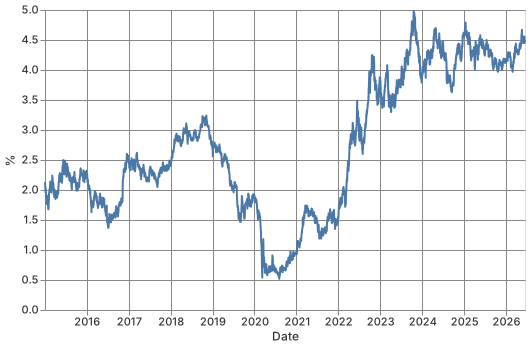
- Treasury yields eased Tuesday as the U.S.-Iran interim peace deal remained short on operational specifics regarding the Strait of Hormuz and the Federal Reserve began its first policy meeting under Chairman Kevin Warsh.
- The 10-year Treasury yield closed at 4.48%, according to FRED data, down from its prior session as investors weighed the tentative agreement and its implications for energy prices and inflation.
- The Fed’s two-day meeting is expected to hold interest rates steady, with markets pricing in roughly 15 basis points of tightening by year-end, according to LSEG.
- Import prices rose 1.9% in May, while housing starts fell 15.4%, both substantially exceeding consensus estimates, according to data cited by the Wall Street Journal.
Treasury yields declined Tuesday as market participants absorbed the implications of the interim U.S.-Iran peace deal announced last week and turned their attention to the Federal Reserve’s first policy meeting under Chairman Kevin Warsh.
The yield on the benchmark 10-year Treasury note stood at 4.48% on a closing basis, according to FRED data, edging down from 4.468% the prior session. The two-year yield slipped to 4.047%. The 10-year yield has tended to hover in the 4.45% area in recent weeks, according to ING rates strategists, who wrote that “reaction so far on the rates market has been predictably muted.”
“Although yields remain below key marks, the U.S.-Iran deal begins to feel more and more like the ceasefire from late May,” Commerzbank’s Erik Liem said in a note. Most of the relevant details, especially issues concerning the nuclear program, still need to be negotiated, the rates strategist said. In addition, specifics of the reopening of the Strait of Hormuz remain vague, he said.
Oil prices fell nearly 5% on Tuesday, according to the Wall Street Journal, as investors turned cautiously optimistic about the prospect of reopening the waterway. “The prospect of lower energy prices has also eased inflation concerns, contributing to softer Treasury yields,” Empire FX’s Crispus Nyaga said in a note. Caution remains, however, given the numerous advances and setbacks in recent months, with markets awaiting the formal signing of the agreement later this week, Nyaga said.
The Fed’s two-day meeting, which began Tuesday, is the central bank’s first under Chairman Kevin Warsh, who was appointed by President Donald Trump. The announcement is due Wednesday. “No one expects to change” interest rates, Amundi Investment Institute’s Alessia Berardi said in a note. “Inflation is increasing and the economy remains resilient, in particular, the labour market is not cooling down,” she said. Warsh is expected to receive questions about the balance sheet at the press conference, “though there will not be any clear answers,” Berardi said.
Markets currently price in around 15 basis points of interest-rate hike by the Fed by year-end, according to LSEG. Russell Investments’ Paul Eitelman said in a note that the firm sees “good value in two-year Treasurys,” believing that two-year yields are reflecting more tightening risk than the Fed is likely to deliver.
Economic data released Tuesday painted a mixed picture. Import prices rose 1.9% in May, following April’s revised 2% increase and surpassing the Wall Street Journal consensus of 1.1%. Housing starts shrank 15.4%, versus consensus of a milder 2.4% decline. Building permits contracted by 0.7%, compared to a negative 1.5% forecast.
In Japan, the Bank of Japan’s decision to hike rates continued to pressure Japanese government bonds. The two-year JGB yield rose 1.5 basis points to 1.410%, and the 10-year yield climbed 5 basis points to 2.625%, according to the Wall Street Journal. “Despite Ueda’s absence, the 7-1 vote underscores strong momentum behind normalization, with the reflationary camp clearly in the minority,” State Street Investment Management’s Masahiko Loo said in commentary. State Street sees at least one more BOJ rate increase this year.
Eurozone government bond yields were stable, tracking calm trading in U.S. Treasurys. The 10-year German Bund yield held at 2.955%, according to Tradeweb.
MSI previously reported that eurozone bond yields fell as the U.S.-Iran deal eased inflation fears earlier this week. That dynamic continued Tuesday, though with the more measured tone characterized by market participants as tempered caution.