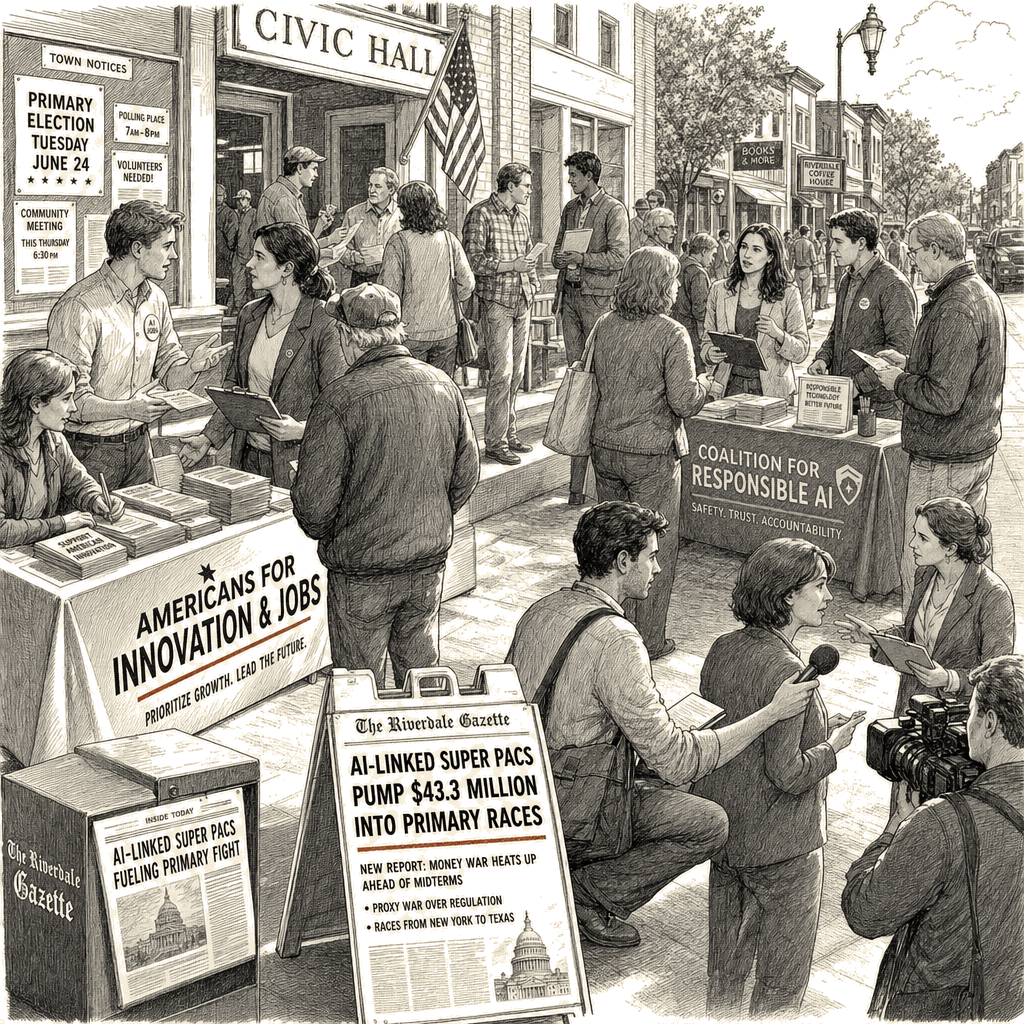
Groups tied to the artificial intelligence industry are flooding money into the midterm election cycle in hopes of shaping future regulation of the technology. AI-focused super PACs have already spent $43.3 million on congressional races, according to OpenSecrets, a nonpartisan group that tracks campaign finance.
“This type of spending really helps shape who is at the table and what perspectives they are bringing into those conversations when new legislation is crafted,” said Michael Beckel, director of money-in-politics reform at Issue One, a bipartisan nonprofit that works to reduce the influence of money in politics. “It’s rewriting the playbook for how industries are trying to exert their influence in Washington and in states across the country.”
A major test of that influence is playing out in New York City’s 12th Congressional District, where a crowded Democratic primary to replace retiring Rep. Jerry Nadler has drawn more than $15 million in combined AI-backed spending. The candidate at the center, Alex Bores, is a 35-year-old state assemblyman who co-sponsored New York’s Responsible AI Safety and Education Act—legislation that requires AI companies to report safety incidents and publish details about their safeguards.
Tied to investor OpenAI’s co-founder Greg Brockman and venture capital firm Andreessen Horowitz, a super PAC called Leading the the Future has raised more than $75 million and already spent $23.5 million on dozens of races across Texas, Georgia, Illinois and Montana, according to OpenSecrets. Its stated mission is to “oppose policies that stifle innovation, enable China to gain global AI superiority, or make it harder to bring AI’s benefits into the world, and those who support that agenda.”
Rival AI company Anthropic, founded by OpenAI defectors and positioning itself as a proponent of stricter safety rules, has deployed its own political infrastructure to counter the assault on Bores. In February, Anthropic announced it was contributing $20 million to a related nonprofit, Public First Action, that “opposes federal efforts to freeze state progress without adequate federal safeguards.” Public First’s affiliated PACs, including Jobs and Democracy and Defending Our Values, have spent $16.6 million so far on congressional races in states including North Carolina, Texas and Utah.
“The political antagonism really mirrors the corporate competition between OpenAI and Anthropic” and their differing approaches to AI development and safety, said Molly White, an independent researcher and tech industry critic. The spending, she said, “is really about sending a message to other candidates who might be thinking about coming out in support of stricter AI regulation.”
Beyond the OpenAI–Anthropic rivalry, Facebook owner Meta is funding super PACs aimed at shaping AI policy in Texas and California, and both Google and Meta are backing another super PAC focused on California state legislative races. Billionaire crypto investor Chris Larsen, who has spent millions on local and state races in California this year, launched a super PAC called You Can Push Back that has spent nearly $2 million backing Bores in New York.
“AI development is driving economic inequality, says tech critic Karen Hao” the article reported. On top of the tens of millions of dollars AI-linked groups have spent, AI firms are investing heavily in lobbying—$50.9 million combined from OpenAI, Meta, Google parent Alphabet, and AI chipmaker Nvidia in 2025, according to a review of federal reports by Issue One.
Despite bipartisan interest in federal AI legislation, momentum on the issue has stalled. “So far, the key battle lines have been whether to spend much time on federal AI legislation at all,” said Adam Kovacevich, CEO of the center-left tech policy group Chamber of Progress. “The real fight,” said Nicole Alvarez, a senior tech policy analyst at the Center for American Progress, “is what governance looks like.”
The outcome of this summer’s primaries and the fall’s general election will shape any legislation that emerges, even if Republicans maintain control of Congress. The de facto 60-vote threshold in the Senate to pass most legislation means AI regulation will almost certainly require bipartisan compromise.