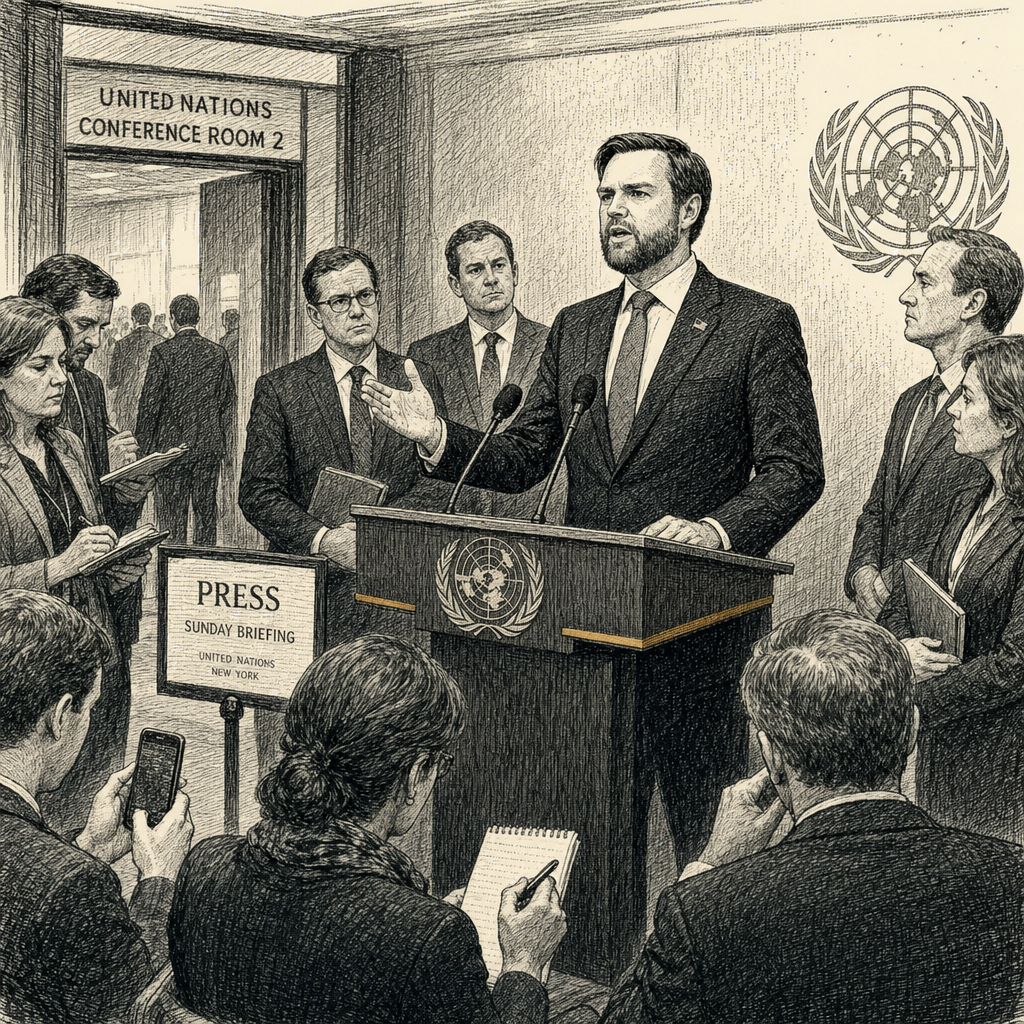
ZURICH — Vice President JD Vance said Iranian officials had agreed to allow nuclear inspectors from the United Nations back into their country, possibly as early as this week, signaling progress on an issue key to bringing the war to a permanent end.
Speaking to reporters from the Swiss alpine resort of Bürgenstock ahead of his return flight to the U.S., Vance said Iran’s invite to the International Atomic Energy Agency was a “major milestone” and the first step in “permanently ending a nuclear weapons program in Iran.” He suggested some conversations with inspectors could happen as soon as Monday but did not detail how much access they would have or crucially whether they would be able to visit sites attacked by the U.S. and Israel last year.
There was no immediate comment from the IAEA, whose director general, Rafael Grossi, is at the talks in Switzerland. One of Grossi’s key goals in attending the negotiations was to persuade Iran to allow inspectors back to the damaged sites, according to people familiar with the matter. Esmail Baghaei, a spokesman for Iran’s Foreign Ministry, did not immediately respond to requests for comment.
The future of Iran’s nuclear program — which the regime claims to be peaceful but involves highly enriched uranium and other efforts that the U.S. and Israel say are consistent with work that would be needed to produce a bomb — is the core matter that negotiators hope to resolve. Washington wants Iran to commit to giving up its stockpile of highly enriched uranium, while Iran is seeking sanctions relief for its beleaguered economy and insists it has the right to enrich.
Vance said his delegation and the Iranian side, led by parliament speaker Mohammad Ghalibaf, had also moved closer to resolving thorny issues related to Lebanon, where Israel is fighting Hezbollah militants — a conflict that has tripped up progress toward a permanent peace — and the movement of ships through the Strait of Hormuz.
“We laid a very good foundation for a successful final deal,” Vance said. “I think it’s important for all of us to appreciate how much was done but honestly there is still a lot to do.”
He said technical teams would remain on the ground for further negotiations, and that the two sides had agreed to a mechanism to avoid a new escalation in Lebanon. The first clause of the document to end the fighting and open the strait insists on an end to the fighting in Lebanon as a precondition.
The vice president said a so-called deconfliction system brokered by Pakistan and Qatar was designed to ensure Hezbollah no longer attacks Israel — strikes to which he said Israel had felt compelled to respond — by ensuring all sides were engaging with each other. He said he had told Iran to curb its militant proxy but had also been in constant contact with Israeli Prime Minister Benjamin Netanyahu and the Emirati and Saudi leaderships.
The vice president also confirmed an agreement on a mechanism for communication between the U.S. and Iran in the strait so there wouldn’t be any further disruption or escalation in the vital waterway.
After the U.S. and Israel attacked Iran’s three main nuclear sites last June, the IAEA’s inspectors left Iran, where they had maintained a permanent rotating team, because of the danger and haven’t been allowed back on a permanent basis since. Iran has since allowed inspectors back into the country for visits to several locations, including the Bushehr nuclear reactor, but they have been barred so far from visiting the damaged sites of Natanz, Fordow and Isfahan.
Having inspectors back at those sites would be crucial for several reasons. It would allow the IAEA to get a sense of the extent of damage done by the strikes and whether there is any possibility that Tehran could use the locations to begin enriching uranium in the future. U.S. officials have said they believe Iran isn’t currently enriching uranium, which is a critical component of a civilian and nuclear-weapons program.
Most important, it would allow the IAEA to begin scoping the damaged sites within Iran to identify Tehran’s stockpile of enriched uranium, including its near-weapons-grade highly enriched uranium. The interim deal between the U.S. and Iran stipulated that the two sides would agree on the fate of Iran’s fissile material stockpile and said Tehran may be able to dilute it down to harmless levels. President Trump has said he wanted the material transferred to the U.S.
Grossi has said half of the material probably lies in an underground tunnel network below the Isfahan plant. While the IAEA is unlikely to be able to excavate the barrels of enriched uranium itself, it could conduct environmental samples which would allow it to say whether any of the containers were destroyed, spreading enriched uranium into the immediate area.
The IAEA also wants to visit an enrichment site Iran declared open last June just before the U.S. and Israeli attacks. The agency has said Tehran has provided no information on its whereabouts nor on whether it is operating.
Vance also said there had been progress on the possible release of billions of dollars in Iranian funds held in Qatar. Tehran badly needs the cash to alleviate a crippling economic crisis, but critics say the money could be used to fund Iran’s Middle East allies. The vice president said the funds, if they are ever unfrozen, should be used to buy U.S. food products. “They’re going to go to make American farmers richer and to feed the Iranian people, that’s a very very good and classic Trump deal,” he said.
Talks had a rocky start Sunday afternoon after President Trump threatened to restart attacks on Iran. The Iranian delegation paused direct talks with the U.S. in response, Iranian state media said, though engagement through mediators continued. “They did threaten to walk out,” Vance said. “They did not walk out.”
Vance defended the president’s right to intervene on social media in reaction to Iranian statements. “What we told the Iranians yesterday is when you guys engage in what us millennials might call ‘trash talk,’ you can’t expect the president of the United States not to respond and not to correct the record,” he said.