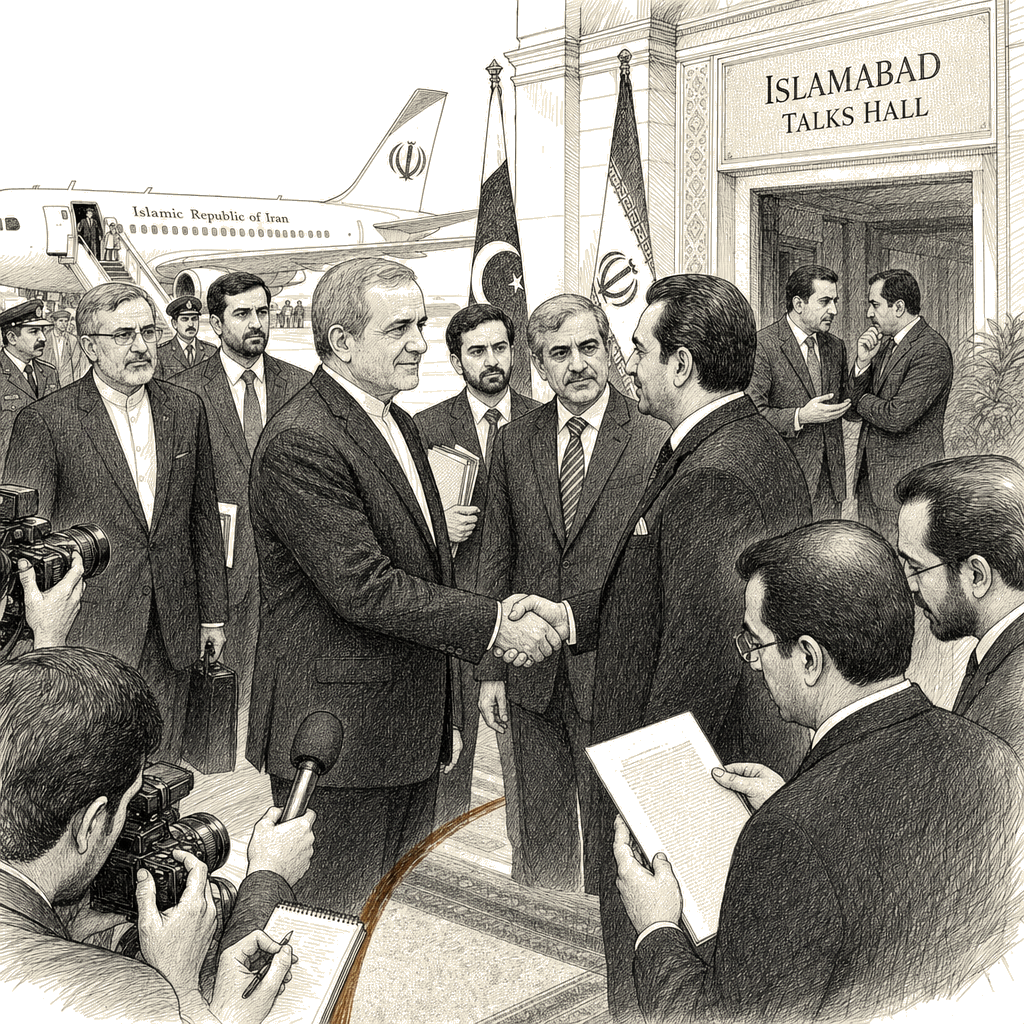
ISLAMABAD — Iranian President Masoud Pezeshkian arrived in Pakistan’s capital on Tuesday for meetings with President Asif Ali Zardari and Prime Minister Shehbaz Sharif, who have served as mediators between Tehran and Washington in months of negotiations aimed at ending the war that began with U.S. and Israeli strikes on Iran on Feb. 28.
The visit, Pezeshkian’s first to Pakistan since the conflict began, comes one day after U.S. and Iranian negotiators in Switzerland agreed to a 60-day diplomatic process toward a permanent deal. Vice President JD Vance led the U.S. delegation; Iran was represented by parliamentary speaker Mohammad Bagher Qalibaf. Mediators Pakistan and Qatar announced the agreement on a “road map” for a final deal.
But conflicting accounts emerged almost immediately over a key provision. Vance said the talks had secured an agreement for the International Atomic Energy Agency to inspect Iranian nuclear sites that the U.S. bombed last year. In Tehran, Foreign Ministry spokesperson Esmail Baghaei told reporters that no such visits had been scheduled. The IAEA has not been granted access to the bombed enrichment sites since the U.S. strikes, according to the report.
Ahead of his meetings in Islamabad, Pezeshkian appeared to address the discrepancy in a post on X, writing that “the effectiveness of the talks depends on full commitment to the agreed obligations and their precise implementation.” He added that “statements outside the agreed text do not help advance the negotiations.”
Security was tight in the area of Islamabad where Pezeshkian was to meet with Zardari and Sharif. The Iranian president and Sharif were scheduled to hold a joint news conference after their discussions.
The preliminary agreement includes the creation of a “de-confliction cell” to address the fighting in Lebanon between Israel and the Iranian-backed Hezbollah militia group. The U.S. said negotiators also discussed mechanisms to ensure the Strait of Hormuz — a key waterway for oil transit that Iran had effectively blocked during the war — remains open.
Iran’s state-run IRNA news agency reported that technical talks in Switzerland have produced specific negotiation groups focused on sanctions relief, nuclear issues, reconstruction and monitoring. The report quoted deputy foreign minister Kazem Gharibabadi, who is leading the technical talks, saying the countries also formed a contact mechanism over ships moving through the Strait of Hormuz and over the fighting in Lebanon.
Neither Israel nor Hezbollah are signatories to the U.S.-Iran deal. Israeli Prime Minister Benjamin Netanyahu raised new questions late Monday, saying his military still has “full freedom of action to thwart any direct or emerging threat to them or to the residents of the north.” Hezbollah has refused to halt attacks unless Israel commits to withdrawing from southern Lebanon.
U.S. President Donald Trump, asked about Netanyahu’s comments, said “we’re going to take a look at it” and added that the situation would “get solved.” “I’m a problem solver, I get problems solved real fast, including with Bibi,” he said, using a nickname for Netanyahu.
A renewed ceasefire in Lebanon, brokered on Saturday, appeared to be holding as of Tuesday with no new Israeli or Hezbollah strikes reported overnight. Lebanon and Israel planned another round of direct talks in Washington on Tuesday expected to focus on a plan for an Israeli withdrawal.