- The number of ultrawealthy individuals worth over $30 million jumped 14.4% to 556,850 people worldwide by the end of 2025, the fastest pace of growth since 2017, according to wealth-intelligence firm Altrata.
- Altrata Senior Director Maya Imberg attributed the surge to lower inflation, resilient corporate earnings and enthusiasm for AI investment.
- A separate 2025 study from the World Inequality Lab found that the wealth of the richest billionaires grew at about 8.5% annually from 1995 to 2025, compared with about 3.4% for the bottom half of the global population.
- The U.S. was home to 37% of the ultrawealthy population, more than the rest of the top 10 countries combined.
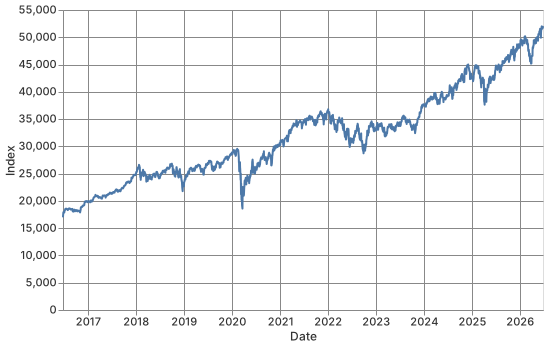
- The Dow Jones Industrial Average stood at 51,712.71 on June 23, 2026, reflecting the market conditions that have benefited the ultrawealthy.
The ranks of the ultrawealthy hit a record high in 2025 as the artificial-intelligence trade lifted global markets, according to a new report by wealth-intelligence firm Altrata.
The number of ultrawealthy individuals — those Altrata defines as having a net worth of more than $30 million — jumped by 14.4% last year to 556,850 people worldwide by the end of 2025, the fastest pace of growth since 2017.
“What we’ve been seeing in the past decade is, on the whole, it’s been going up over time and it’s been growing quickly,” said Altrata Senior Director Maya Imberg.
Lower inflation, resilient corporate earnings and enthusiasm for AI investment bolstered the number of ultrawealthy individuals and the value of their holdings in 2025, Imberg said.
One of the fastest-growing subgroups of the ultrawealthy in recent years has been centi-millionaires, or those worth more than $100 million, mainly from founding or investing in rapidly growing technology companies, according to Altrata. The finding echoes research from other sources showing that the world is getting wealthier, with riches disproportionately accruing to the wealthiest.
The Paris-based World Inequality Lab published a separate study in 2025 that found the wealth of the richest billionaires from 1995 to 2025 grew at about 8.5% a year, compared with about 3.4% a year for the bottom half of the global population. The researchers said around 60,000 people — the top 0.001% wealthiest in the world — are each worth at least $254 million.
“The population that can fit in a football stadium own three times more wealth than half of humanity combined,” said Ricardo Gómez-Carrera, lead author of the report, referring to the wealthiest 0.001% of the population.
The Altrata report showed that those worth more than $30 million made up a little over 1% of the millionaire population — defined as those worth $1 million or more — but held 32% of that group’s wealth. The ultrawealthy made up 0.01% of the global adult population but held 11% of all private wealth held by individuals.
Imberg said the numbers tell a story about the outsize returns possible from financial wealth, including from investments, from successful entrepreneurship and from ongoing intergenerational wealth transfers.
The U.S. remained home to more of the ultrawealthy than the rest of the top 10 countries combined, with 37% of the population. China and Germany came in second and third, respectively, with about 10% and 5%.
The New York metropolitan area continued to have the largest number of ultrawealthy residents, followed by the metropolitan areas of Hong Kong, Los Angeles and San Francisco.