- The Federal Reserve said all 32 of the nation’s largest banks passed its 2026 annual stress test, indicating the banking system would remain solvent under a severe economic contraction.
- Under the Fed’s hypothetical scenario, unemployment would rise from 5.5% to 10%, the U.S. economy would contract 4.6%, housing prices would fall 30%, and the stock market would drop 58%.
- The stress tests are mandated by the Dodd-Frank Act, the financial reform law enacted after the 2008 crisis.
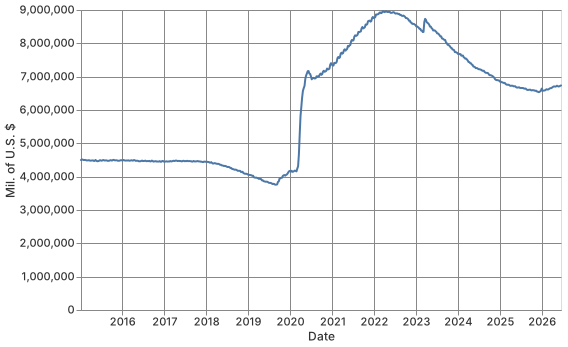
- The Fed’s total assets stood at approximately $6.74 trillion on the day of the announcement, according to FRED data.
The Federal Reserve announced Wednesday that all 32 of the nation’s largest banks had passed its annual “stress test” of the financial system, a finding the central bank said demonstrates that the banking system would remain healthy even in a major economic downturn that caused hundreds of billions of dollars in projected losses.
The stress test evaluates whether a bank’s capital — the financial cushion it uses to absorb losses — remains above a required minimum under a hypothetical severe recession. Under the 2026 scenario designed by the Fed, unemployment would climb from 5.5% to 10%, the U.S. economy would contract by 4.6%, housing prices would fall 30% from their current levels, and the stock market would decline 58%.
The tests are required under the Dodd-Frank Act, a 2010 law passed in response to the 2008 financial crisis that nearly brought down the global financial system. The 2026 scenario closely resembles the one the Fed used in the 2025 stress test, a senior Fed official said.
The results come as the Federal Reserve’s balance sheet remains sizable at approximately $6.74 trillion in total assets, a legacy of years of quantitative easing and crisis-era interventions, according to FRED data from the Federal Reserve Bank of St. Louis. The scale of the central bank’s holdings has been a subject of debate among policymakers and economists about the appropriate pace of balance sheet normalization.
The passing rate — all 32 banks — marks a repeat of the 2025 outcome, in which every institution tested also cleared the hurdle.